
Leonardo da Vinci - Madrid Codices

Italy — 1490–1505
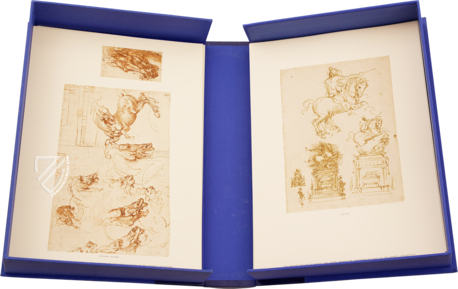
Only rediscovered by chance in 1967 in the Biblioteca Nacional: the entire spectrum of Leonardo da Vinci's art and science in two bound volumes with hundreds of sketches by the famous universal genius
Two-volume collection (Madrid Codices I–II) of notes, sketches, and drawings by Leonardo da Vinci (1452–1519)
Painting, geography, mechanics, mathematics, geometry, weapons, and architecture are depicted therein
The American Professor of Romance Studies, Jules Piccus, coincidentally discovered them in February of 1967
Leonardo da Vinci - Madrid Codices


(1,000€ - 3,000€)
The Madrid Codices are a two-volume collection of pages, notes, sketches, and drawings by the Italian Renaissance artist Leonardo da Vinci. The works originated between 1490 and 1505. The precious manuscripts show some sketches and designs, which significantly influenced the architecture and technology of our time.
Leonardo da Vinci - Madrid Codices
“Read me, reader, if it pleases you, for I rarely return to this world.” With this sentence ends the first volume of the so-called Madrid Codices by Leonardo da Vinci. The greatest artist and scholar of the Renaissance composed two codices, which treated the entire spectrum of his interests. The manuscripts concerned themselves with painting, geography, mechanics, mathematics, geometry, weapons technology, and architecture. The first volume of the manuscript contains 384 pages and the second 316 pages. The pages show a number of notes, sketches, and drawings by the great Renaissance artist.
A Treasure of the Spanish National Library
Both manuscripts by Da Vinci get their name from the location where they are housed today. After Da Vinci’s death, his student Francesco Melzi inherited the valuable document. This he in turn left to his son Orazio, who sold it to the wealthy sculptor Pompeo Leoni ca. 1590. The path of the volumes into the possession of the Biblioteca Nacional in Madrid is still unclear. Although it was known since the 19th century that the codices were in Madrid, they remained undiscoverable until the end of the 1960’s. The American Professor of Romance Studies, Jules Piccus, uncovered both of the precious manuscripts by a lucky coincidence while conducting literary research in the Spanish National Library in February of 1967.
A Glimpse into the Conceptual World of Da Vinci
The first Madrid Codex is dated in the time period from 1490–99, the second from ca. 1503-05. Leonardo composed the text in his characteristic mirror writing and was furnished with numerous depictions and sketches. A fascinating design invites exploration: the Paris Manuscript L contains the design of a bridge to cross the Golden Horn, a bay at the Bosporus in Turkey. In the Norwegian locality of Ås, the Leonardo-Da-Vinci-Bridge was erected in the year 2001 as a footbridge. A drawing in the Madrid Codex I shows the draft of a gearbox. The engineer and Da Vinci expert Roberto Guatelli presumes that is a detailed design of a counting mechanism. Therefore, it is probably dealing with the first calculator in world history.
Codicology
- Alternative Titles
- I Codici di Madrid
Manuscritos Leonardo da Vinci - Codex Madrid
Códex Madrid
Codex Madrid I (Ms. 8937) “Tratado de estática y mecánica”
Codex Madrid II (Ms. 8936) “Tratado de fortificación, estática y geometría”
Leonardo da Vinci - Madrider Codizes - Type
- Manuscript on paper
- Size / Format
- 2 volumes: Codex Madrid I: 384 pages Codex Madrid II: 316 pages / 21.0 × 15.0 cm
- Origin
- Italy
- Date
- 1490–1505
- Epochs
- Style
- Genre
- Language
- Content
- Volume I: Principles of mechanics and its fields of application
Volume II: Urban planning tasks such as fortifications and sewer systems - Artist / School
- Leonardo da Vinci (1452–1519)
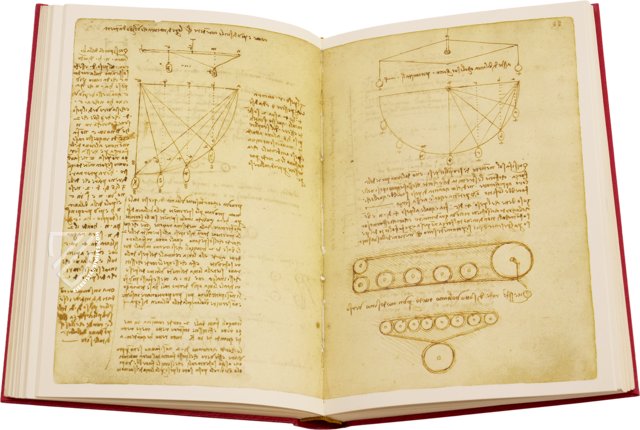


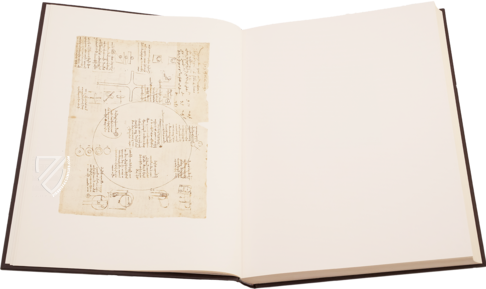
Leonardo da Vinci - Madrid Codices
Drum Brake
The modern drum brake was first used in a car manufactured by Maybach in 1900, but Leonardo da Vinci already conceived of the design 500 years earlier. Appearing on a page dedicated to various kinetic devices using gears and change, these drawings were concerned with how to efficiently counter kinetic energy in a wagon wheel. In his own words, Leonardo envisioned a “spring that tightens equally and slackens equally. And it shall be tempered in the most perfect circle possible.” Although manufacturing such a device to consistent standards was nearly impossible before the Industrial Revolution, it already existed theoretically during the Renaissance – at least in Leonardo’s brilliant mind.

Leonardo da Vinci - Madrid Codices
Semi-Toothed Wheels, Rack, and Pin Bars
These two diagrams show devices that use a continuous rotary motion to produce a reciprocal linear motion, i.e. up-and-down or left-and-right. Above, an oscillating mechanism swings in one direction and then the other to engage with the pin bar on one side. Below two half-wheels turning in opposite directions engage two sets of pins on either side of the bar to create the back-and-forth motion.
A passage in mirror writing from da Vinci’s own hand, which appears at the top of the page, reads: “Each body requires its members and each art, its instruments. And as soon as the whole is created, its parts are also created.” Indeed, these mechanisms required the pins of the rotating wheel to seamlessly interlock with and disengage from those of the rack, which would require the precise and uniform manufacture of parts.

#1 I Codici di Madrid
Language: Italian, German
Volumes III-V of the edition are commentary volumes with the following contents:
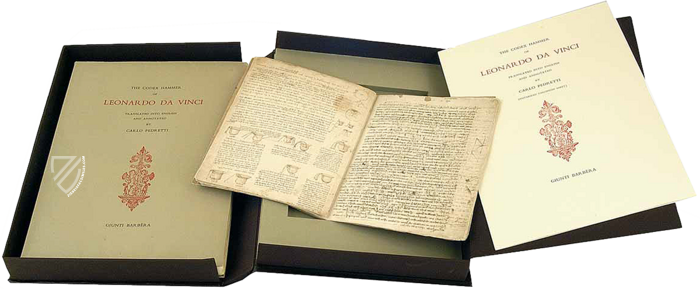
Volume III (154 pages): Introduction, history of the Madrid codices, index, and glossary.
Volumes IV + V (536 + 336 pages): Annotated transcription of the texts of the two original volumes with enlarged illustrations of interesting details.
(1,000€ - 3,000€)
#2 Manuscritos Leonardo da Vinci - Codex Madrid


Language: Spanish
(1,000€ - 3,000€)
#3 Manuscritos 8936 (Códex Madrid II) y 8937 (Códex Madrid I)

(under 1,000€)
#4 I Codici di Madrid

Language: Italian, German
Volumes III-V of the edition are commentary volumes with the following contents:
Volume III (154 pages): Introduction, history of the Madrid codices, index, and glossary.
Volumes IV + V (536 + 336 pages): Annotated transcription of the texts of the two original volumes with enlarged illustrations of interesting details.
(under 1,000€)
#5 Códices Madrid I-II (Library Edition)
Language: Spanish
(1,000€ - 3,000€)


- Block Books / Incunables / Post-incunables
- Alchemy
- Apocalypses / Beatus Manuscripts
- Astronomy / Astrology
- Bibles / Gospels
- Picture Bibles / Bibles Moralisées / Mirror of Human Salvation
- Botany
- Chronicles / History / Letters
- Cookbook / Recipes
- Diaries / Biographies / Autograph Books
- Encyclopedias
- Fashion / Costume Books
- Games / Game Theory
- Geography / Cartography / Navigation
- Graduals / Antiphonaries / Exultet Roll
- Haggadot
- Hunting Books
- Law / Deeds / Rules
- Leonardo da Vinci
- Literature / Poetry
- Medicine
- Missals / Lectionaries / Sacramentaries
- Model Books / Sketchbooks / Notebooks
- Music
- Mythology
- Natural History / Bestiaries
- Other Liturgical Manuscripts
- Other Religious Works
- Other Secular Works
- Paintings / Graphics
- Primers / Textbooks
- Private Devotion Books
- Prophecies / Divination
- Psalters
- Quran
- Saints' Lives
- Sermons / Homilies
- Single Leaf Collections
- Song Books
- Tanakh
- Tournament Books / Armorials / Genealogy
- Travelogues / Travel Guides
- Treatises
- Afghanistan
- Algeria
- Armenia
- Austria
- Azerbaijan
- Belarus
- Belgium
- Belize
- Bosnia and Herzegovina
- China
- Colombia
- Costa Rica
- Croatia
- Cyprus
- Czech Republic
- Denmark
- Egypt
- El Salvador
- Ethiopia
- France
- Germany
- Greece
- Guatemala
- Honduras
- Hungary
- India
- Iran
- Iraq
- Israel
- Italy
- Japan
- Jordan
- Kazakhstan
- Kyrgyzstan
- Lebanon
- Libya
- Liechtenstein
- Luxembourg
- Mexico
- Morocco
- Netherlands
- Palestine
- Panama
- Peru
- Poland
- Portugal
- Romania
- Russia
- Serbia
- Slovakia
- Spain
- Sri Lanka
- Sweden
- Switzerland
- Syria
- Tajikistan
- Tunisia
- Turkey
- Turkmenistan
- Ukraine
- United Kingdom
- United States
- Uzbekistan
- Vatican City
- A. Oosthoek, van Holkema & Warendorf
- Aboca Museum
- Ajuntament de Valencia
- Akademie Verlag
- Akademische Druck- u. Verlagsanstalt (ADEVA)
- Aldo Ausilio Editore - Bottega d’Erasmo
- Alecto Historical Editions
- Alkuin Verlag
- Almqvist & Wiksell
- Amilcare Pizzi
- Andreas & Andreas Verlagsbuchhandlung
- Archa 90
- Archiv Verlag
- Archivi Edizioni
- Arnold Verlag
- ARS
- Ars Magna
- Ars Millenii
- Art Market
- ArtCodex
- AyN Ediciones
- Azimuth Editions
- Badenia Verlag
- Bärenreiter-Verlag
- Belser Verlag
- Belser Verlag / WK Wertkontor
- Benziger Verlag
- Bernardinum Wydawnictwo
- BiblioGemma
- Biblioteca Apostolica Vaticana (Vaticanstadt, Vaticanstadt)
- Bibliotheca Palatina Faksimile Verlag
- Bibliotheca Rara
- Boydell & Brewer
- Bramante Edizioni
- Bredius Genootschap
- Brepols Publishers
- British Library
- Brokarte
- C. Weckesser
- Caixa Catalunya
- Canesi
- CAPSA, Ars Scriptoria
- Caratzas Brothers, Publishers
- Carus Verlag
- Casamassima Libri
- Centrum Cartographie Verlag GmbH
- Chavane Verlag
- Christian Brandstätter Verlag
- Circulo Cientifico
- Club Bibliófilo Versol
- Club du Livre
- Club Internacional del Libro
- CM Editores
- Collegium Graphicum
- Collezione Apocrifa Da Vinci
- Comissão Nacional para as Comemorações dos Descobrimentos Portugueses
- Coron Verlag
- Corvina
- CTHS
- D. S. Brewer
- Damon
- De Agostini/UTET
- De Nederlandsche Boekhandel
- De Schutter
- Deuschle & Stemmle
- Deutscher Verlag für Kunstwissenschaft
- DIAMM
- Dropmore Press
- Droz
- E. Schreiber Graphische Kunstanstalten
- Ebrisa
- Ediciones Boreal
- Ediciones Grial
- Ediclube
- Edições Inapa
- Edilan
- Editalia
- Edition Deuschle
- Edition Georg Popp
- Edition Leipzig
- Edition Libri Illustri
- Editiones Reales Sitios S. L.
- Éditions de l'Oiseau Lyre
- Editions Medicina Rara
- Editorial Base
- Editorial Casariego
- Editorial Mintzoa
- Editrice Antenore
- Editrice Velar
- Edizioni Edison
- Egeria, S.L.
- Eikon Editores
- Electa
- Emery Walker Limited
- Enciclopèdia Catalana
- Eos-Verlag
- Ephesus Publishing
- Ernst Battenberg
- Eugrammia Press
- Extraordinary Editions
- Fackelverlag
- Facsimila Art & Edition
- Facsimile Editions Ltd.
- Facsimilia Art & Edition Ebert KG
- Faksimile Verlag
- Feuermann Verlag
- Folger Shakespeare Library
- Franco Cosimo Panini Editore
- Friedrich Wittig Verlag
- Fundación Hullera Vasco-Leonesa
- G. Braziller
- Gabriele Mazzotta Editore
- Gebr. Mann Verlag
- Gesellschaft für graphische Industrie
- Getty Research Institute
- Giunti Editore
- Goldenmark Librarium
- Graffiti
- Grafica European Center of Fine Arts
- Guido Pressler
- Guillermo Blazquez
- Gustav Kiepenheuer
- H. N. Abrams
- Harrassowitz
- Harvard University Press
- Helikon
- Hendrickson Publishers
- Henning Oppermann
- Herder Verlag
- Hes & De Graaf Publishers
- Hoepli
- Holbein-Verlag
- Houghton Library
- Hugo Schmidt Verlag
- Hungarian Academy of Sciences
- Idion Verlag
- Il Bulino, edizioni d'arte
- ILte
- Imago
- In Officina Danesi
- Insel Verlag
- Instituto de Estudios Altoaragoneses
- Instituto Nacional de Antropología e Historia
- Introligatornia Budnik Jerzy
- Istituto dell'Enciclopedia Italiana - Treccani
- Istituto Ellenico di Studi Bizantini e Postbizantini
- Istituto Geografico De Agostini
- Istituto Poligrafico e Zecca dello Stato
- Italarte Art Establishments
- Jaca Book
- Jan Thorbecke Verlag
- Johnson Reprint Corporation
- Johnson Reprint Corporation
- Jos. Baer
- Josef Stocker
- Josef Stocker-Schmid
- Jugoslavija
- Karl W. Hiersemann
- Kasper Straube
- Kaydeda Ediciones
- Kindler Verlag / Coron Verlag
- Kodansha International Ltd.
- Konrad Kölbl Verlag
- Kurt Wolff Verlag
- La Linea Editrice
- La Meta Editore
- Lambert Schneider
- Landeskreditbank Baden-Württemberg
- Leo S. Olschki
- Les Incunables
- Liber Artis
- Library of Congress
- Libreria Musicale Italiana
- Lichtdruck
- Lito Immagine Editore
- Lumen Artis
- Lund Humphries
- M. Moleiro Editor
- Maison des Sciences de l'homme et de la société de Poitiers
- Manuscriptum
- Martinus Nijhoff
- Maruzen-Yushodo Co. Ltd.
- MASA
- Massada Publishers
- McGraw-Hill
- Metropolitan Museum of Art
- Militos
- Millennium Liber
- Müller & Schindler
- Nahar - Stavit
- Nahar and Steimatzky
- National Library of Wales
- Neri Pozza
- Nova Charta
- Oceanum Verlag
- Odeon
- Omnia Arte
- Orbis Mediaevalis
- Orbis Pictus
- Österreichische Staatsdruckerei
- Oxford University Press
- Pageant Books
- Parzellers Buchverlag
- Patrimonio Ediciones
- Pattloch Verlag
- PIAF
- Plon-Nourrit et cie
- Poligrafiche Bolis
- Presses Universitaires de Strasbourg
- Prestel Verlag
- Princeton University Press
- Prisma Verlag
- Priuli & Verlucca, editori
- Pro Sport Verlag
- Propyläen Verlag
- Pytheas Books
- Quaternio Verlag Luzern
- Reales Sitios
- Recht-Verlag
- Reichert Verlag
- Reichsdruckerei
- Reprint Verlag
- Riehn & Reusch
- Rizzoli
- Roberto Vattori Editore
- Rosenkilde and Bagger
- Roto-Sadag
- Roxburghe Club
- Salerno Editrice
- Saltellus Press
- Sandoz
- Sarajevo Svjetlost
- Schöck ArtPrint Kft.
- Schulsinger Brothers
- Scolar Press
- Scrinium
- Scripta Maneant
- Scriptorium
- Shazar
- Siloé, arte y bibliofilia
- SISMEL - Edizioni del Galluzzo
- Sociedad Mexicana de Antropología
- Société des Bibliophiles & Iconophiles de Belgique
- Soncin Publishing
- Sorli Ediciones
- Stainer and Bell
- Studer
- Styria Verlag
- Sumptibus Pragopress
- Szegedi Tudomànyegyetem
- Taberna Libraria
- Tarshish Books
- Taschen
- Tempus Libri
- Testimonio Compañía Editorial
- TGB Limited Editions
- Thames and Hudson
- The Clear Vue Publishing Partnership Limited
- The Facsimile Codex
- The Folio Society
- The Marquess of Normanby
- The Orphan Hospital Ward of Israel
- The Richard III and Yorkist History Trust
- The Warburg Institute
- Tip.Le.Co
- TouchArt
- TREC Publishing House
- TRI Publishing Co.
- Trident Editore
- Tuliba Collection
- Typis Regiae Officinae Polygraphicae
- Union Verlag Berlin
- Universidad de Granada
- Universitaire Bibliotheken Leiden
- University of California Press
- University of Chicago Press
- Urs Graf
- Vallecchi
- Van Wijnen
- VCH, Acta Humaniora
- VDI Verlag
- VEB Deutscher Verlag für Musik
- Verein Schweizerischer Lithographie-Besitzer
- Verlag Anton Pustet / Andreas Verlag
- Verlag Bibliophile Drucke Josef Stocker
- Verlag der Münchner Drucke
- Verlag für Regionalgeschichte
- Verlag Styria
- Vicent Garcia Editores
- W. Turnowsky
- Waanders Printers
- Wiener Mechitharisten-Congregation (Wien, Österreich)
- Wissenschaftliche Buchgesellschaft
- Wissenschaftliche Verlagsgesellschaft
- Wydawnictwo Dolnoslaskie
- Xuntanza Editorial
- Zakład Narodowy
- Zollikofer AG