
Oxford Bestiary
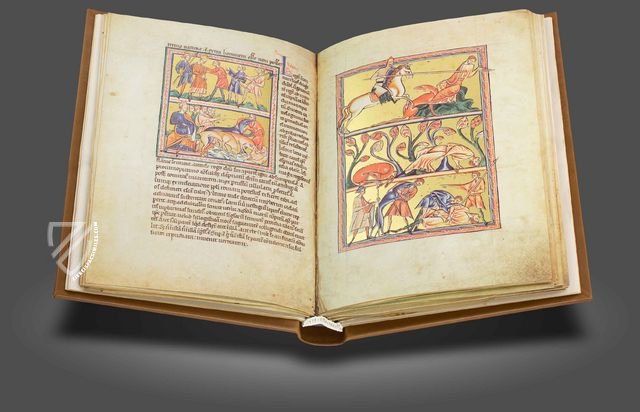
Possibly Peterborough or Lincoln (England) — ca. 1210
A moral and religious perspective on nature, and one of the finest examples of this genre: the famous Oxford Bestiary with more than 130 golden images of wild animals and fantastical mythical creatures
One of the most beautiful and splendid representatives of the bestiary
This codex is filled with gilded representations of creatures that reflect a medieval Christian view of nature
The ornamentally shaped depictions of animals can be understood less as naturalistic and more as literary
Oxford Bestiary
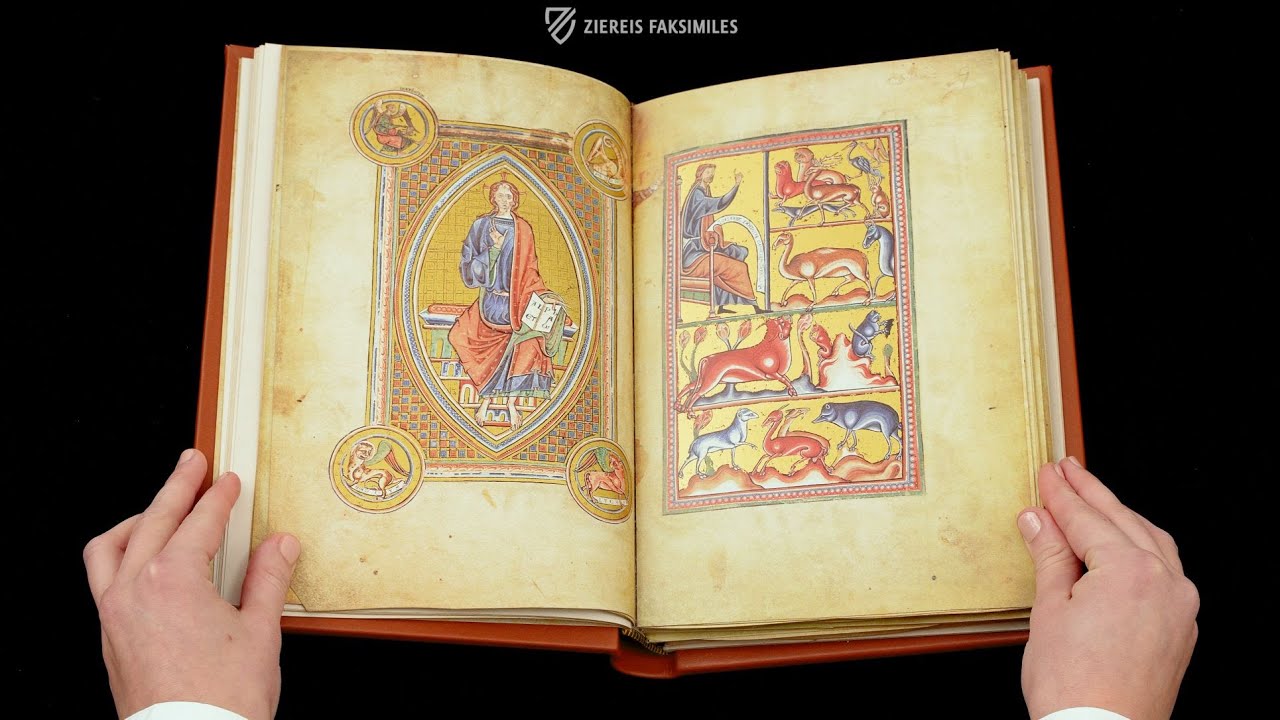

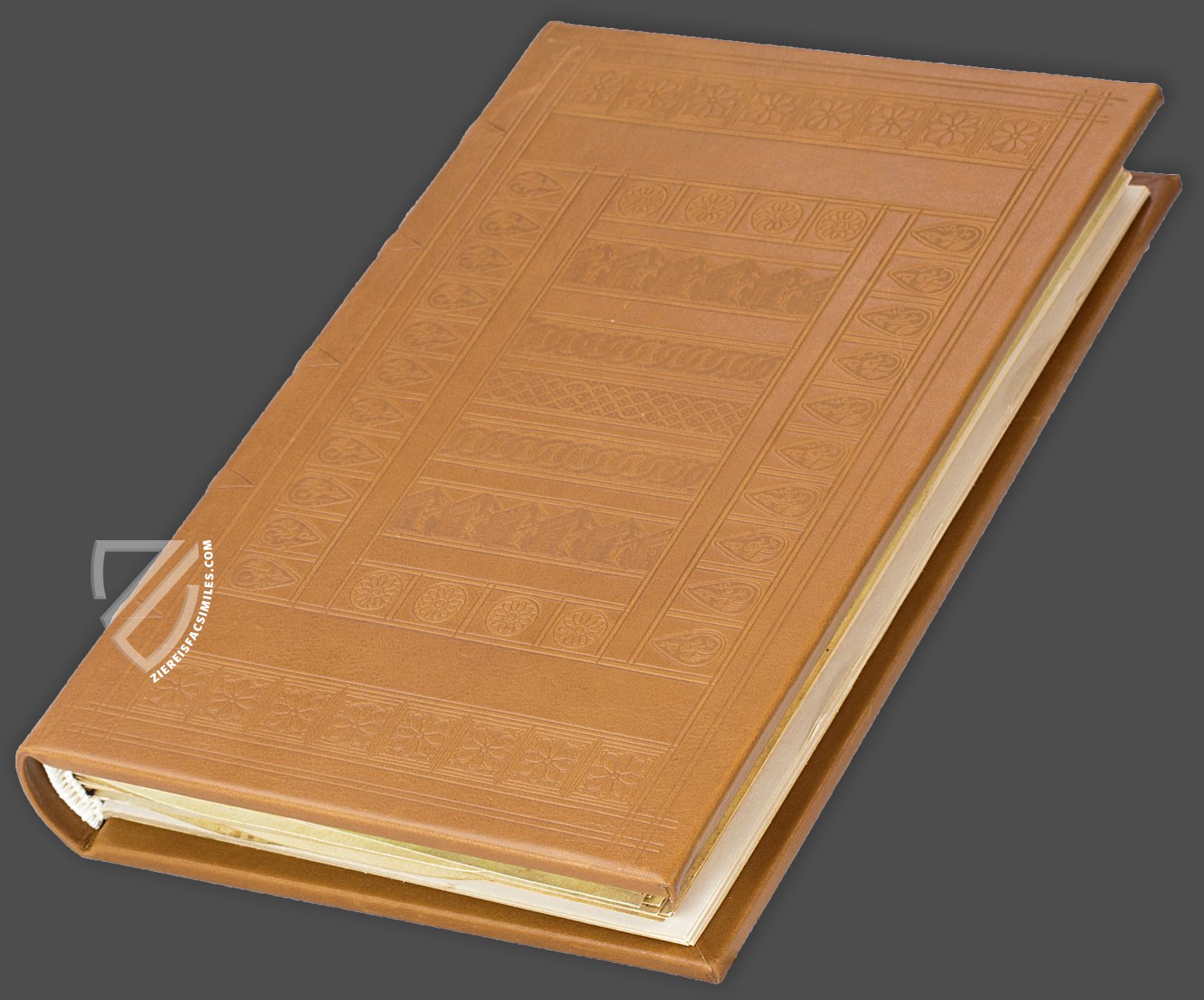
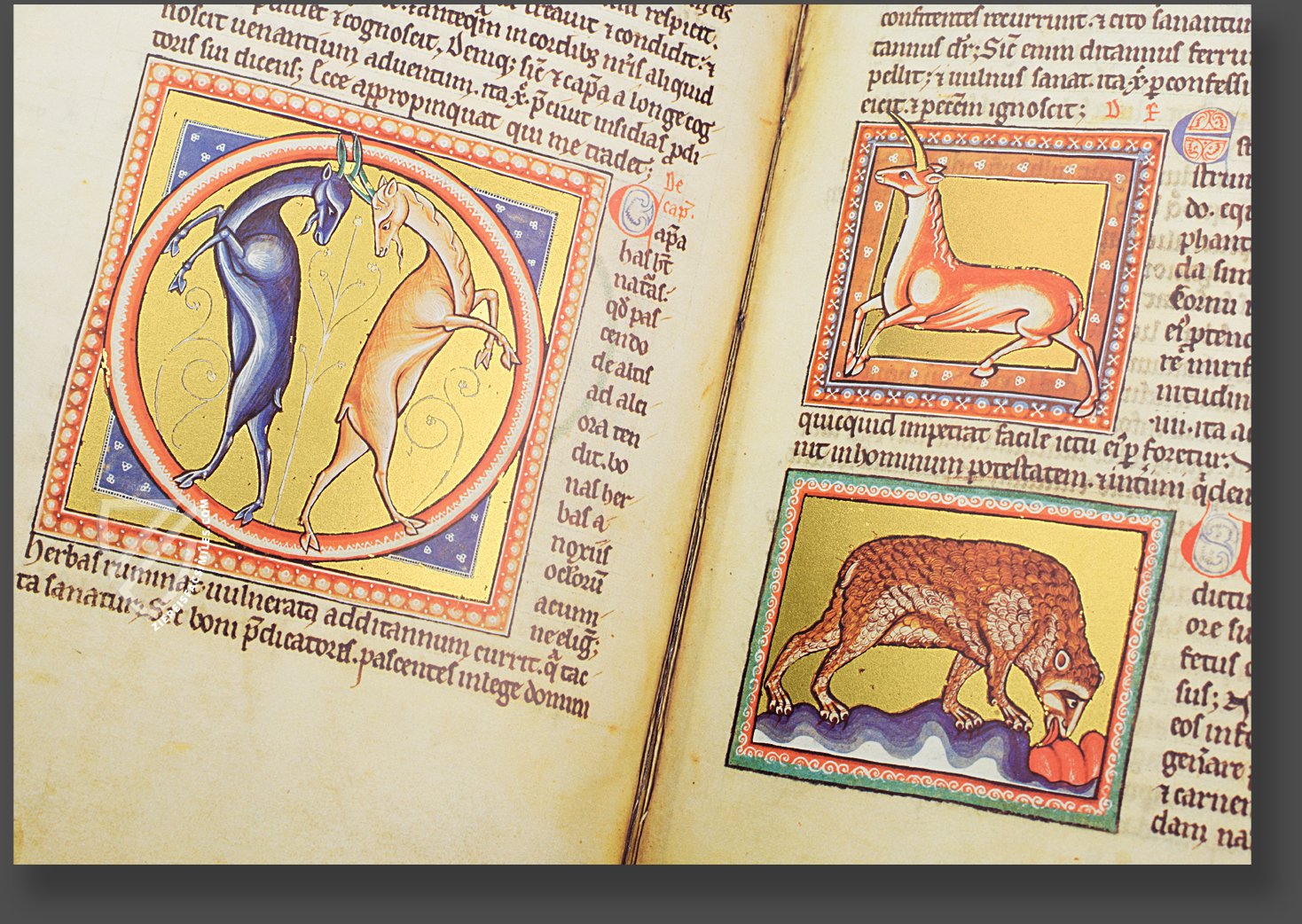
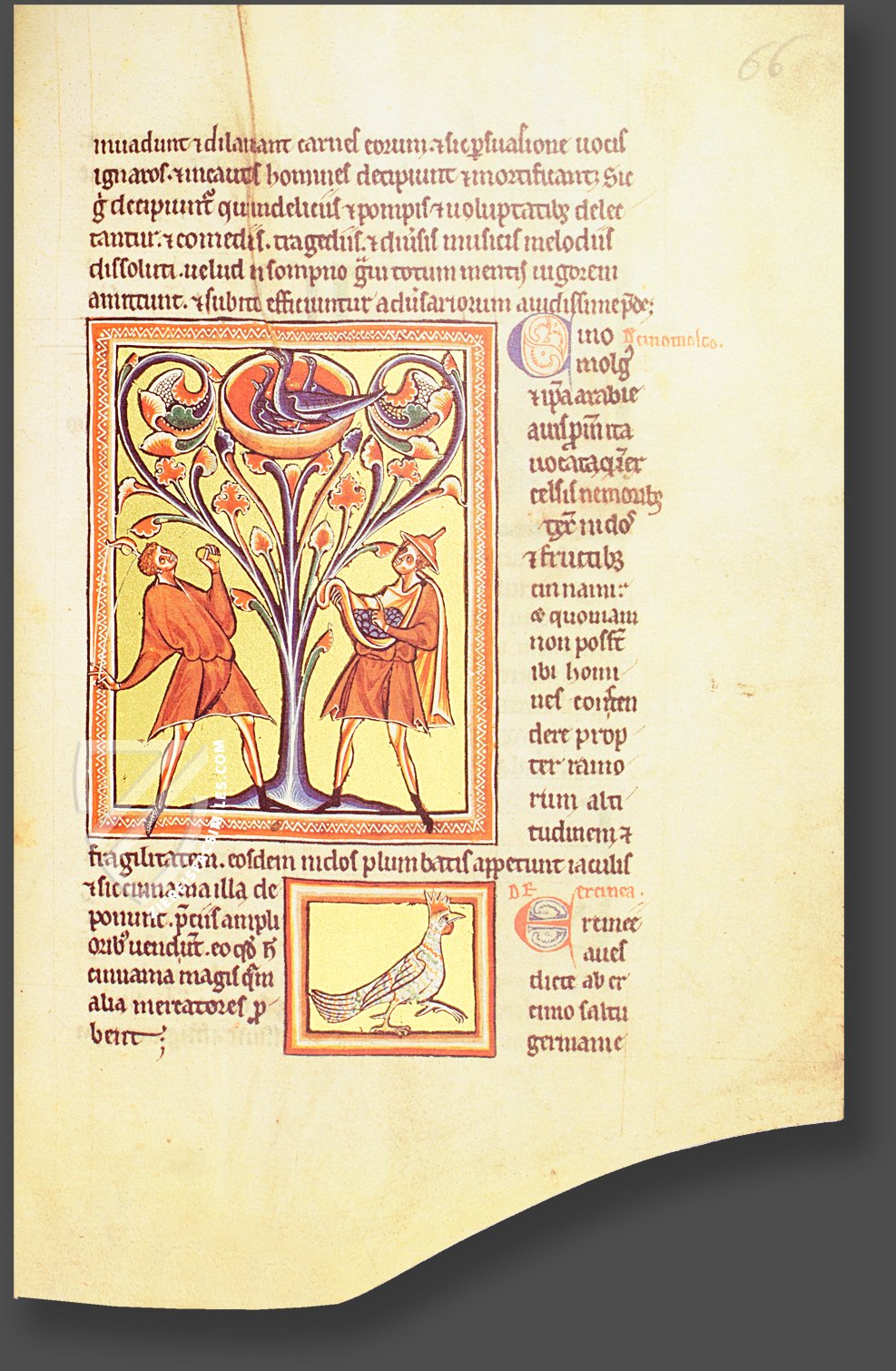
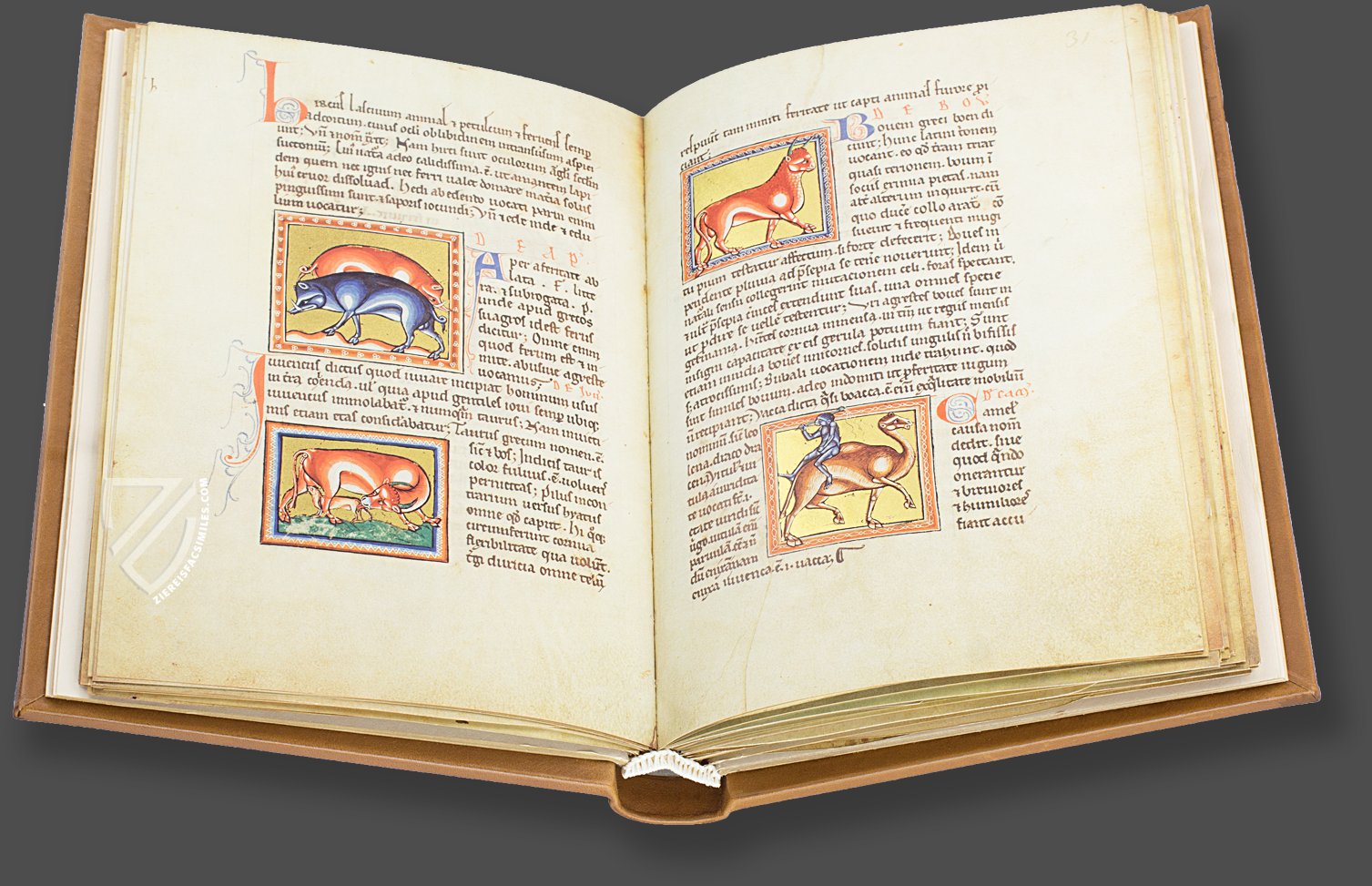
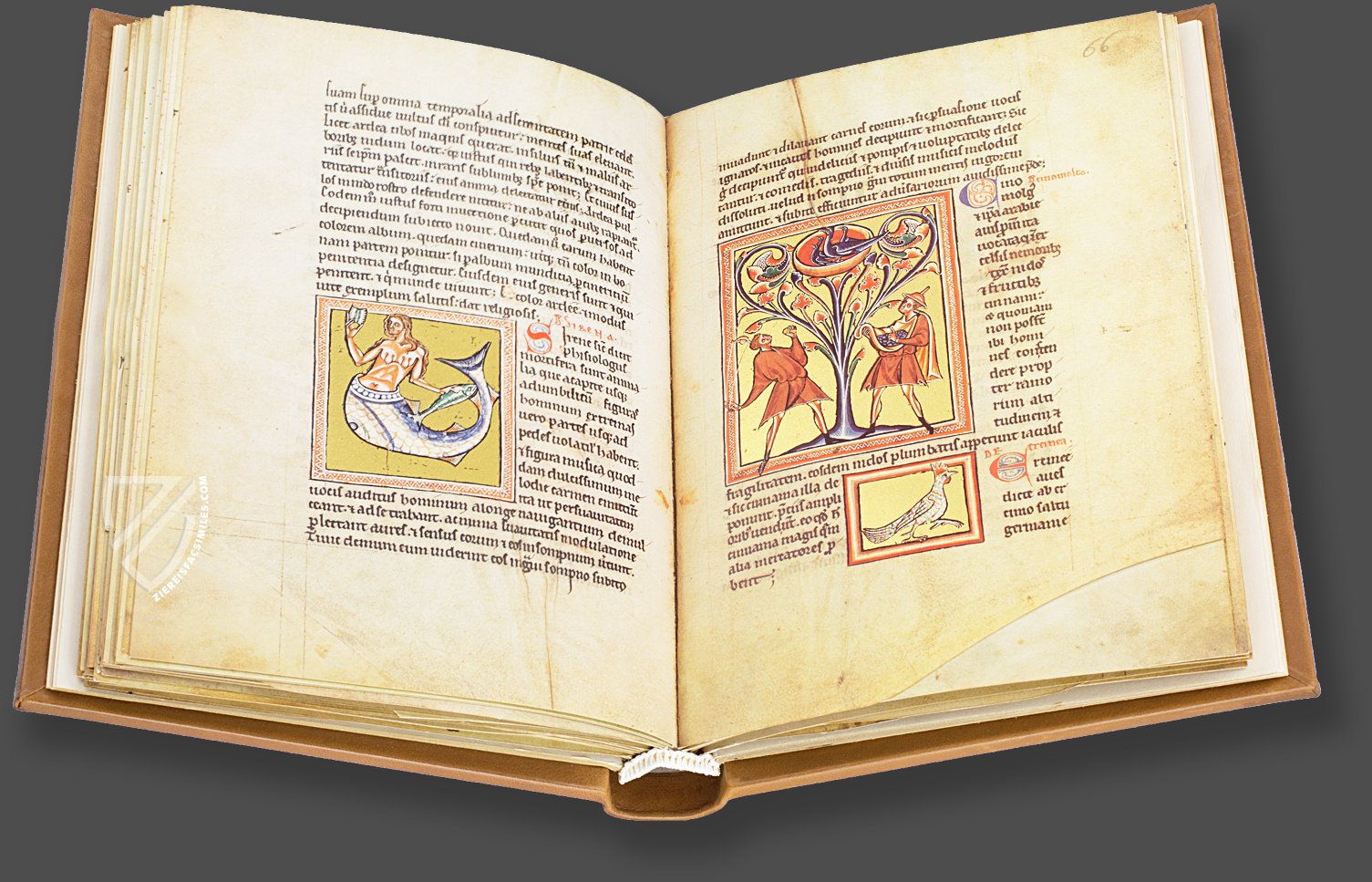
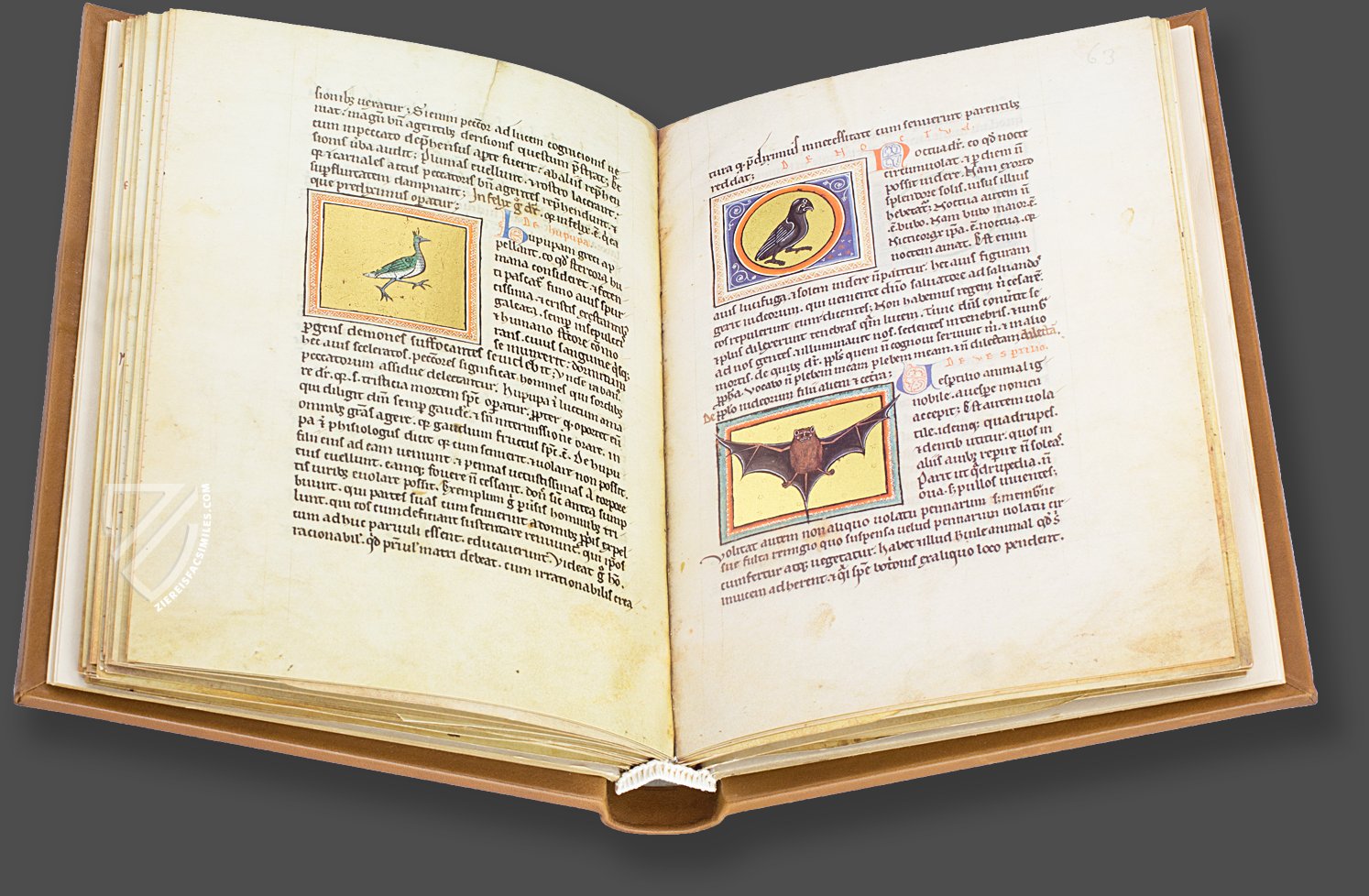
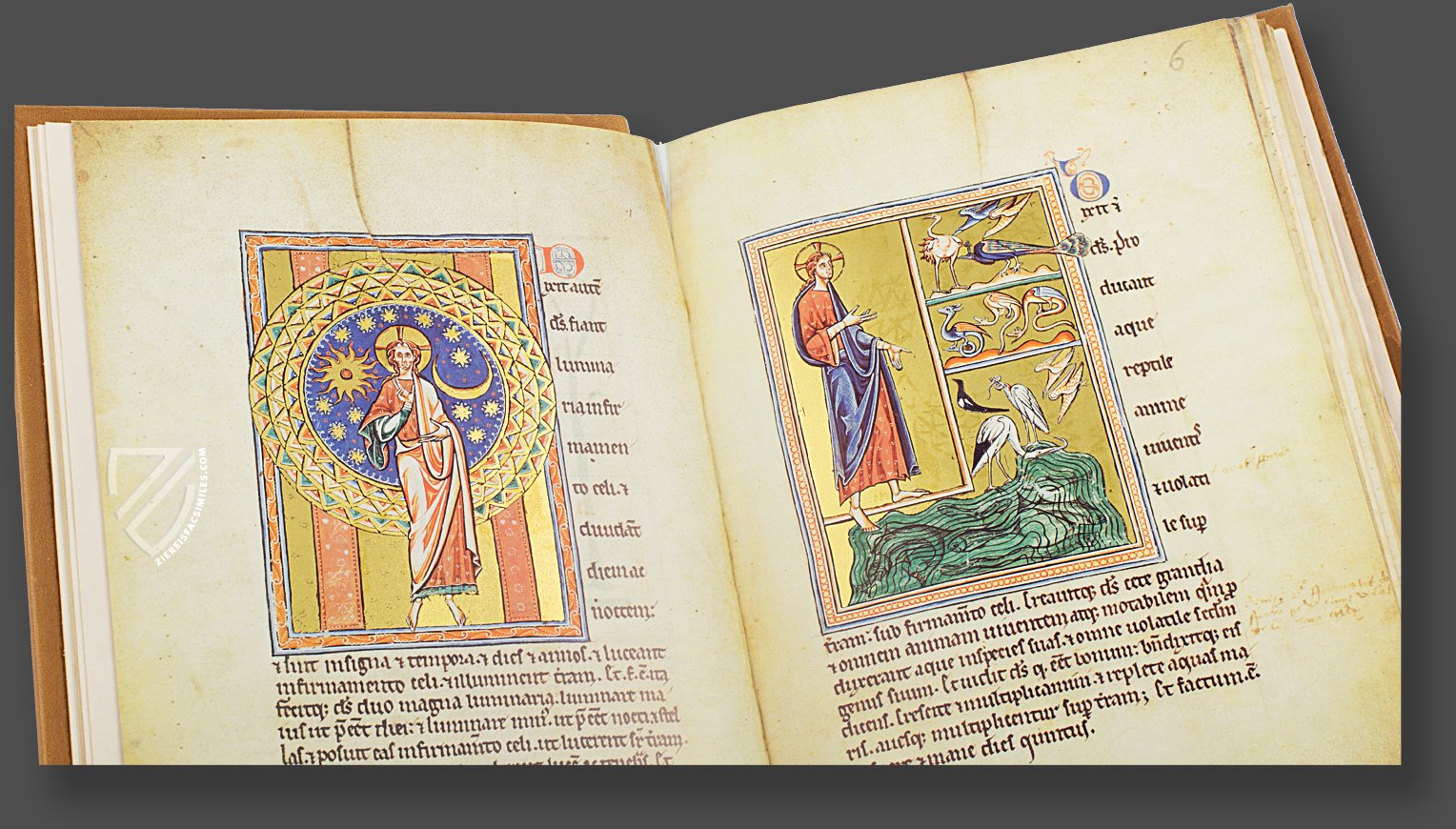
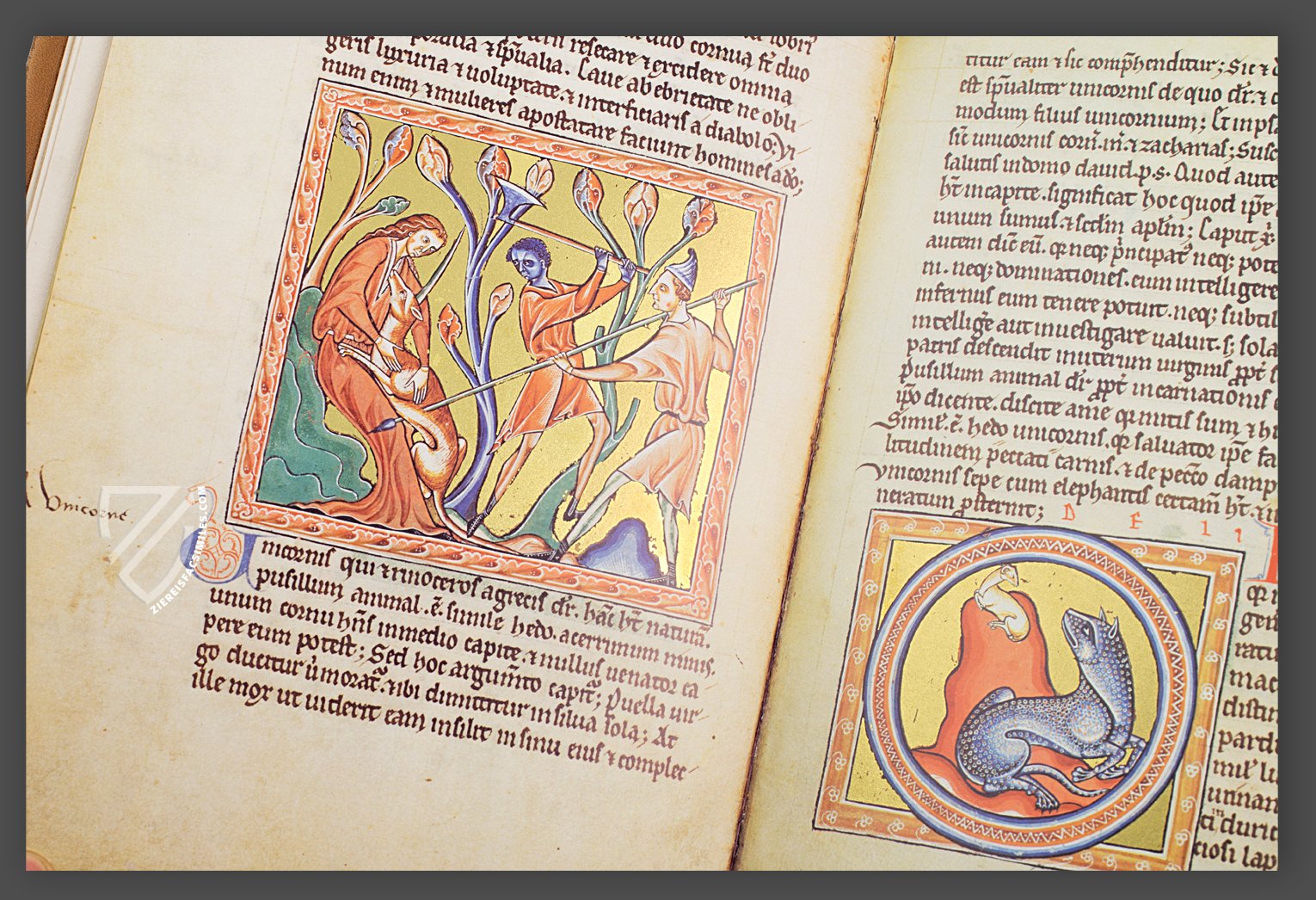
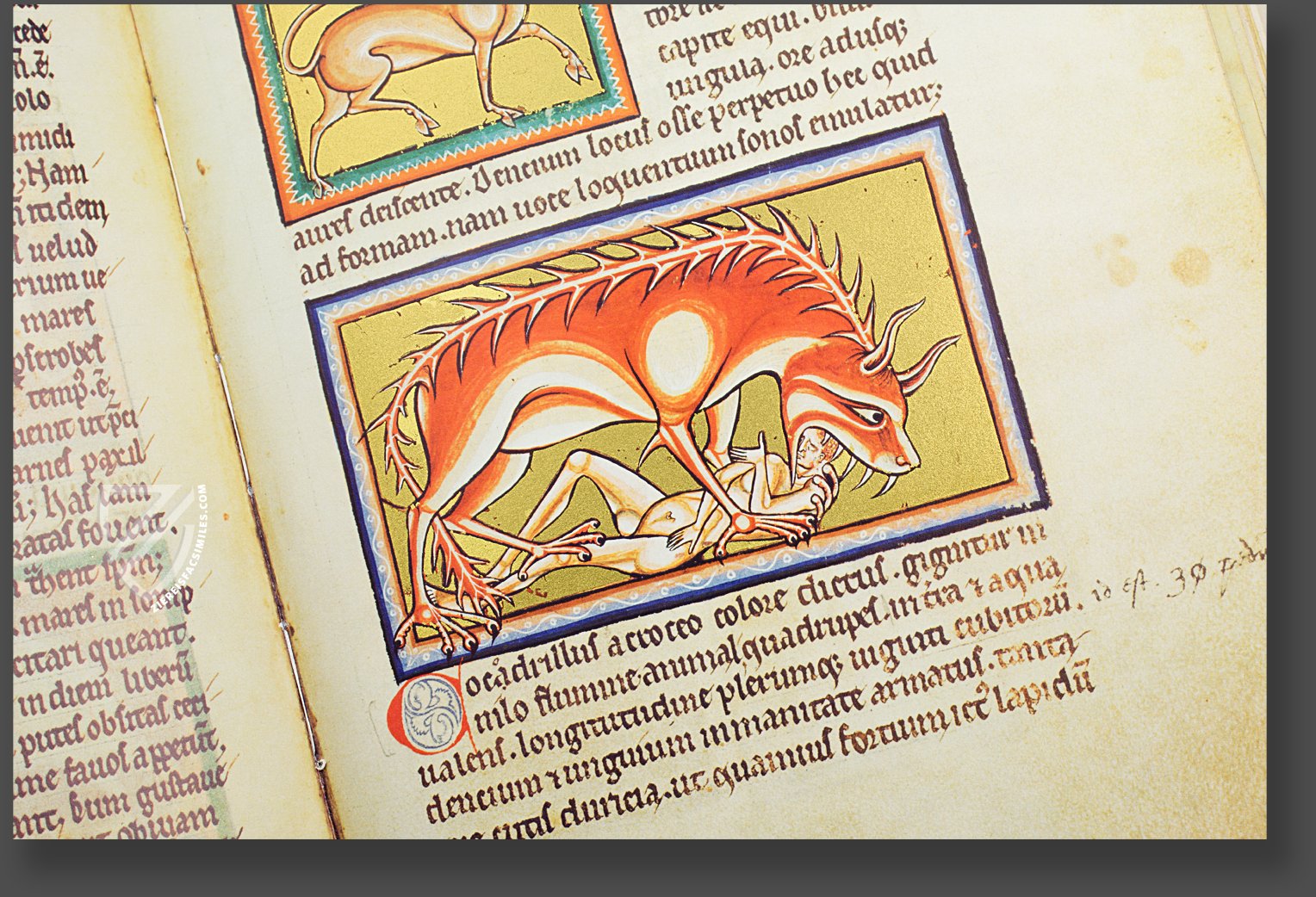
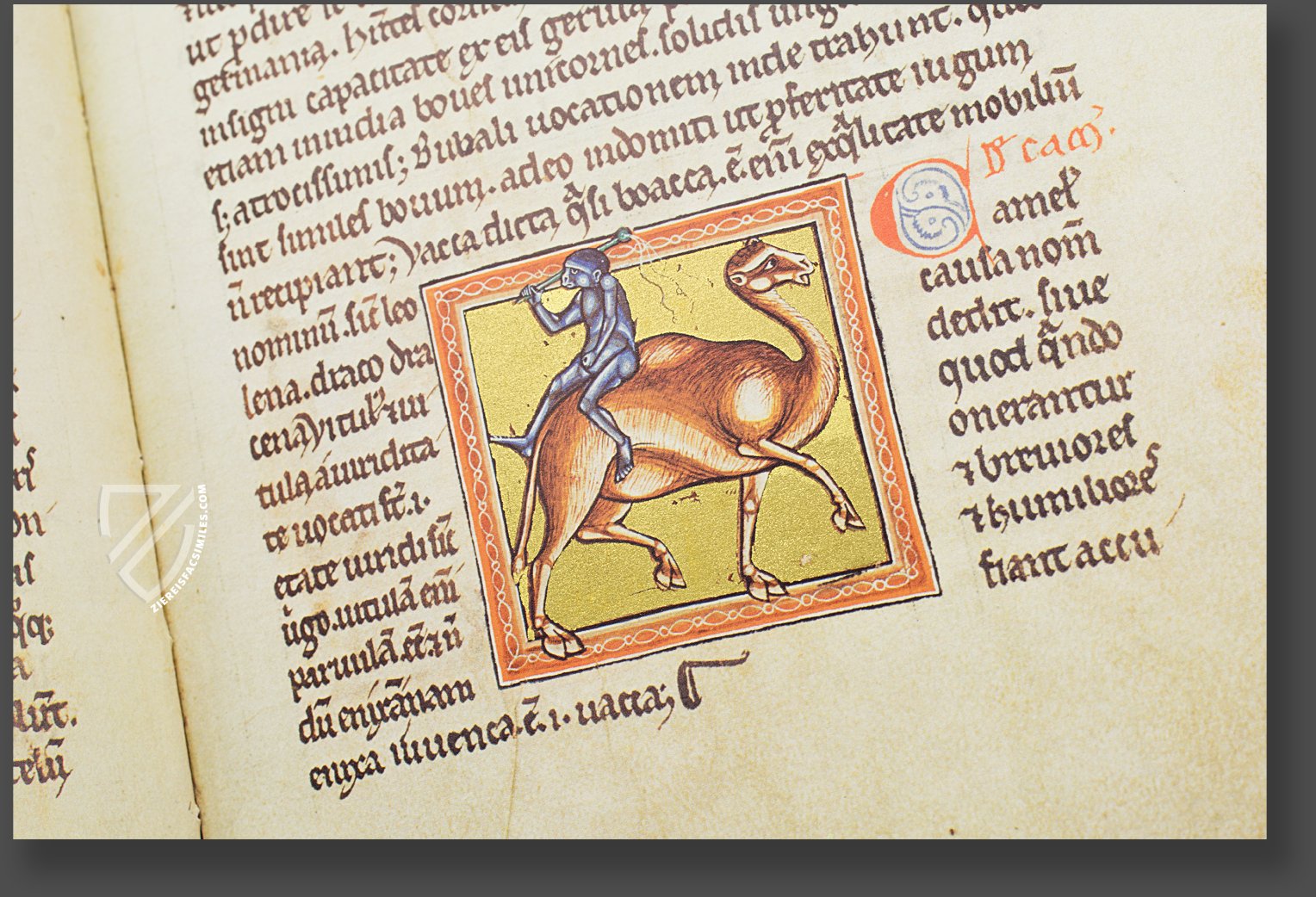
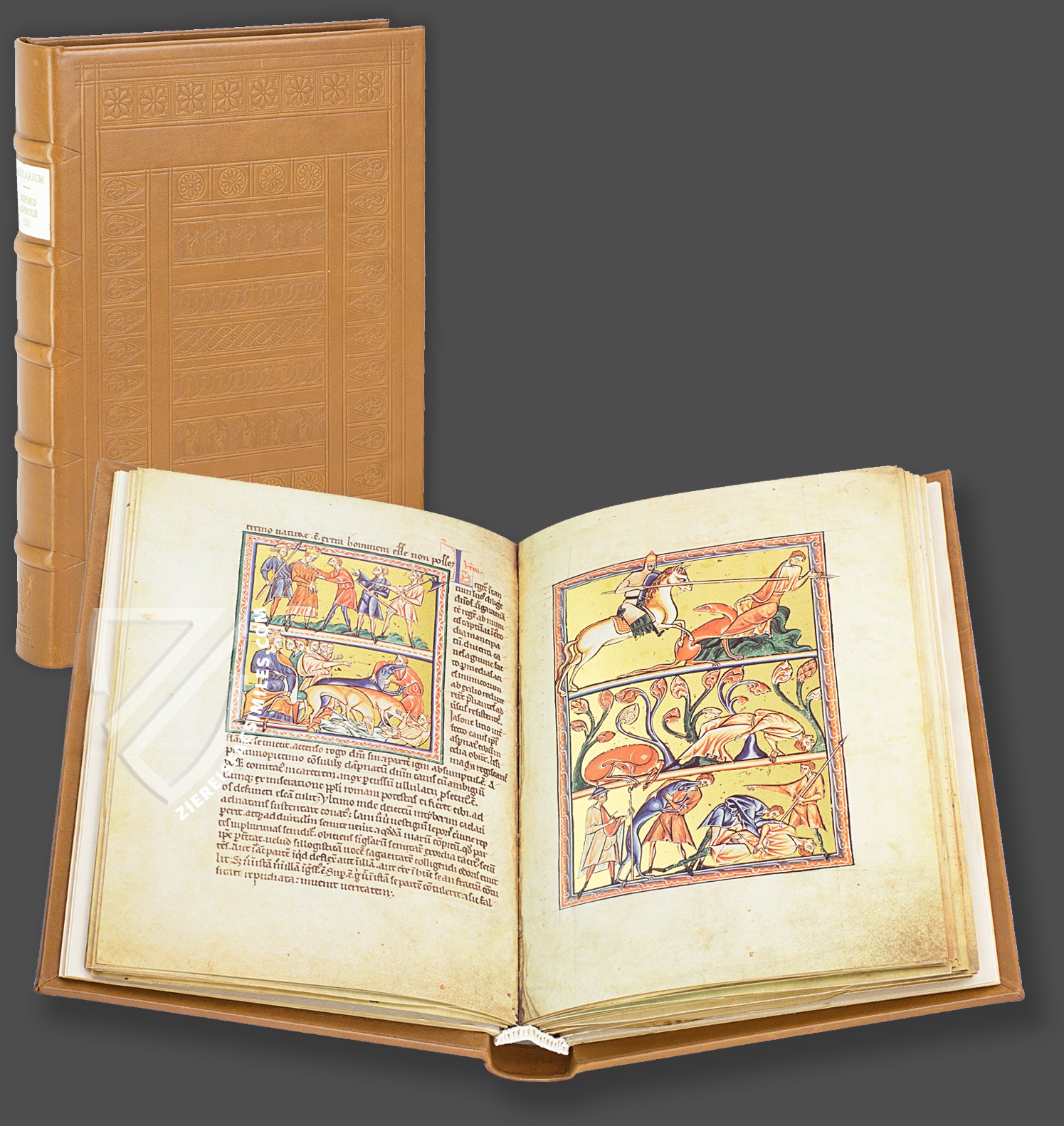
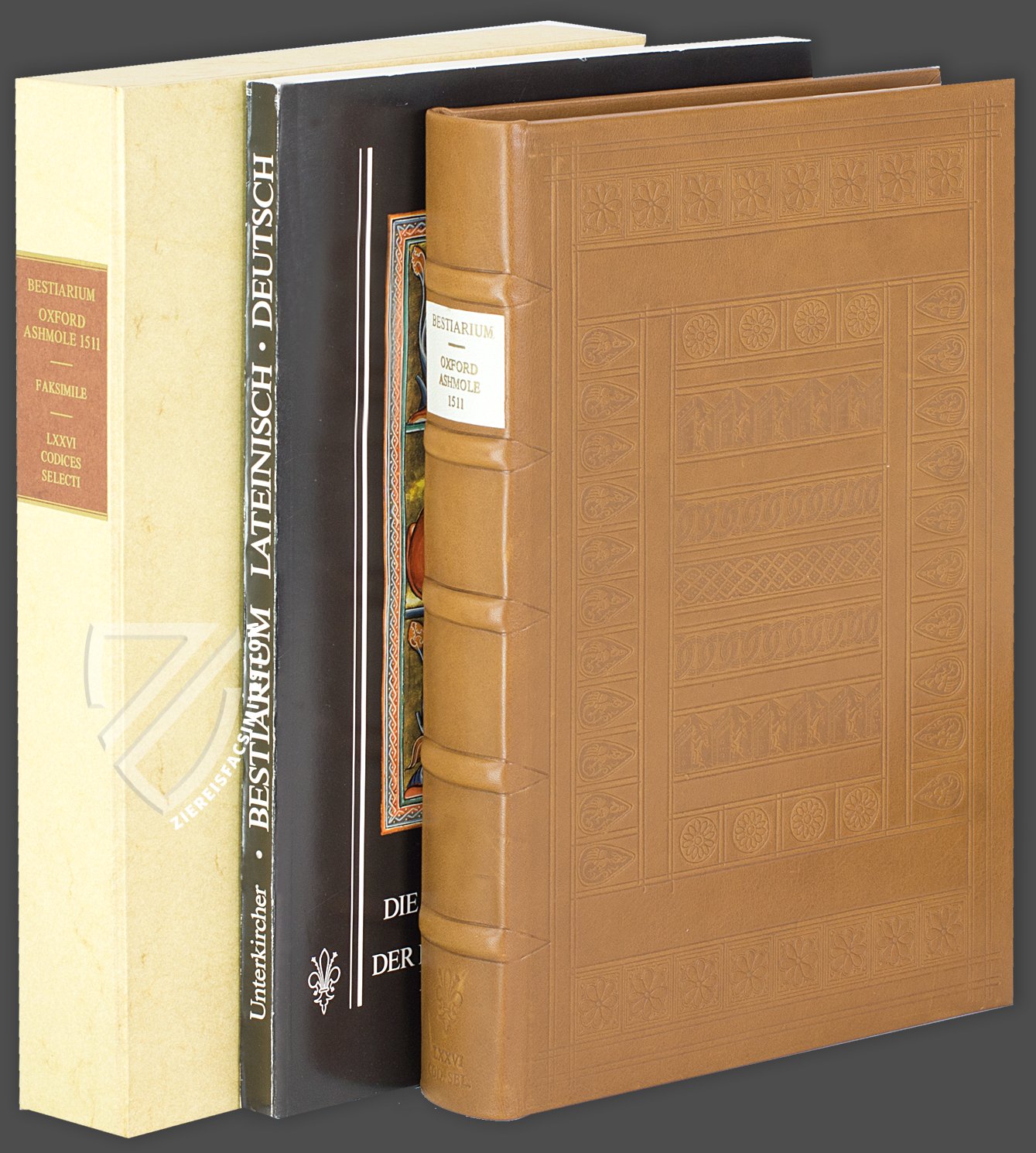
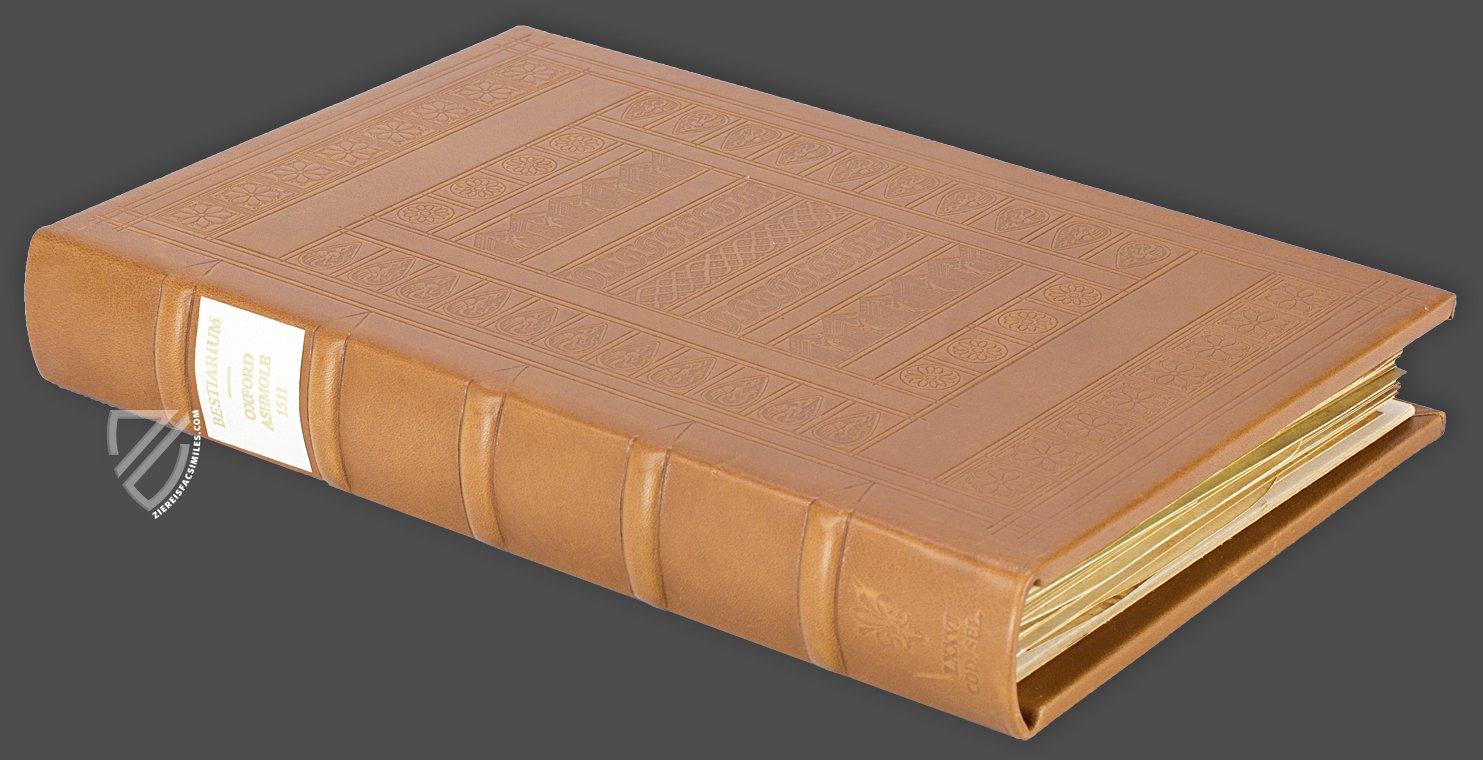

Jesus never stood face to face with an elephant, and in antiquity the panther was not believed to have horns; however, historical as well as zoological considerations are of only minor importance in the popular genre of the bestiary. At the beginning of this tradition stands the symbolic interpretation of nature found in the Physiologus of Late Antiquity. A bestiary’s particular interest lies in the fact that fantastical animals are placed on an equal footing with the often strikingly lifelike depictions of real animals. The aim is to transfer the mythical characteristics attributed to these creatures into an allegorical interpretation relating to Christ as well as to the Church and to humankind. Despite its rich and imaginative character, the Oxford Bestiary from the early 13th century is distinguished by its calm symmetry and refined ornamentation, frequently set against carefully and lovingly patterned backgrounds, thereby offering the reader a cohesive and visually engaging reading experience.
Oxford Bestiary
Toward the end of the 12th century, a new book genre became very popular in England: the illuminated bestiary, a Christian didactic book about animals. Otto Mazal discusses this in his Buchkunst der Romanik (Graz 1978): “At the root of this book type lies the Greek Physiologus, a Christian handbook of late antique, allegorical natural history. Mythical traits were attributed to real and imaginary animals, for which material was drawn from ancient authors, and these were interpreted allegorically in relation to Christ, the Church, humanity, and demons.” The animal allegories, which gradually became part of the common knowledge of Christian societies, enjoyed great popularity in the Middle Ages. The Latin prose text served as the basis for the compilation of the medieval bestiary. The earliest manuscripts, dating from the 8th to the 10th century, have been preserved. They represent various editorial versions. There is no direct link to the bestiaries of the 12th century, whose sudden emergence represents an fascinating historical phenomenon.
Fabulous Images of Animals on Rich Gold Leaf
The books were part of the encyclopedic tradition of the 12th and 13th centuries, which was linked to a newly awakened interest in nature that was understood as a divine creation. This interest is also evident in contemporary translations and copies of texts by Pliny, Solinus, Isidore, and Aristotle, as well as in independent works on natural science. The images are scattered irregularly throughout the text; occasionally, an animal is characterized by several of the described traits. By modern standards, the animals’ forms are often quite bizarre: a crocodile with a dragon’s head and bird’s feet, a horned panther, and unnatural color schemes are just a few examples of the fascinating iconography, which, far from being based on nature studies, draws freely on literary models.
130 Vibrant Miniatures
Dating from the early 13th century, the marvellous bestiary manuscript held by the Bodleian Library in Oxford is arguably one of the most beautiful of its kind. This codex, magnificently adorned with gold leaf, captivates not only with its magnificent, vibrant tempera painting and the clear memorability of its depictions of animals, plants, and humans, but also with its preference for calm symmetry, delicate ornamentation, and often lovingly patterned backgrounds.
The 130 miniatures in the 105-leaf book block illuminate not only chapters on the nature of four-legged animals, birds, snakes, the properties of snakes, worms, fish, trees, flint, and the nature of humans, but also the Christian history of creation with particularly large and vividly narrative images at the beginning of the book.
Of Unicorns and Famous Doves
The abundance of represented creatures is incredible. This list is intended to name just a few, to give a sense of the manuscript’s richness:
lion, tiger, panther, antelope, unicorn, lynx, elephant, ibex, hyena, monkey, satyr, deer, goat, bear, fox, wolf, dogs, lamb, camel, dromedary, donkey, weasel, hedgehog, ant, dove, the dove of Christ, the dove of David, the dove of Noah, north wind, south wind, falcon, sparrow, pelican, raven, hoopoe, rooster, parrot, swallow, blackbird, eagle owl, bat, stork, partridge, moose, waterfowl, crow, peacock, eagle, bee, dragon, lizard, otter, lizard, salamander, worms, whale, dolphin, guinea pig, crocodile, fig tree, blackberry, walnut tree, oak, beech, fir, cedar, cypress, plane tree, elm, willow, boxwood. … The list could go on almost indefinitely, for such is the abundance of the living world depicted and described. Hardly any of the other surviving bestiaries is as rich as the Oxford manuscript.
Codicology
- Alternative Titles
- Das Bestiarium
Oxforder Bestiarium
Ashmole Bestiary - Size / Format
- 210 pages / 27.6 × 18.3 cm
- Origin
- United Kingdom
- Date
- ca. 1210
- Epochs
- Style
- Language
- Script
- Early gothic textura formata
- Illustrations
- About 130 miniatures with animal illustrations on richly gilded background
- Content
- Creation story and detailed allegorical descriptions of over 100 animals
- Previous Owners
- William Wright, vicar of High Wycombe
William Mann
Sir Peter Mancroft
John Tradescant (1608 –62)
Elias Ashmole (1617–92)
Oxford University
Oxford Bestiary
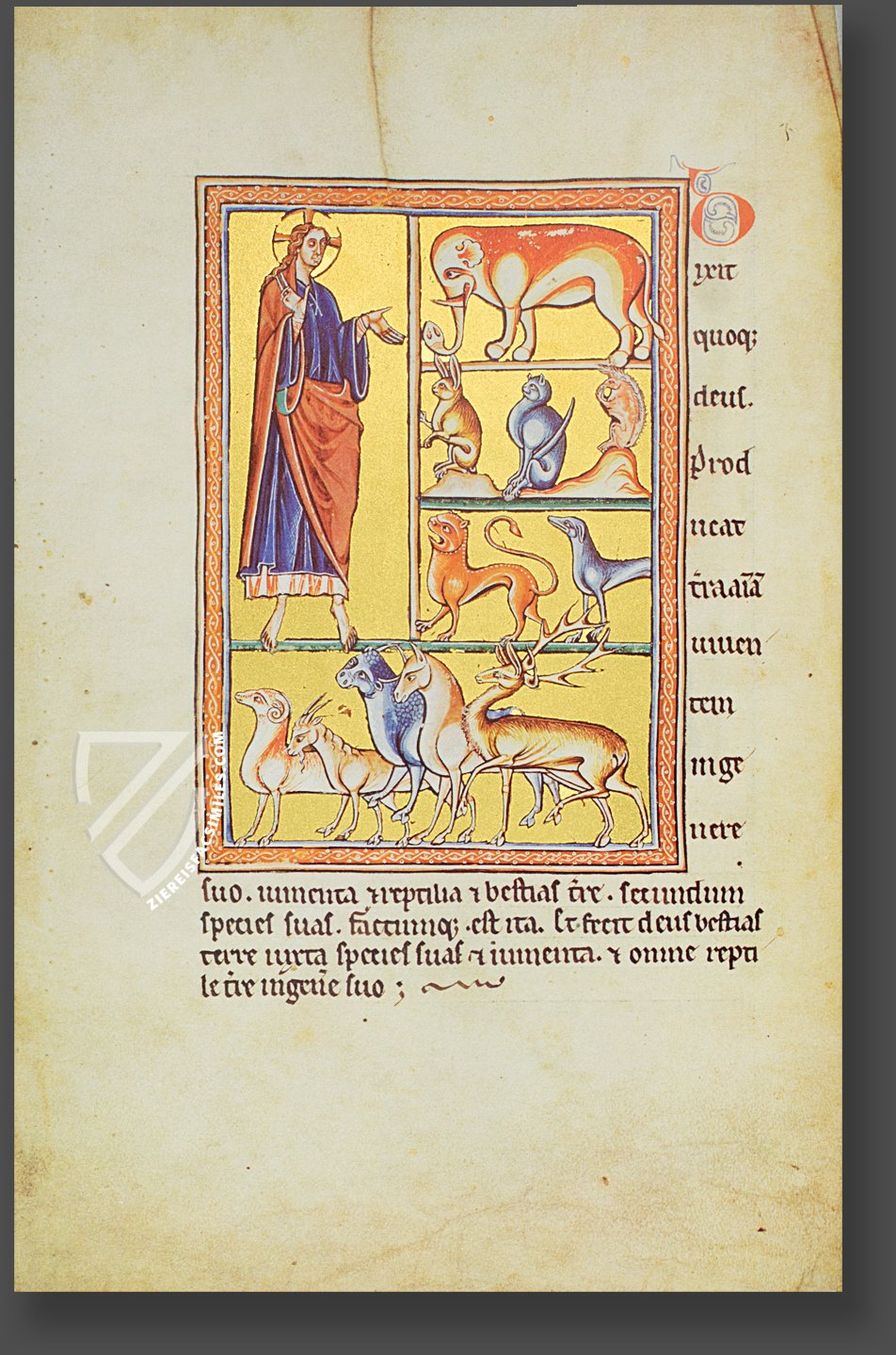
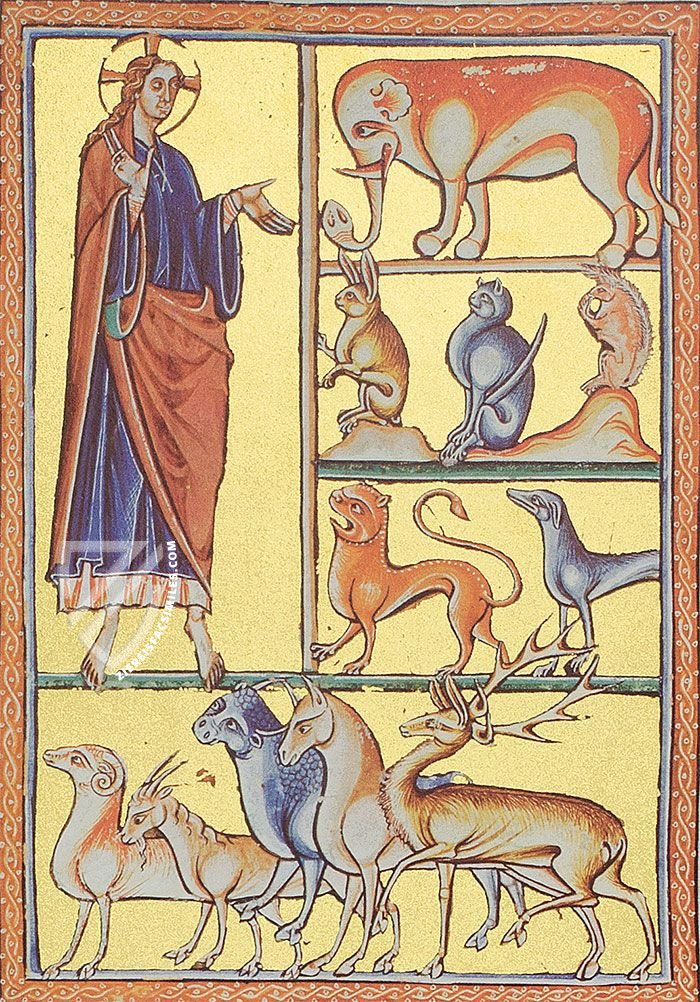
Sixth Day of Creation
With the sign of benediction, God creates animals as he floats before a timeless and spaceless gold background: “Then God said, ‘Let the earth bring forth the living creature according to its kind: cattle and creeping thing and beast of the earth, each according to its kind’; and it was so. And God made the beast of the earth according to its kind, cattle according to its kind, and everything that creeps on the earth according to its kind. And God saw that it was good.” (Genesis 1:24-25)
Oxford Bestiary
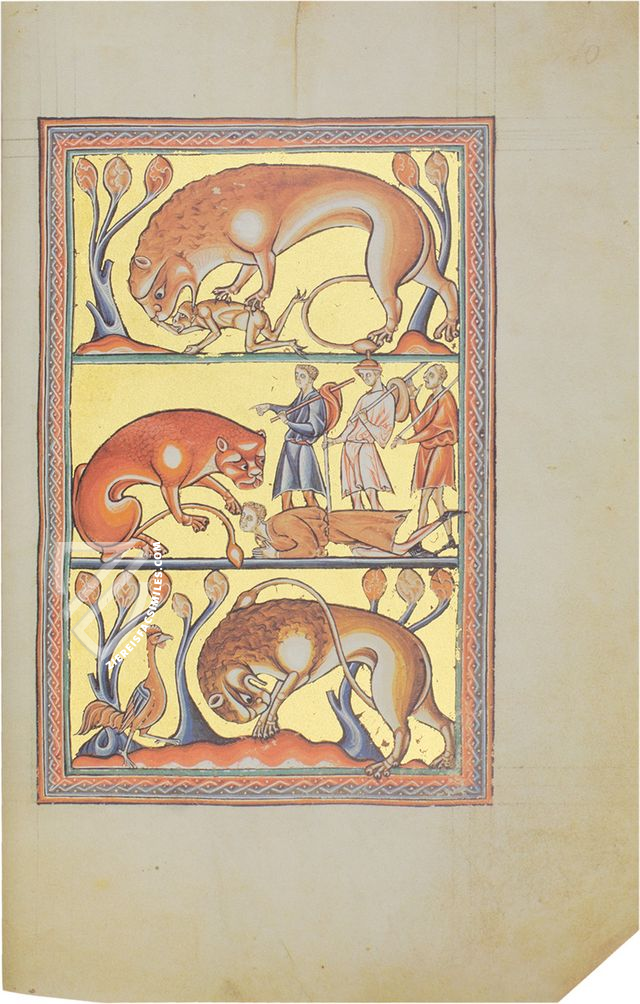
The Lion
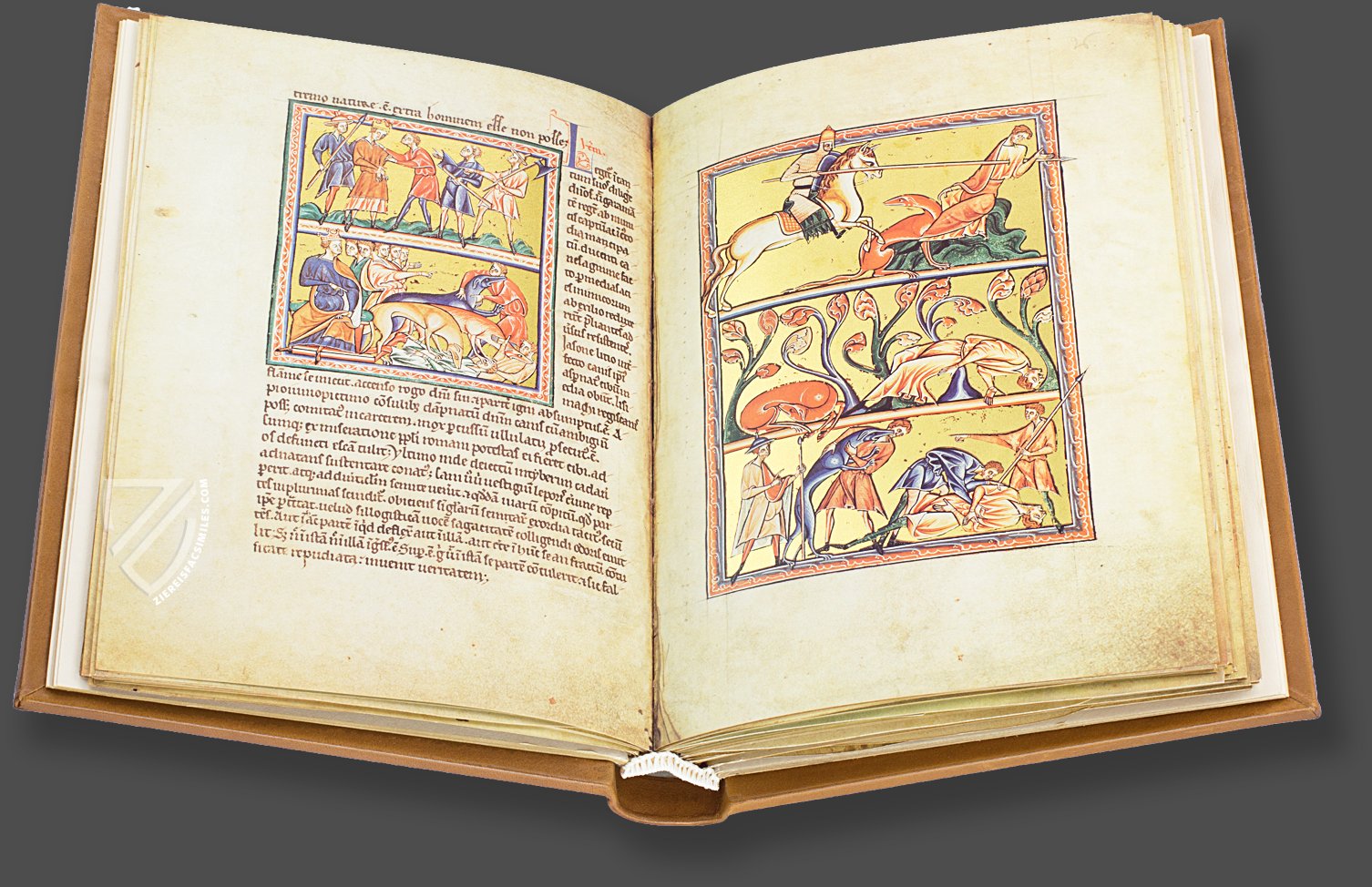
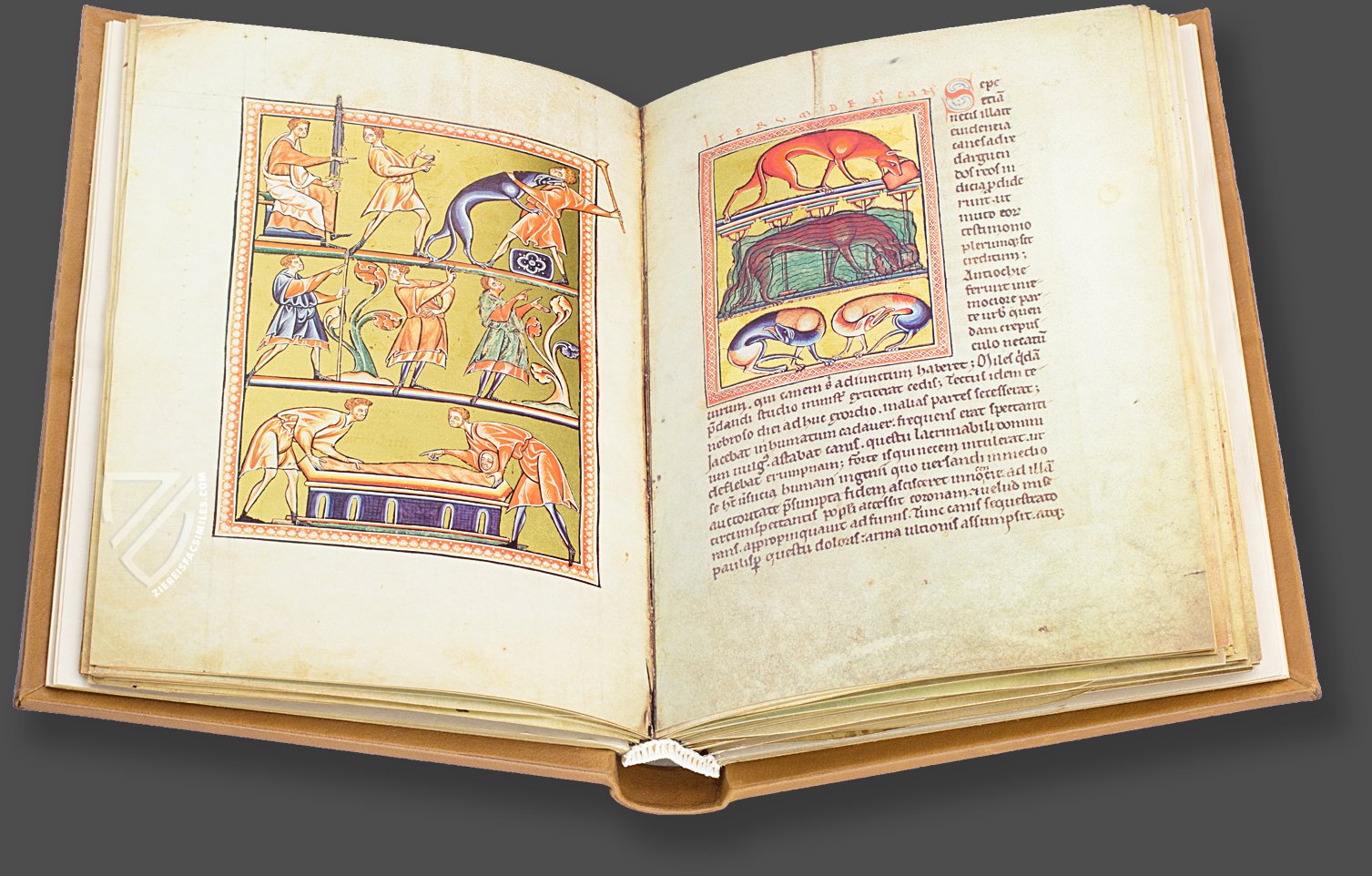
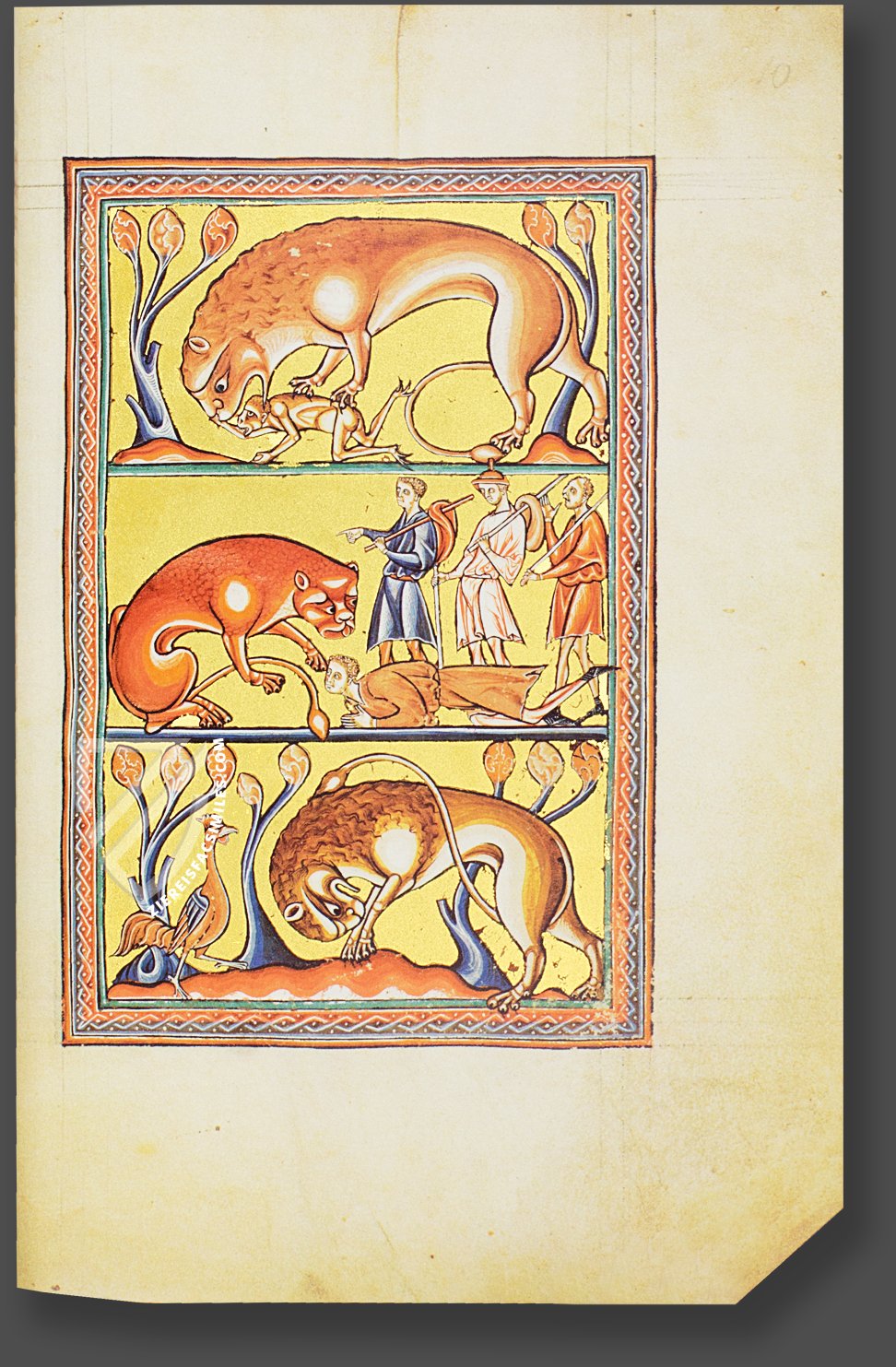
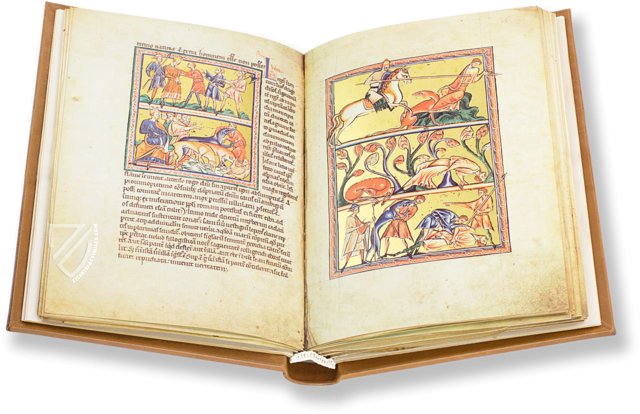
Here we have one of the splendid full-page miniatures of this famous bestiary. It has a frame with an interlace pattern and gracefully transitions from green to red to purple and back to red. This brightly colored scene shimmers with burnished gold leaf backgrounds and depicts three scenes regarding lions in register.
In the top scene, a lion has chased down an ape and is about to devour the poor primate between two abstract trees with blue trunks and red leaves. The middle scene offers a contrast as the sympathetic-looking lion spares a man who is lying prostrate before him. In the bottom scene, the lion is afraid of a rooster or some other kind of fowl – an observation of how super predators can be easily startled by an animal reckless enough to face them.
#1 Das Bestiarium
Languages: French, German, Spanish
The commentary volume contains a transcription and a German translation of the medieval text.
#2 BESTIARIUM. Facsimilé du Manuscrit du Bestiaire Ashmole 1511, Conservé à la Bodleian Library d'Oxford
Language: French
The commentary volume features a French translation of the original text.
(under 1,000€)
- Block Books / Incunables / Post-incunables
- Alchemy
- Apocalypses / Beatus Manuscripts
- Astronomy / Astrology
- Bibles / Gospels
- Picture Bibles / Bibles Moralisées / Mirror of Human Salvation
- Botany
- Chronicles / History / Letters
- Cookbook / Recipes
- Diaries / Biographies / Autograph Books
- Encyclopedias
- Fashion / Costume Books
- Games / Game Theory
- Geography / Cartography / Navigation
- Graduals / Antiphonaries / Exultet Roll
- Haggadot
- Hunting Books
- Law / Deeds / Rules
- Leonardo da Vinci
- Literature / Poetry
- Medicine
- Missals / Lectionaries / Sacramentaries
- Model Books / Sketchbooks / Notebooks
- Music
- Mythology
- Natural History / Bestiaries
- Other Liturgical Manuscripts
- Other Religious Works
- Other Secular Works
- Paintings / Graphics
- Primers / Textbooks
- Private Devotion Books
- Prophecies / Divination
- Psalters
- Quran
- Saints' Lives
- Sermons / Homilies
- Single Leaf Collections
- Song Books
- Tanakh
- Tournament Books / Armorials / Genealogy
- Travelogues / Travel Guides
- Treatises
- Afghanistan
- Algeria
- Armenia
- Austria
- Azerbaijan
- Belarus
- Belgium
- Belize
- Bosnia and Herzegovina
- China
- Colombia
- Costa Rica
- Croatia
- Cyprus
- Czech Republic
- Denmark
- Egypt
- El Salvador
- Ethiopia
- France
- Germany
- Greece
- Guatemala
- Honduras
- Hungary
- India
- Iran
- Iraq
- Israel
- Italy
- Japan
- Jordan
- Kazakhstan
- Kyrgyzstan
- Lebanon
- Libya
- Liechtenstein
- Luxembourg
- Mexico
- Morocco
- Netherlands
- Palestine
- Panama
- Peru
- Poland
- Portugal
- Romania
- Russia
- Serbia
- Slovakia
- Spain
- Sri Lanka
- Sweden
- Switzerland
- Syria
- Tajikistan
- Tunisia
- Turkey
- Turkmenistan
- Ukraine
- United Kingdom
- United States
- Uzbekistan
- Vatican City
- A. Oosthoek, van Holkema & Warendorf
- Aboca Museum
- Ajuntament de Valencia
- Akademie Verlag
- Akademische Druck- u. Verlagsanstalt (ADEVA)
- Aldo Ausilio Editore - Bottega d’Erasmo
- Alecto Historical Editions
- Alkuin Verlag
- Almqvist & Wiksell
- Amilcare Pizzi
- Andreas & Andreas Verlagsbuchhandlung
- Archa 90
- Archiv Verlag
- Archivi Edizioni
- Arnold Verlag
- ARS
- Ars Magna
- Ars Millenii
- Art Market
- ArtCodex
- AyN Ediciones
- Azimuth Editions
- Badenia Verlag
- Bärenreiter-Verlag
- Belser Verlag
- Belser Verlag / WK Wertkontor
- Benziger Verlag
- Bernardinum Wydawnictwo
- BiblioGemma
- Biblioteca Apostolica Vaticana (Vaticanstadt, Vaticanstadt)
- Bibliotheca Palatina Faksimile Verlag
- Bibliotheca Rara
- Boydell & Brewer
- Bramante Edizioni
- Bredius Genootschap
- Brepols Publishers
- British Library
- Brokarte
- C. Weckesser
- Caixa Catalunya
- Canesi
- CAPSA, Ars Scriptoria
- Caratzas Brothers, Publishers
- Carus Verlag
- Casamassima Libri
- Centrum Cartographie Verlag GmbH
- Chavane Verlag
- Christian Brandstätter Verlag
- Circulo Cientifico
- Club Bibliófilo Versol
- Club du Livre
- Club Internacional del Libro
- CM Editores
- Collegium Graphicum
- Collezione Apocrifa Da Vinci
- Comissão Nacional para as Comemorações dos Descobrimentos Portugueses
- Coron Verlag
- Corvina
- CTHS
- D. S. Brewer
- Damon
- De Agostini/UTET
- De Nederlandsche Boekhandel
- De Schutter
- Deuschle & Stemmle
- Deutscher Verlag für Kunstwissenschaft
- DIAMM
- Dropmore Press
- Droz
- E. Schreiber Graphische Kunstanstalten
- Ediciones Boreal
- Ediciones Grial
- Ediclube
- Edições Inapa
- Edilan
- Editalia
- Edition Deuschle
- Edition Georg Popp
- Edition Leipzig
- Edition Libri Illustri
- Editiones Reales Sitios S. L.
- Éditions de l'Oiseau Lyre
- Editions Medicina Rara
- Editorial Base
- Editorial Casariego
- Editorial Mintzoa
- Editrice Antenore
- Editrice Velar
- Edizioni Edison
- Egeria, S.L.
- Eikon Editores
- Electa
- Emery Walker Limited
- Enciclopèdia Catalana
- Eos-Verlag
- Ephesus Publishing
- Ernst Battenberg
- Eugrammia Press
- Extraordinary Editions
- Fackelverlag
- Facsimila Art & Edition
- Facsimile Editions Ltd.
- Facsimilia Art & Edition Ebert KG
- Faksimile Verlag
- Feuermann Verlag
- Folger Shakespeare Library
- Franco Cosimo Panini Editore
- Friedrich Wittig Verlag
- Fundación Hullera Vasco-Leonesa
- G. Braziller
- Gabriele Mazzotta Editore
- Gebr. Mann Verlag
- Gesellschaft für graphische Industrie
- Getty Research Institute
- Giovanni Domenico de Rossi
- Giunti Editore
- Goldenmark Librarium
- Graffiti
- Grafica European Center of Fine Arts
- Guido Pressler
- Guillermo Blazquez
- Gustav Kiepenheuer
- H. N. Abrams
- Harrassowitz
- Harvard University Press
- Helikon
- Hendrickson Publishers
- Henning Oppermann
- Herder Verlag
- Hes & De Graaf Publishers
- Hoepli
- Holbein-Verlag
- Houghton Library
- Hugo Schmidt Verlag
- Hungarian Academy of Sciences
- Idion Verlag
- Il Bulino, edizioni d'arte
- ILte
- Imago
- In Officina Danesi
- Insel Verlag
- Instituto de Estudios Altoaragoneses
- Instituto Nacional de Antropología e Historia
- Introligatornia Budnik Jerzy
- Istituto dell'Enciclopedia Italiana - Treccani
- Istituto Ellenico di Studi Bizantini e Postbizantini
- Istituto Geografico De Agostini
- Istituto Poligrafico e Zecca dello Stato
- Italarte Art Establishments
- Jaca Book
- Jan Thorbecke Verlag
- Johnson Reprint Corporation
- Johnson Reprint Corporation
- Jos. Baer
- Josef Stocker
- Josef Stocker-Schmid
- Jugoslavija
- Karl W. Hiersemann
- Kasper Straube
- Kaydeda Ediciones
- Kindler Verlag / Coron Verlag
- Kodansha International Ltd.
- Konrad Kölbl Verlag
- Kurt Wolff Verlag
- La Linea Editrice
- La Meta Editore
- Lambert Schneider
- Landeskreditbank Baden-Württemberg
- Leo S. Olschki
- Les Incunables
- Liber Artis
- Library of Congress
- Libreria Musicale Italiana
- Lichtdruck
- Lito Immagine Editore
- Lumen Artis
- Lund Humphries
- M. Moleiro Editor
- Maison des Sciences de l'homme et de la société de Poitiers
- Manuscriptum
- Martinus Nijhoff
- Maruzen-Yushodo Co. Ltd.
- MASA
- Massada Publishers
- McGraw-Hill
- Metropolitan Museum of Art
- Militos
- Millennium Liber
- Müller & Schindler
- Nahar - Stavit
- Nahar and Steimatzky
- National Library of Wales
- Neri Pozza
- Nova Charta
- Oceanum Verlag
- Odeon
- Omnia Arte
- Orbis Mediaevalis
- Orbis Pictus
- Österreichische Staatsdruckerei
- Oxford University Press
- Pageant Books
- Parzellers Buchverlag
- Patrimonio Ediciones
- Pattloch Verlag
- PIAF
- Plon-Nourrit et cie
- Poligrafiche Bolis
- Presses Universitaires de Strasbourg
- Prestel Verlag
- Princeton University Press
- Prisma Verlag
- Priuli & Verlucca, editori
- Pro Sport Verlag
- Propyläen Verlag
- Pytheas Books
- Quaternio Verlag Luzern
- Reales Sitios
- Recht-Verlag
- Reichert Verlag
- Reichsdruckerei
- Reprint Verlag
- Riehn & Reusch
- Rizzoli
- Roberto Vattori Editore
- Rosenkilde and Bagger
- Roto-Sadag
- Roxburghe Club
- Salerno Editrice
- Saltellus Press
- Sandoz
- Sarajevo Svjetlost
- Schöck ArtPrint Kft.
- Schulsinger Brothers
- Scolar Press
- Scrinium
- Scripta Maneant
- Scriptorium
- Shazar
- Siloé, arte y bibliofilia
- SISMEL - Edizioni del Galluzzo
- Sociedad Mexicana de Antropología
- Société des Bibliophiles & Iconophiles de Belgique
- Soncin Publishing
- Sorli Ediciones
- Stainer and Bell
- Studer
- Styria Verlag
- Sumptibus Pragopress
- Szegedi Tudomànyegyetem
- Taberna Libraria
- Tarshish Books
- Taschen
- Tempus Libri
- Testimonio Compañía Editorial
- TGB Limited Editions
- Thames and Hudson
- The Clear Vue Publishing Partnership Limited
- The Facsimile Codex
- The Folio Society
- The Marquess of Normanby
- The Orphan Hospital Ward of Israel
- The Richard III and Yorkist History Trust
- The Warburg Institute
- Tip.Le.Co
- TouchArt
- TREC Publishing House
- TRI Publishing Co.
- Trident Editore
- Tuliba Collection
- Typis Regiae Officinae Polygraphicae
- Union Verlag Berlin
- Universidad de Granada
- Universitaire Bibliotheken Leiden
- University of California Press
- University of Chicago Press
- Urs Graf
- Vallecchi
- Van Wijnen
- VCH, Acta Humaniora
- VDI Verlag
- VEB Deutscher Verlag für Musik
- Verein Schweizerischer Lithographie-Besitzer
- Verlag Anton Pustet / Andreas Verlag
- Verlag Bibliophile Drucke Josef Stocker
- Verlag der Münchner Drucke
- Verlag für Regionalgeschichte
- Verlag Styria
- Vicent Garcia Editores
- W. Turnowsky
- Waanders Printers
- Wiener Mechitharisten-Congregation (Wien, Österreich)
- Wissenschaftliche Buchgesellschaft
- Wissenschaftliche Verlagsgesellschaft
- Wydawnictwo Dolnoslaskie
- Xuntanza Editorial
- Zakład Narodowy
- Zollikofer AG