
Aefric's First Series of Catholic Homilies

Cerne Abbey, Dorset (England) — 7th or 8th century, late 10th century, and 12th century
Christian faith in the language of the people: Forty sermons and the earliest known copy of Ælfric’s Catholic Homilies – a unique insight into the development of Old English prose
Composed by Ælfric in Old English in the early 990s
Earliest known copy of the forty homilies
More than 1,000 corrections and revisions, some possibly by Ælfric himself
Aefric's First Series of Catholic Homilies

(under 1,000€)
With his Catholic Homilies, Ælfric created one of the most important works of Old English prose. At the beginning of the 990s, the learned Benedictine composed forty sermons to communicate the central teachings of Christianity in an accessible vernacular and to counter surviving pagan beliefs. The texts follow the liturgical year and address the Gospels, saints’ lives, Christian doctrine, and moral questions. The manuscript preserves the earliest known copy of these homilies and apparently represents a particularly early stage in the work’s textual development. More than 1,000 corrections and revisions document the intensive reworking of the text shortly after its creation; some entries may even have been made by Ælfric himself. The codex thus offers an exceptionally direct insight into the creation of a key work of Anglo-Saxon scholarship.
Preaching in the Language of the People
At the end of the tenth century, English monasticism underwent a profound reform. Monasteries were expected to follow the Rule of Saint Benedict more rigorously, the clergy were to receive better education, and Christian teaching was to be conveyed reliably. It was in this environment that Ælfric began composing his Catholic Homilies. His aim was to provide theologically sound sermons in accessible Old English.
Ælfric had received a thorough education at Winchester and came to the Benedictine monastery of Cerne around 987. It was probably there that he created the collection of forty homilies for the full liturgical year. They were intended to enable priests to explain the message of the Latin Bible and the Church Fathers in the language of their congregations.
Forty Homilies for the Liturgical Year
The texts accompany Sundays, major feast days, and the commemorations of saints. They explain passages from the Gospels, recount the lives of saints, discuss the Trinity, angels, and the Resurrection, and offer moral instruction. Ælfric drew on Latin authorities such as Augustine, Jerome, Gregory the Great, and Bede, transforming their teachings into clearly structured sermons in Old English.
His concern was not merely clarity, but also doctrinal accuracy. Ælfric lamented that erroneous or legendary ideas were being transmitted as truth in English books. His homilies were intended to counter such misconceptions and to unite Christian teaching with linguistic clarity and careful use of sources.
The Earliest Known Copy
The manuscript was probably created in the first half of the 990s at the monastery of Cerne, in close proximity to Ælfric. It preserves the earliest known copy of the homilies and a version of the text that predates the later, more widely circulated forms. Prefaces found in subsequent copies are still absent, while deleted passages reveal earlier stages in the development of individual sermons.
The codex is therefore not merely an early textual witness, but possibly an editorial and working copy from Ælfric’s immediate circle. It allows the development of the work to be traced from an early transcription through corrections and deletions to formulations that were later revised.
More Than a Thousand Traces of Revision
The main text was entered by three scribes and was intensively revised soon after its creation by at least four different hands. Around 1,000 minor corrections and additions are distributed throughout the manuscript. They range from individual letters and words to changes in syntax, vocabulary, and meaning.
Particularly fascinating is the possibility that one of the correcting hands belonged to Ælfric himself. A definitive attribution cannot be made, but comparisons of the handwriting and the manuscript’s proximity to its place of composition make this conceivable. In hardly any other manuscript can the direct revision of a major Old English text be observed so vividly.
Modest Decoration, Exceptional Importance
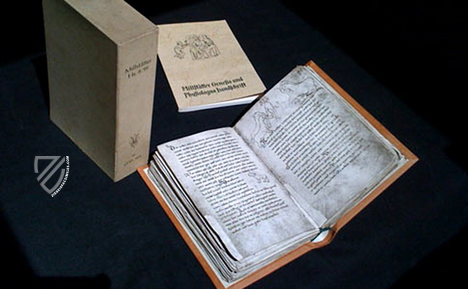
The decoration is deliberately restrained. Red initials once structured the text, although oxidation has caused some of them to turn grey. Later readers added glosses, while small drawings of a bird and an animal-shaped ornament were inserted in the eleventh or twelfth century. These traces show that the manuscript was read and used over several generations.
Its importance lies not in lavish illumination, but in its unique closeness to the author and to the creation of the work. As the earliest known copy, a witness to intensive editorial revision, and a possible bearer of corrections in Ælfric’s own hand, it is an exceptional document of Anglo-Saxon literary and intellectual history.
Codicology
- Alternative Titles
- Ælfrics katholische Homilien
Ælfric’s First Series of Catholic Homilies - Size / Format
- 462 pages / 32.5 × 23.0 cm
- Origin
- United Kingdom
- Date
- 7th or 8th century, late 10th century, and 12th century
- Style
- Genre
- Script
- Anglo-Saxon minuscule
- Illustrations
- Decorated initials
- Content
- Fragments of canon tables; the First Series of Catholic Homilies by Ælfric of Eynsham, extracts from exegetical and historical texts
- Artist / School
- Ælfric of Eynsham (scribe)
and seven other hands - Previous Owners
- Thomas Wolsey
Robert Beale
English Royal Library
British Museum
#1 First Series of Catholic Homilies Aelfrics katholische Homilien
Language: English
(under 1,000€)

- Treatises / Secular Books
- Apocalypses / Beatus
- Astronomy / Astrology
- Bestiaries
- Bibles / Gospels
- Chronicles / History / Law
- Geography / Maps
- Saints' Lives
- Islam / Oriental
- Judaism / Hebrew
- Single Leaf Collections
- Leonardo da Vinci
- Literature / Poetry
- Liturgical Manuscripts
- Medicine / Botany / Alchemy
- Music
- Mythology / Prophecies
- Psalters
- Other Religious Books
- Games / Hunting
- Private Devotion Books
- Other Genres
- Afghanistan
- Armenia
- Austria
- Belgium
- Belize
- Bosnia and Herzegovina
- China
- Colombia
- Costa Rica
- Croatia
- Cyprus
- Czech Republic
- Denmark
- Egypt
- El Salvador
- Ethiopia
- France
- Germany
- Greece
- Guatemala
- Honduras
- Hungary
- India
- Iran
- Iraq
- Israel
- Italy
- Japan
- Jordan
- Kazakhstan
- Kyrgyzstan
- Lebanon
- Liechtenstein
- Luxembourg
- Mexico
- Morocco
- Netherlands
- Palestine
- Panama
- Peru
- Poland
- Portugal
- Romania
- Russia
- Serbia
- Spain
- Sri Lanka
- Sweden
- Switzerland
- Syria
- Tajikistan
- Turkey
- Turkmenistan
- Ukraine
- United Kingdom
- United States
- Uzbekistan
- Vatican City
- A. Oosthoek, van Holkema & Warendorf
- Aboca Museum
- Ajuntament de Valencia
- Akademie Verlag
- Akademische Druck- u. Verlagsanstalt (ADEVA)
- Aldo Ausilio Editore - Bottega d’Erasmo
- Alecto Historical Editions
- Alkuin Verlag
- Almqvist & Wiksell
- Amilcare Pizzi
- Andreas & Andreas Verlagsbuchhandlung
- Archa 90
- Archiv Verlag
- Archivi Edizioni
- Arnold Verlag
- ARS
- Ars Magna
- Ars Millenii
- Art Market
- ArtCodex
- AyN Ediciones
- Azimuth Editions
- Badenia Verlag
- Bärenreiter-Verlag
- Belser Verlag
- Belser Verlag / WK Wertkontor
- Benziger Verlag
- Bernardinum Wydawnictwo
- BiblioGemma
- Biblioteca Apostolica Vaticana (Vaticanstadt, Vaticanstadt)
- Bibliotheca Palatina Faksimile Verlag
- Bibliotheca Rara
- Boydell & Brewer
- Bramante Edizioni
- Bredius Genootschap
- Brepols Publishers
- British Library
- Brokarte
- C. Weckesser
- Caixa Catalunya
- Canesi
- CAPSA, Ars Scriptoria
- Caratzas Brothers, Publishers
- Carus Verlag
- Casamassima Libri
- Centrum Cartographie Verlag GmbH
- Chavane Verlag
- Christian Brandstätter Verlag
- Circulo Cientifico
- Club Bibliófilo Versol
- Club du Livre
- Club Internacional del Libro
- CM Editores
- Collegium Graphicum
- Collezione Apocrifa Da Vinci
- Comissão Nacional para as Comemorações dos Descobrimentos Portugueses
- Coron Verlag
- Corvina
- CTHS
- D. S. Brewer
- Damon
- De Agostini/UTET
- De Nederlandsche Boekhandel
- De Schutter
- Deuschle & Stemmle
- Deutscher Verlag für Kunstwissenschaft
- DIAMM
- Dropmore Press
- Droz
- E. Schreiber Graphische Kunstanstalten
- Ediciones Boreal
- Ediciones Grial
- Ediclube
- Edições Inapa
- Edilan
- Editalia
- Edition Deuschle
- Edition Georg Popp
- Edition Leipzig
- Edition Libri Illustri
- Editiones Reales Sitios S. L.
- Éditions de l'Oiseau Lyre
- Editions Medicina Rara
- Editorial Casariego
- Editorial Mintzoa
- Editrice Antenore
- Editrice Velar
- Edizioni Edison
- Egeria, S.L.
- Eikon Editores
- Electa
- Emery Walker Limited
- Enciclopèdia Catalana
- Eos-Verlag
- Ephesus Publishing
- Ernst Battenberg
- Eugrammia Press
- Extraordinary Editions
- Fackelverlag
- Facsimila Art & Edition
- Facsimile Editions Ltd.
- Facsimilia Art & Edition Ebert KG
- Faksimile Verlag
- Feuermann Verlag
- Folger Shakespeare Library
- Franco Cosimo Panini Editore
- Friedrich Wittig Verlag
- Fundación Hullera Vasco-Leonesa
- G. Braziller
- Gabriele Mazzotta Editore
- Gebr. Mann Verlag
- Gesellschaft für graphische Industrie
- Getty Research Institute
- Giovanni Domenico de Rossi
- Giunti Editore
- Goldenmark Librarium
- Graffiti
- Grafica European Center of Fine Arts
- Guido Pressler
- Guillermo Blazquez
- Gustav Kiepenheuer
- H. N. Abrams
- Harrassowitz
- Harvard University Press
- Helikon
- Hendrickson Publishers
- Henning Oppermann
- Herder Verlag
- Hes & De Graaf Publishers
- Hoepli
- Holbein-Verlag
- Houghton Library
- Hugo Schmidt Verlag
- Hungarian Academy of Sciences
- Idion Verlag
- Il Bulino, edizioni d'arte
- ILte
- Imago
- Insel Verlag
- Insel-Verlag Anton Kippenberger
- Instituto de Estudios Altoaragoneses
- Instituto Nacional de Antropología e Historia
- Introligatornia Budnik Jerzy
- Istituto dell'Enciclopedia Italiana - Treccani
- Istituto Ellenico di Studi Bizantini e Postbizantini
- Istituto Geografico De Agostini
- Istituto Poligrafico e Zecca dello Stato
- Italarte Art Establishments
- Jaca Book
- Jan Thorbecke Verlag
- Johnson Reprint Corporation
- Johnson Reprint Corporation
- Jos. Baer
- Josef Stocker
- Josef Stocker-Schmid
- Jugoslavija
- Karl W. Hiersemann
- Kasper Straube
- Kaydeda Ediciones
- Kindler Verlag / Coron Verlag
- Kodansha International Ltd.
- Konrad Kölbl Verlag
- Kurt Wolff Verlag
- La Liberia dello Stato
- La Linea Editrice
- La Meta Editore
- Lambert Schneider
- Landeskreditbank Baden-Württemberg
- Leo S. Olschki
- Les Incunables
- Liber Artis
- Library of Congress
- Libreria Musicale Italiana
- Lichtdruck
- Lito Immagine Editore
- Lumen Artis
- Lund Humphries
- M. Moleiro Editor
- Maison des Sciences de l'homme et de la société de Poitiers
- Manuscriptum
- Martinus Nijhoff
- Maruzen-Yushodo Co. Ltd.
- MASA
- Massada Publishers
- McGraw-Hill
- Metropolitan Museum of Art
- Militos
- Millennium Liber
- Müller & Schindler
- Nahar - Stavit
- Nahar and Steimatzky
- National Library of Wales
- Neri Pozza
- Nova Charta
- Oceanum Verlag
- Odeon
- Omnia Arte
- Orbis Mediaevalis
- Orbis Pictus
- Österreichische Staatsdruckerei
- Oxford University Press
- Pageant Books
- Parzellers Buchverlag
- Patrimonio Ediciones
- Pattloch Verlag
- PIAF
- Pieper Verlag
- Plon-Nourrit et cie
- Poligrafiche Bolis
- Presses Universitaires de Strasbourg
- Prestel Verlag
- Princeton University Press
- Prisma Verlag
- Priuli & Verlucca, editori
- Pro Sport Verlag
- Propyläen Verlag
- Pytheas Books
- Quaternio Verlag Luzern
- Reales Sitios
- Recht-Verlag
- Reichert Verlag
- Reichsdruckerei
- Reprint Verlag
- Riehn & Reusch
- Roberto Vattori Editore
- Rosenkilde and Bagger
- Roxburghe Club
- Salerno Editrice
- Saltellus Press
- Sandoz
- Sarajevo Svjetlost
- Schöck ArtPrint Kft.
- Schulsinger Brothers
- Scolar Press
- Scrinium
- Scripta Maneant
- Scriptorium
- Shazar
- Siloé, arte y bibliofilia
- SISMEL - Edizioni del Galluzzo
- Sociedad Mexicana de Antropología
- Société des Bibliophiles & Iconophiles de Belgique
- Soncin Publishing
- Sorli Ediciones
- Stainer and Bell
- Studer
- Styria Verlag
- Sumptibus Pragopress
- Szegedi Tudomànyegyetem
- Taberna Libraria
- Tarshish Books
- Taschen
- Tempus Libri
- Testimonio Compañía Editorial
- TGB Limited Editions
- Thames and Hudson
- The Clear Vue Publishing Partnership Limited
- The Facsimile Codex
- The Folio Society
- The Marquess of Normanby
- The Orphan Hospital Ward of Israel
- The Richard III and Yorkist History Trust
- The Warburg Institute
- Tip.Le.Co
- TouchArt
- TREC Publishing House
- TRI Publishing Co.
- Trident Editore
- Tuliba Collection
- Typis Regiae Officinae Polygraphicae
- Union Verlag Berlin
- Universidad de Granada
- Universitaire Bibliotheken Leiden
- University of California Press
- University of Chicago Press
- Urs Graf
- Vallecchi
- Van Wijnen
- VCH, Acta Humaniora
- VDI Verlag
- VEB Deutscher Verlag für Musik
- Verein Schweizerischer Lithographie-Besitzer
- Verlag Anton Pustet / Andreas Verlag
- Verlag Bibliophile Drucke Josef Stocker
- Verlag der Münchner Drucke
- Verlag für Regionalgeschichte
- Verlag Styria
- Vicent Garcia Editores
- W. Turnowsky
- Waanders Printers
- Wiener Mechitharisten-Congregation (Wien, Österreich)
- Wissenschaftliche Buchgesellschaft
- Wissenschaftliche Verlagsgesellschaft
- Wydawnictwo Dolnoslaskie
- Xuntanza Editorial
- Zakład Narodowy
- Zollikofer AG