
Riccardiana Epistle of Christopher Columbus
Rome (Italy) — 1493
Eight pages that transformed Europe’s image of the world: Columbus announces islands, peoples, and riches beyond the Atlantic in the Latin letter that carried his sensational news across the continent
In only eight printed Latin pages, Columbus’s report of his first Atlantic voyage carried the news rapidly across Europe
Translated by Leandro di Cosco and printed in Rome by Stephan Plannck after 29 April 1493 as the corrected issue
Describes Juana and Hispaniola, their landscapes and inhabitants, between wonder, persuasion, and colonial possession
Riccardiana Epistle of Christopher Columbus

(under 1,000€)
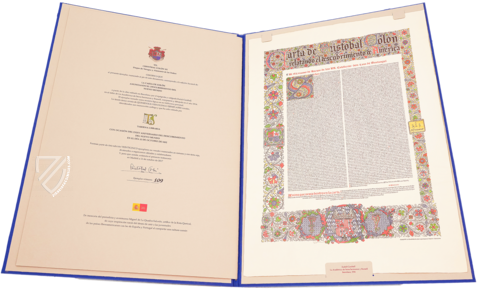
Few printed texts transformed Europe’s image of the world as swiftly as Christopher Columbus’s Letter on the Discovery of the New World. Following his first Atlantic voyage, Columbus describes islands he still believed to belong to Asia: their luxuriant vegetation, secure harbors, broad rivers, and supposed riches in gold, but also their inhabitants, whose openness he interpreted through a colonial lens as an opportunity for conversion and domination. This Latin edition, comprising only eight pages, carried news of the voyage across Europe. Leandro di Cosco translated the Spanish account, and Stephan Plannck printed it in Rome shortly after 29 April 1493. The Florentine copy belongs to the corrected issue, whose preamble names Isabella alongside Ferdinand. Travel narrative, political persuasion, and world-changing news converge in one of the most significant early printed witnesses to European expansion into the Americas.
News That Changed the Image of the World
When Christopher Columbus returned from his first Atlantic voyage in the spring of 1493, he carried news that would fundamentally alter Europe’s geographical imagination. His concise report described islands beyond the ocean that he believed to be the “Indies beyond the Ganges.” The letter became the first printed account of the European arrival in the Caribbean and an early media event in the history of printing.
A Spanish edition appeared in Barcelona in April 1493. Soon afterward, Leandro di Cosco translated the text into Latin, the international language of learned readers and courts. After 29 April, Stephan Plannck printed the eight-page epistle in Rome, allowing the news to travel rapidly across political and linguistic borders.
Islands of Overwhelming Fertility
Columbus begins with the success of his voyage: after thirty-three days, he claims to have reached numerous inhabited islands and taken possession of them for the Spanish Crown. He describes Juana, now Cuba, and devotes particular attention to Hispaniola. Expansive coastlines, secure harbors, broad rivers, lofty mountains, and evergreen trees form an image of almost limitless fertility.
These passages are more than detached observations. Columbus constructs an alluring panorama of land, resources, and future opportunity, designed to emphasize his achievement and secure support for further ventures. Gold, spices, and other riches appear partly as things observed and partly as expectation or hearsay.
Encounter, Appropriation, and Mission
The inhabitants of the islands occupy a central place in the account. Columbus portrays them as peaceful, generous, and lightly armed. Yet he interprets their willingness to trade and their hospitality from the perspective of a European conqueror: as evidence that they could be easily dominated and converted to Christianity.
The letter therefore possesses a double historical significance. It preserves one of the earliest European reports concerning the Taíno while also exposing the assumptions, claims, and structures of power with which colonial expansion began. The taking of territory, the seizure of Indigenous people, missionary ambition, and economic exploitation already stand side by side.
A Letter as Political Persuasion
The Latin printing is explicitly addressed to Gabriel Sánchez, treasurer of the Crown of Aragon, although the epistle was intended for a much wider audience. It publicized the voyage’s success, celebrated royal patronage, and helped prepare the ground for a second expedition.
Plannck’s first issue named only Ferdinand in its preamble. A corrected issue quickly followed, adding Isabella. The copy in the Biblioteca Riccardiana belongs to this second, politically corrected edition. The seemingly small alteration reveals how carefully the voyage was presented as the shared triumph of the royal couple.
Eight Pages of World-Historical Consequence
Rather than narrating the voyage in detail, Columbus concentrates on discoveries, landscapes, inhabitants, and anticipated riches. Personal danger and failure recede; success, possession, and future promise dominate the tone. A travel report is transformed into a brilliantly compressed public message.
The Florentine copy also has an extraordinary modern history. It was stolen from the Biblioteca Riccardiana and replaced by a sophisticated forgery before the original was identified in the United States and returned to Italy in 2016. Its recovery underscores the rarity and exceptional importance of this modest-looking yet world-changing incunable.
Codicology
- Alternative Titles
- Christoph Kolumbus' Brief über die Entdeckung der Neuen Welt
Grande Viaggio di Cristoforo Colombo - Type
- Print on paper
- Size / Format
- 8 pages / 14.5 × 19.0 cm
- Origin
- Italy
- Date
- 1493
- Epochs
- Style
- Language
- Content
- Christopher Columbus' letter to Isabella I of Castile and Ferdinand II of Aragon about the “discovery” of the New World, translated into Latin
- Artist / School
- Stephan Plannck (printer)
#1 Grande Viaggio di Cristoforo Colombo
Language: Italian
(under 1,000€)
- Block Books / Incunables / Post-incunables
- Alchemy
- Apocalypses / Beatus Manuscripts
- Astronomy / Astrology
- Bibles / Gospels
- Picture Bibles / Bibles Moralisées / Mirror of Human Salvation
- Botany
- Chronicles / History / Letters
- Cookbook / Recipes
- Diaries / Biographies / Autograph Books
- Encyclopedias
- Fashion / Costume Books
- Games / Game Theory
- Geography / Cartography / Navigation
- Graduals / Antiphonaries / Exultet Roll
- Haggadot
- Hunting Books
- Law / Deeds / Rules
- Leonardo da Vinci
- Literature / Poetry
- Medicine
- Missals / Lectionaries / Sacramentaries
- Model Books / Sketchbooks / Notebooks
- Music
- Mythology
- Natural History / Bestiaries
- Other Liturgical Manuscripts
- Other Religious Works
- Other Secular Works
- Paintings / Graphics
- Primers / Textbooks
- Private Devotion Books
- Prophecies / Divination
- Psalters
- Quran
- Saints' Lives
- Sermons / Homilies
- Single Leaf Collections
- Song Books
- Tanakh
- Tournament Books / Armorials / Genealogy
- Travelogues / Travel Guides
- Treatises
- Afghanistan
- Algeria
- Armenia
- Austria
- Azerbaijan
- Belarus
- Belgium
- Belize
- Bosnia and Herzegovina
- China
- Colombia
- Costa Rica
- Croatia
- Cyprus
- Czech Republic
- Denmark
- Egypt
- El Salvador
- Ethiopia
- France
- Germany
- Greece
- Guatemala
- Honduras
- Hungary
- India
- Iran
- Iraq
- Israel
- Italy
- Japan
- Jordan
- Kazakhstan
- Kyrgyzstan
- Lebanon
- Libya
- Liechtenstein
- Luxembourg
- Mexico
- Morocco
- Netherlands
- Palestine
- Panama
- Peru
- Poland
- Portugal
- Romania
- Russia
- Serbia
- Slovakia
- Spain
- Sri Lanka
- Sweden
- Switzerland
- Syria
- Tajikistan
- Tunisia
- Turkey
- Turkmenistan
- Ukraine
- United Kingdom
- United States
- Uzbekistan
- Vatican City
- A. Oosthoek, van Holkema & Warendorf
- Aboca Museum
- Ajuntament de Valencia
- Akademie Verlag
- Akademische Druck- u. Verlagsanstalt (ADEVA)
- Aldo Ausilio Editore - Bottega d’Erasmo
- Alecto Historical Editions
- Alkuin Verlag
- Almqvist & Wiksell
- Amilcare Pizzi
- Andreas & Andreas Verlagsbuchhandlung
- Archa 90
- Archiv Verlag
- Archivi Edizioni
- Arnold Verlag
- ARS
- Ars Magna
- Ars Millenii
- Art Market
- ArtCodex
- AyN Ediciones
- Azimuth Editions
- Badenia Verlag
- Bärenreiter-Verlag
- Belser Verlag
- Belser Verlag / WK Wertkontor
- Benziger Verlag
- Bernardinum Wydawnictwo
- BiblioGemma
- Biblioteca Apostolica Vaticana (Vaticanstadt, Vaticanstadt)
- Bibliotheca Palatina Faksimile Verlag
- Bibliotheca Rara
- Boydell & Brewer
- Bramante Edizioni
- Bredius Genootschap
- Brepols Publishers
- British Library
- Brokarte
- C. Weckesser
- Caixa Catalunya
- Canesi
- CAPSA, Ars Scriptoria
- Caratzas Brothers, Publishers
- Carus Verlag
- Casamassima Libri
- Centrum Cartographie Verlag GmbH
- Chavane Verlag
- Christian Brandstätter Verlag
- Circulo Cientifico
- Club Bibliófilo Versol
- Club du Livre
- Club Internacional del Libro
- CM Editores
- Collegium Graphicum
- Collezione Apocrifa Da Vinci
- Comissão Nacional para as Comemorações dos Descobrimentos Portugueses
- Coron Verlag
- Corvina
- CTHS
- D. S. Brewer
- Damon
- De Agostini/UTET
- De Nederlandsche Boekhandel
- De Schutter
- Deuschle & Stemmle
- Deutscher Verlag für Kunstwissenschaft
- DIAMM
- Dropmore Press
- Droz
- E. Schreiber Graphische Kunstanstalten
- Ediciones Boreal
- Ediciones Grial
- Ediclube
- Edições Inapa
- Edilan
- Editalia
- Edition Deuschle
- Edition Georg Popp
- Edition Leipzig
- Edition Libri Illustri
- Editiones Reales Sitios S. L.
- Éditions de l'Oiseau Lyre
- Editions Medicina Rara
- Editorial Base
- Editorial Casariego
- Editorial Mintzoa
- Editrice Antenore
- Editrice Velar
- Edizioni Edison
- Egeria, S.L.
- Eikon Editores
- Electa
- Emery Walker Limited
- Enciclopèdia Catalana
- Eos-Verlag
- Ephesus Publishing
- Ernst Battenberg
- Eugrammia Press
- Extraordinary Editions
- Fackelverlag
- Facsimila Art & Edition
- Facsimile Editions Ltd.
- Facsimilia Art & Edition Ebert KG
- Faksimile Verlag
- Feuermann Verlag
- Folger Shakespeare Library
- Franco Cosimo Panini Editore
- Friedrich Wittig Verlag
- Fundación Hullera Vasco-Leonesa
- G. Braziller
- Gabriele Mazzotta Editore
- Gebr. Mann Verlag
- Gesellschaft für graphische Industrie
- Getty Research Institute
- Giovanni Domenico de Rossi
- Giunti Editore
- Goldenmark Librarium
- Graffiti
- Grafica European Center of Fine Arts
- Guido Pressler
- Guillermo Blazquez
- Gustav Kiepenheuer
- H. N. Abrams
- Harrassowitz
- Harvard University Press
- Helikon
- Hendrickson Publishers
- Henning Oppermann
- Herder Verlag
- Hes & De Graaf Publishers
- Hoepli
- Holbein-Verlag
- Houghton Library
- Hugo Schmidt Verlag
- Hungarian Academy of Sciences
- Idion Verlag
- Il Bulino, edizioni d'arte
- ILte
- Imago
- In Officina Danesi
- Insel Verlag
- Instituto de Estudios Altoaragoneses
- Instituto Nacional de Antropología e Historia
- Introligatornia Budnik Jerzy
- Istituto dell'Enciclopedia Italiana - Treccani
- Istituto Ellenico di Studi Bizantini e Postbizantini
- Istituto Geografico De Agostini
- Istituto Poligrafico e Zecca dello Stato
- Italarte Art Establishments
- Jaca Book
- Jan Thorbecke Verlag
- Johnson Reprint Corporation
- Johnson Reprint Corporation
- Jos. Baer
- Josef Stocker
- Josef Stocker-Schmid
- Jugoslavija
- Karl W. Hiersemann
- Kasper Straube
- Kaydeda Ediciones
- Kindler Verlag / Coron Verlag
- Kodansha International Ltd.
- Konrad Kölbl Verlag
- Kurt Wolff Verlag
- La Linea Editrice
- La Meta Editore
- Lambert Schneider
- Landeskreditbank Baden-Württemberg
- Leo S. Olschki
- Les Incunables
- Liber Artis
- Library of Congress
- Libreria Musicale Italiana
- Lichtdruck
- Lito Immagine Editore
- Lumen Artis
- Lund Humphries
- M. Moleiro Editor
- Maison des Sciences de l'homme et de la société de Poitiers
- Manuscriptum
- Martinus Nijhoff
- Maruzen-Yushodo Co. Ltd.
- MASA
- Massada Publishers
- McGraw-Hill
- Metropolitan Museum of Art
- Militos
- Millennium Liber
- Müller & Schindler
- Nahar - Stavit
- Nahar and Steimatzky
- National Library of Wales
- Neri Pozza
- Nova Charta
- Oceanum Verlag
- Odeon
- Omnia Arte
- Orbis Mediaevalis
- Orbis Pictus
- Österreichische Staatsdruckerei
- Oxford University Press
- Pageant Books
- Parzellers Buchverlag
- Patrimonio Ediciones
- Pattloch Verlag
- PIAF
- Plon-Nourrit et cie
- Poligrafiche Bolis
- Presses Universitaires de Strasbourg
- Prestel Verlag
- Princeton University Press
- Prisma Verlag
- Priuli & Verlucca, editori
- Pro Sport Verlag
- Propyläen Verlag
- Pytheas Books
- Quaternio Verlag Luzern
- Reales Sitios
- Recht-Verlag
- Reichert Verlag
- Reichsdruckerei
- Reprint Verlag
- Riehn & Reusch
- Rizzoli
- Roberto Vattori Editore
- Rosenkilde and Bagger
- Roto-Sadag
- Roxburghe Club
- Salerno Editrice
- Saltellus Press
- Sandoz
- Sarajevo Svjetlost
- Schöck ArtPrint Kft.
- Schulsinger Brothers
- Scolar Press
- Scrinium
- Scripta Maneant
- Scriptorium
- Shazar
- Siloé, arte y bibliofilia
- SISMEL - Edizioni del Galluzzo
- Sociedad Mexicana de Antropología
- Société des Bibliophiles & Iconophiles de Belgique
- Soncin Publishing
- Sorli Ediciones
- Stainer and Bell
- Studer
- Styria Verlag
- Sumptibus Pragopress
- Szegedi Tudomànyegyetem
- Taberna Libraria
- Tarshish Books
- Taschen
- Tempus Libri
- Testimonio Compañía Editorial
- TGB Limited Editions
- Thames and Hudson
- The Clear Vue Publishing Partnership Limited
- The Facsimile Codex
- The Folio Society
- The Marquess of Normanby
- The Orphan Hospital Ward of Israel
- The Richard III and Yorkist History Trust
- The Warburg Institute
- Tip.Le.Co
- TouchArt
- TREC Publishing House
- TRI Publishing Co.
- Trident Editore
- Tuliba Collection
- Typis Regiae Officinae Polygraphicae
- Union Verlag Berlin
- Universidad de Granada
- Universitaire Bibliotheken Leiden
- University of California Press
- University of Chicago Press
- Urs Graf
- Vallecchi
- Van Wijnen
- VCH, Acta Humaniora
- VDI Verlag
- VEB Deutscher Verlag für Musik
- Verein Schweizerischer Lithographie-Besitzer
- Verlag Anton Pustet / Andreas Verlag
- Verlag Bibliophile Drucke Josef Stocker
- Verlag der Münchner Drucke
- Verlag für Regionalgeschichte
- Verlag Styria
- Vicent Garcia Editores
- W. Turnowsky
- Waanders Printers
- Wiener Mechitharisten-Congregation (Wien, Österreich)
- Wissenschaftliche Buchgesellschaft
- Wissenschaftliche Verlagsgesellschaft
- Wydawnictwo Dolnoslaskie
- Xuntanza Editorial
- Zakład Narodowy
- Zollikofer AG