
Vorau Picture Bible
Vienna area (Austria) — 1467
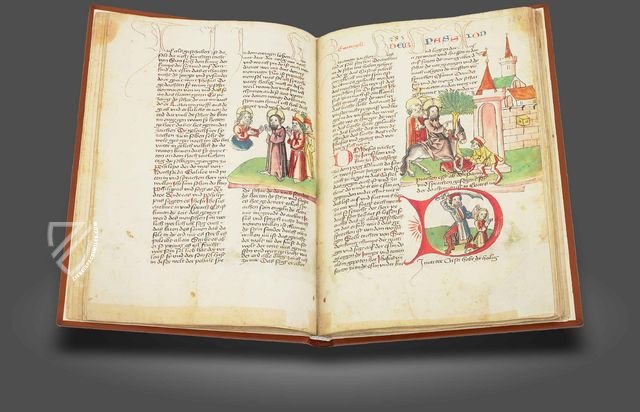
Created long before Luther and adorned with over 550 expressive miniatures: the stories of the Bible and world history united in a large Bible Historiale in German vernacular from 1467
A German vernacular Bible from long before Luther's translation of the Bible
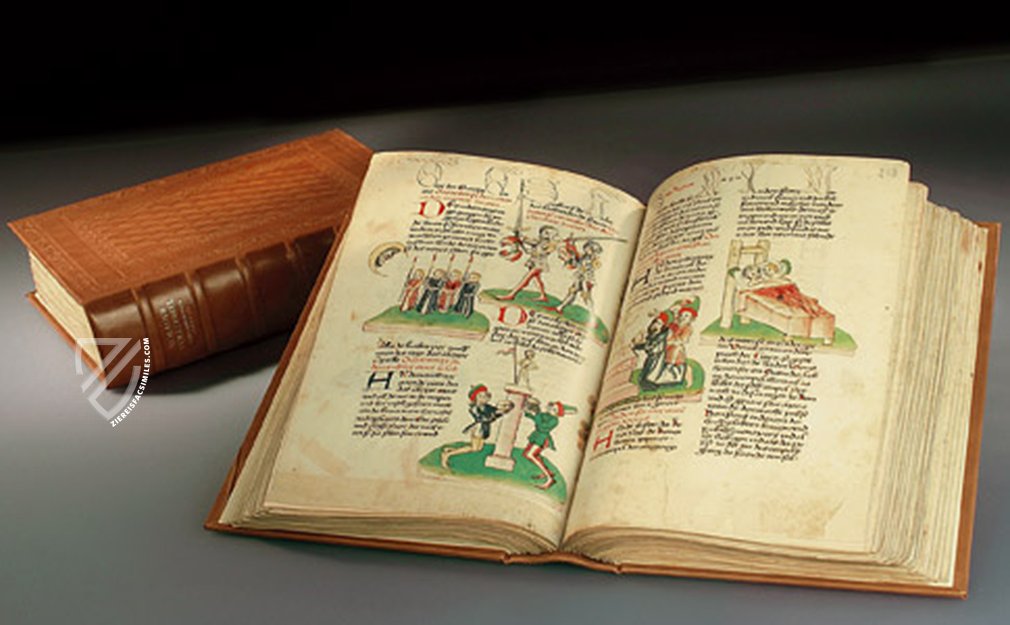
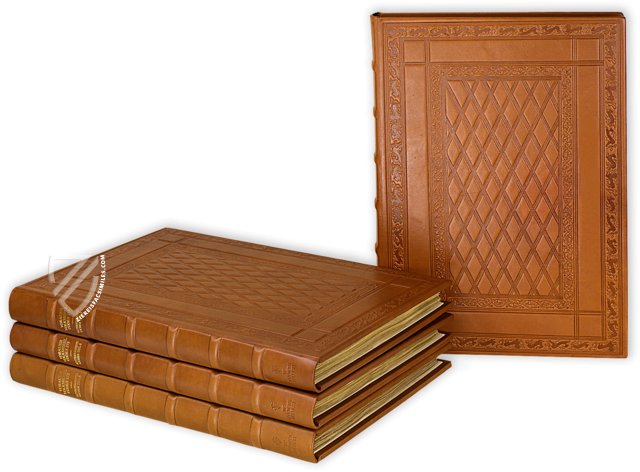
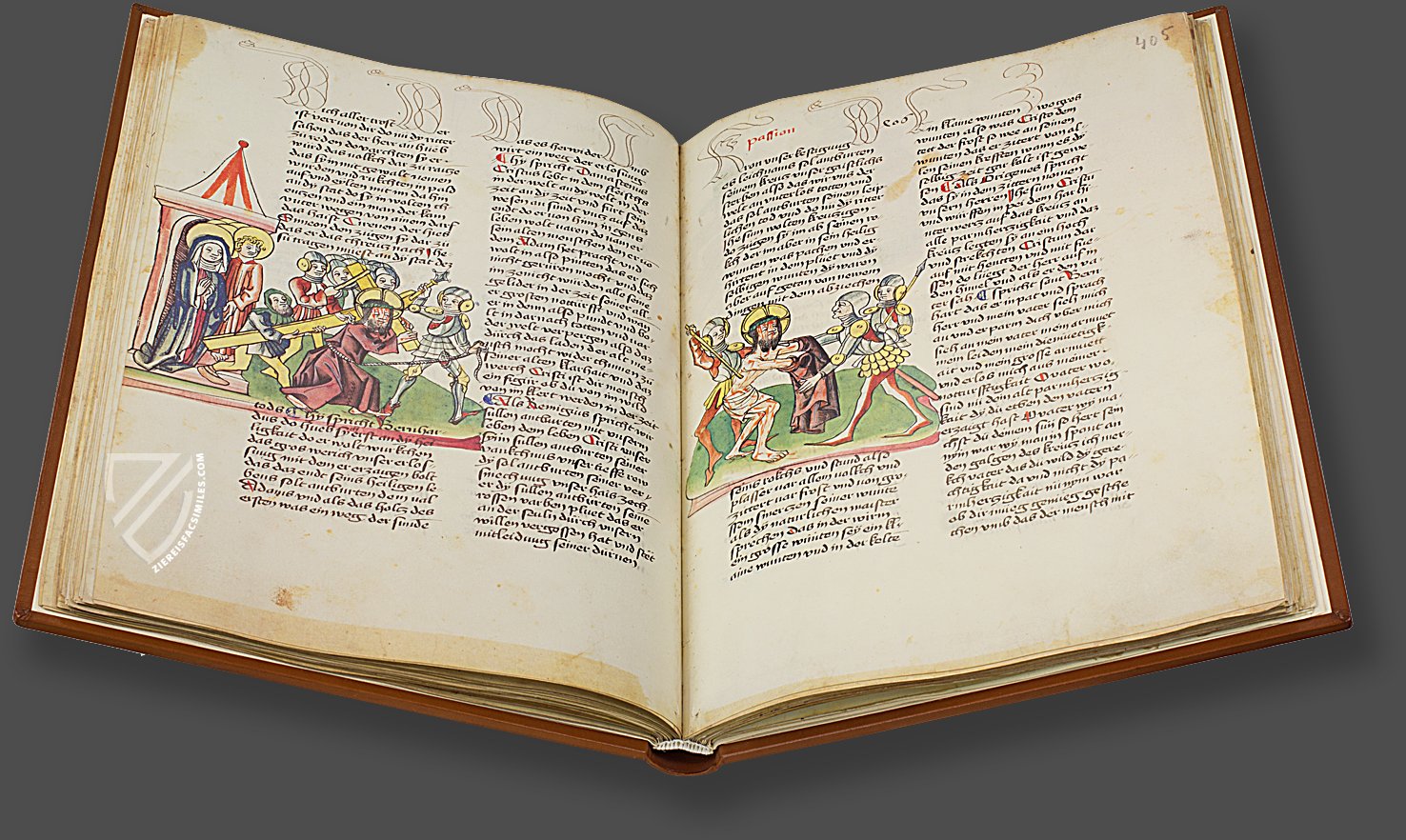
The four-volume work boasts 559 miniatures rendered skillfully in innovatively expressive watercolors
The figures of this popular Bible already have individual characteristics that were still lacking in contemporary "high art"
Vorau Picture Bible


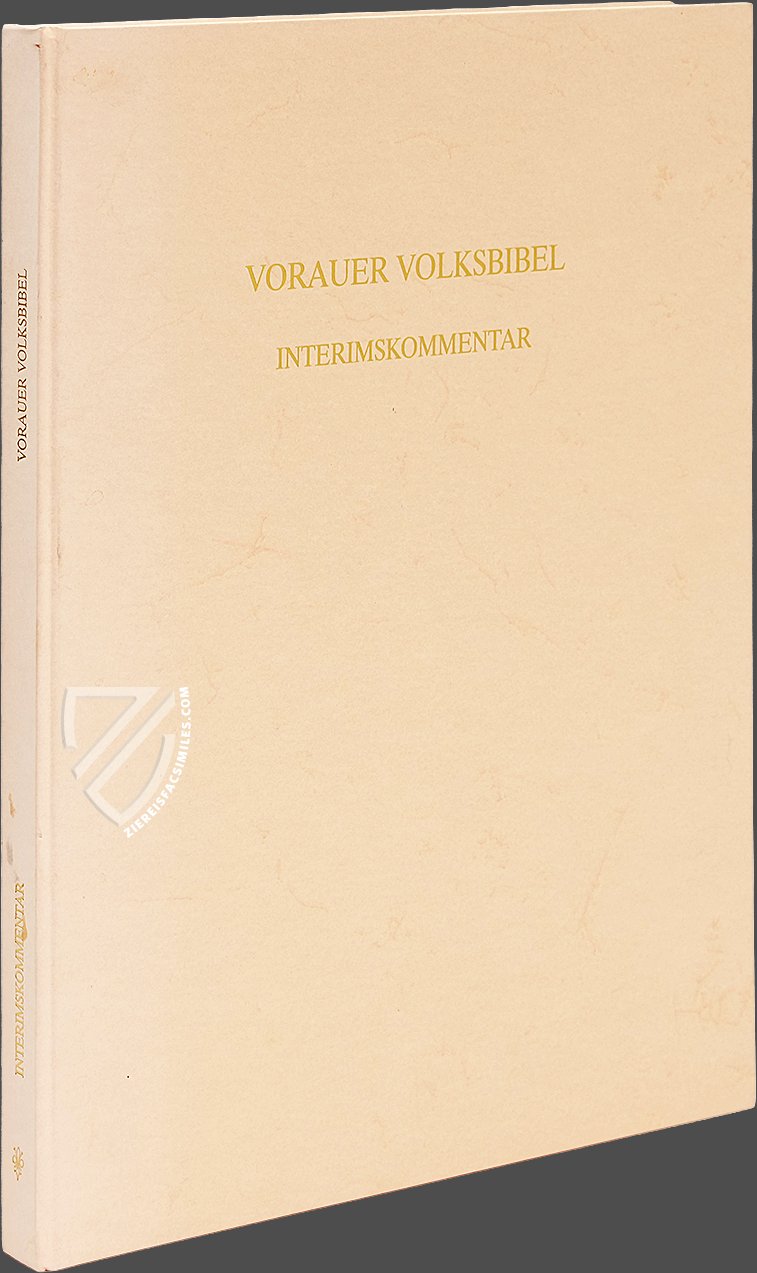
(3,000€ - 7,000€)
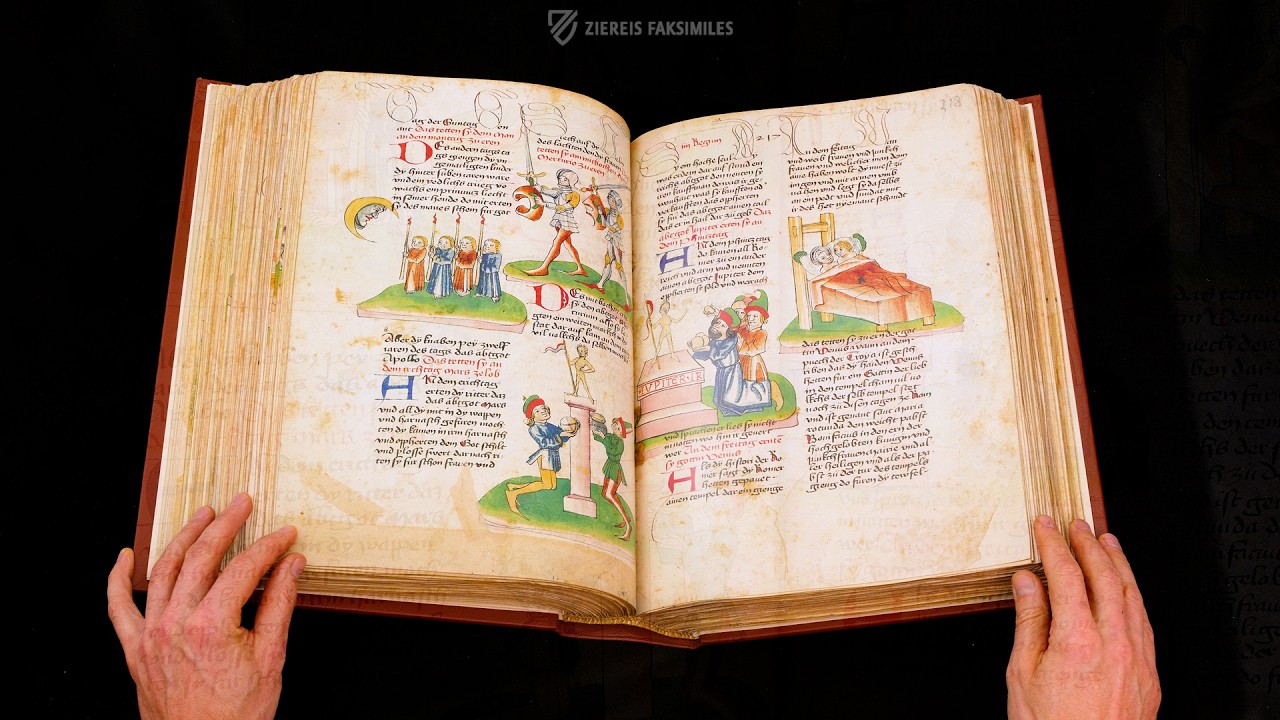
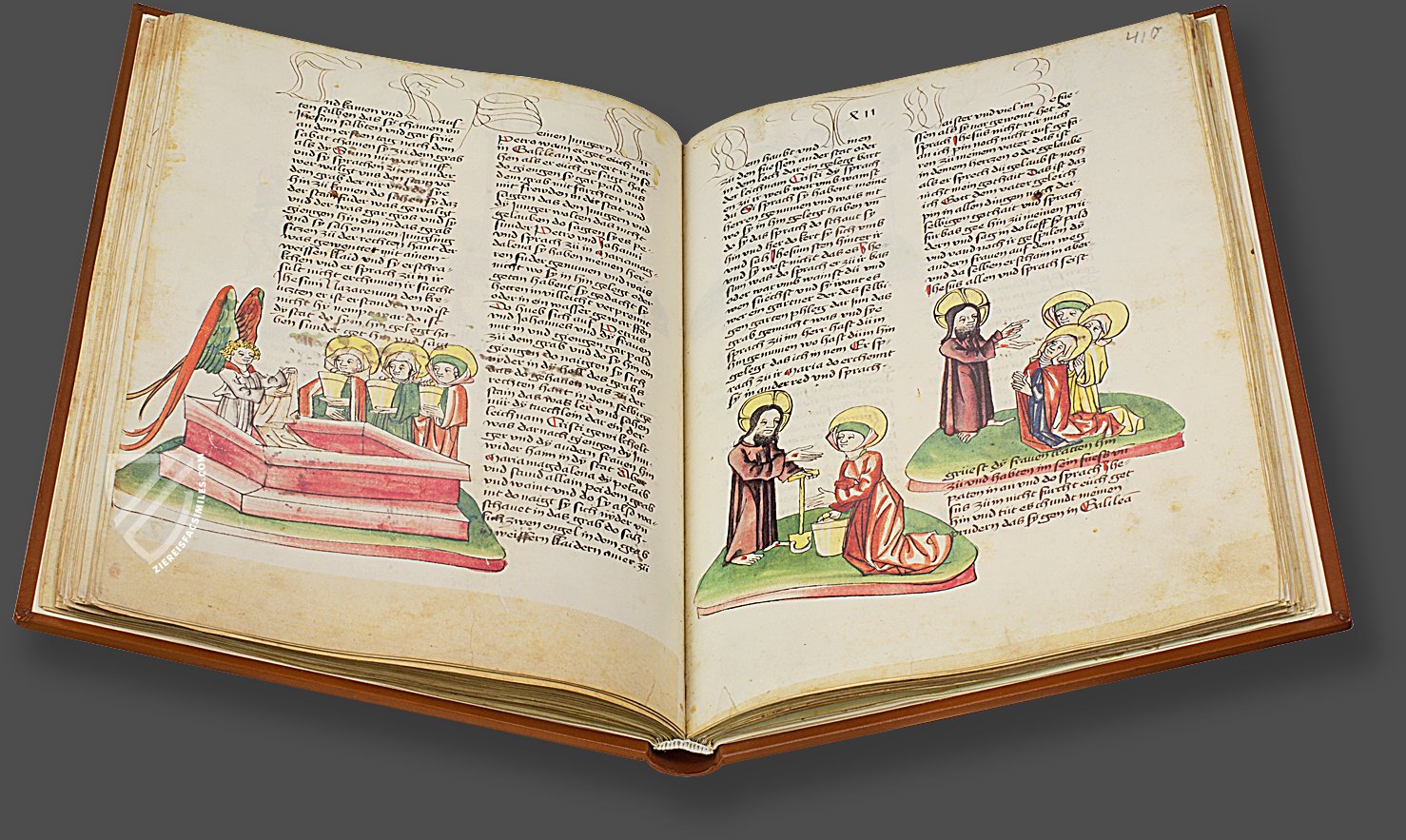
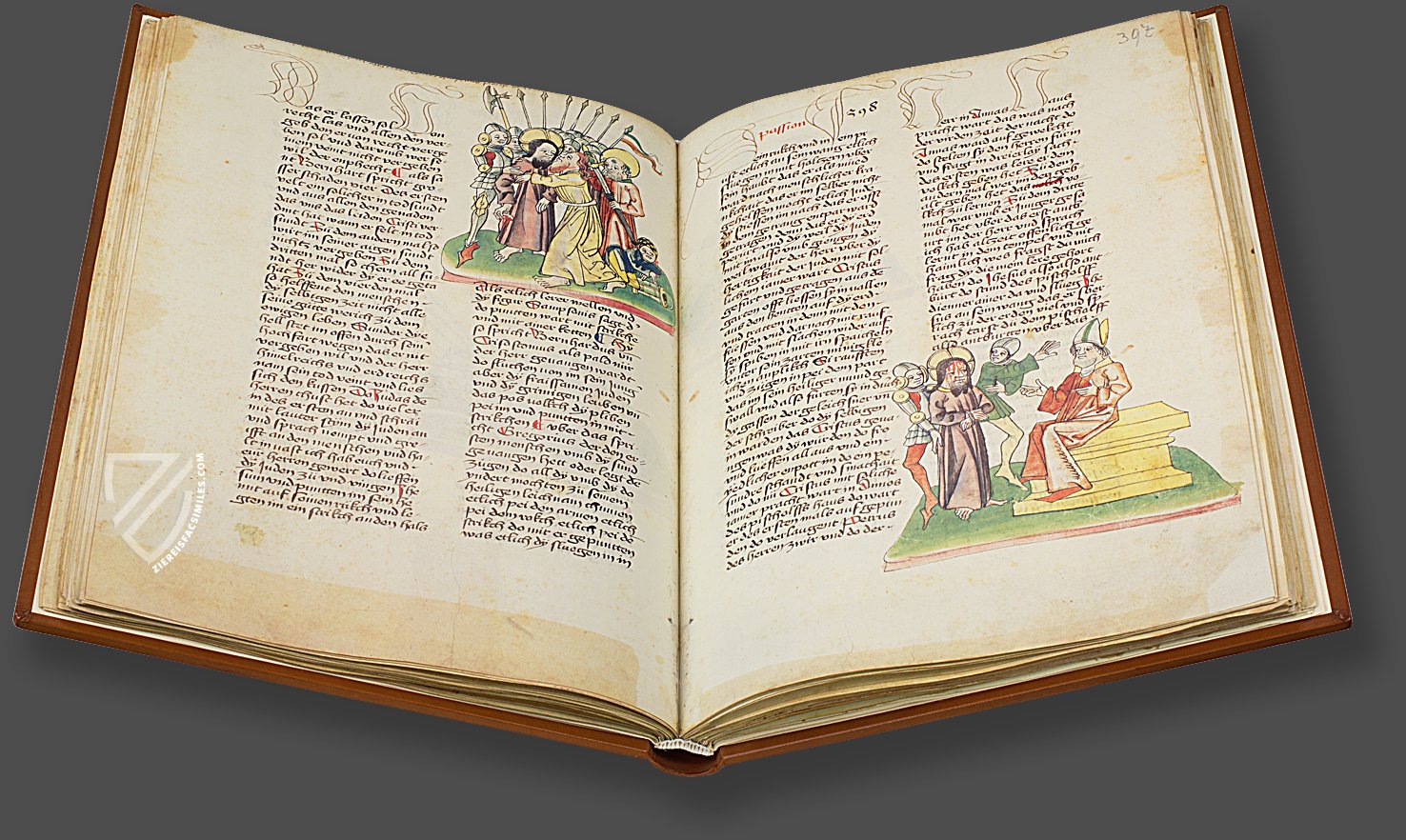
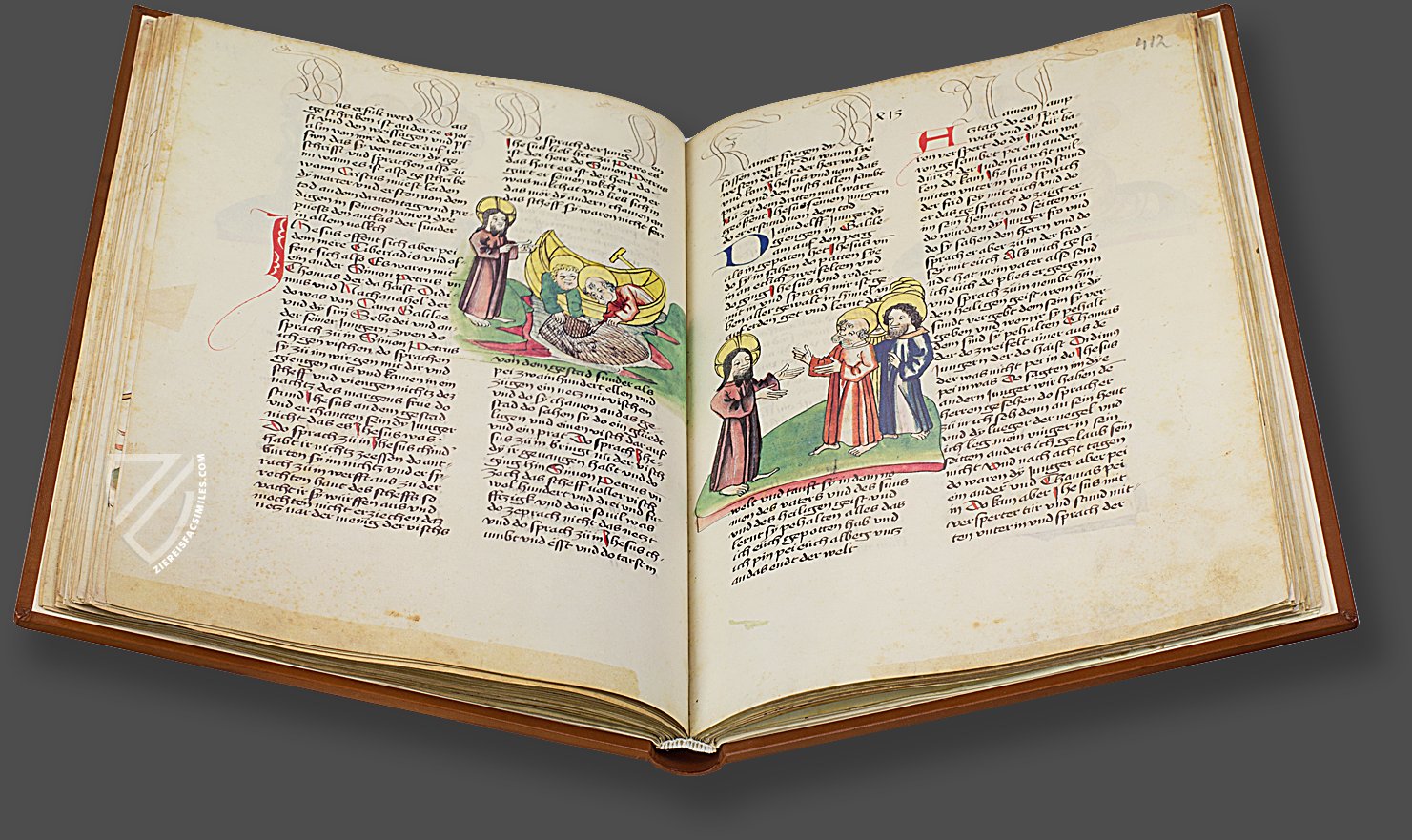
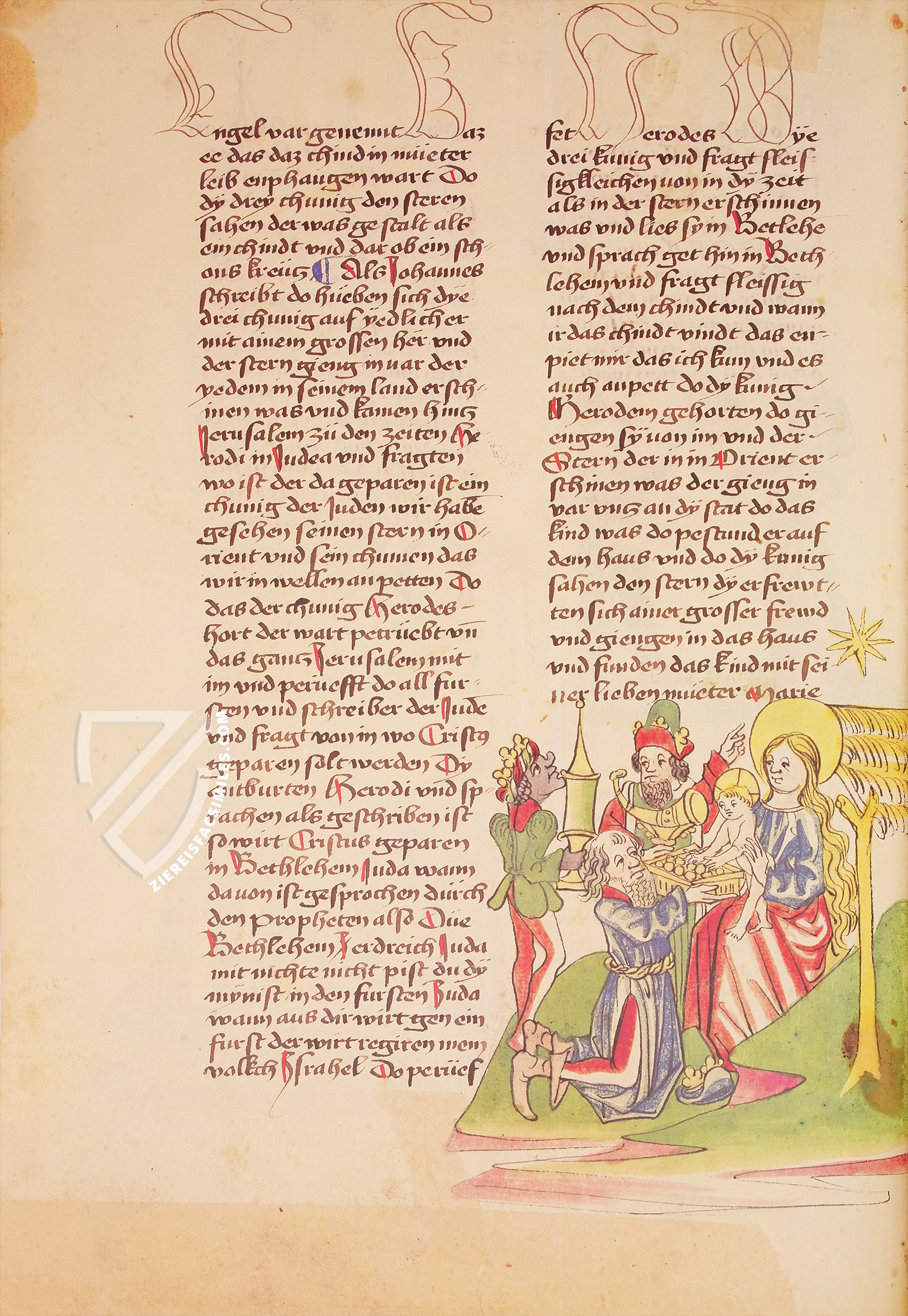
The late medieval development of the popular Bible enjoyed a great deal of freedom in the face of the diverse origins of its sources. popular Bibles combine biblical narratives with profane history and freely fill the gaps with apocryphal writings, legends, and secular historical works. The result is a Christian universal history from Creation to the Last Judgment, which served many generations as the only work of history they had. The Vorau Picture Bible is one of the most beautiful German popular Bibles: written in a Bavarian-Austrian dialect with an easily readable bastarda, it even records the day of its completion: the 31st of October 1467. Above all, however, it captivates with a total of 559 colorful miniatures, which served the medieval readers as summaries, illustrations, and interpretations of the texts. Today, they are an invaluable, vivid historical source for learning about the costumes and material culture of those days.
Vorau Picture Bible
The end of the Middle Ages was marked by major intellectual, social, and economic upheavals. These are also reflected in the manuscripts of that time, which are outstanding documents of cultural development.
In this context, popular Bibles – also known as historiated or story Bibles – occupy a special place. In these, the biblical narratives were expanded through profane historical and philosophical excursions into a kind of medieval universal history, which could range from the Creation to the Last Judgment. Where the biblical narrative had historical gaps, these were filled in with the help of apocryphal writings, legends, and secular historical works. They were also written in the language of the people and thus fulfilled the requirement for religious and educational edification, while at the same time serving as the only accessible “history book” for large sections of the population.
Outstanding Illumination
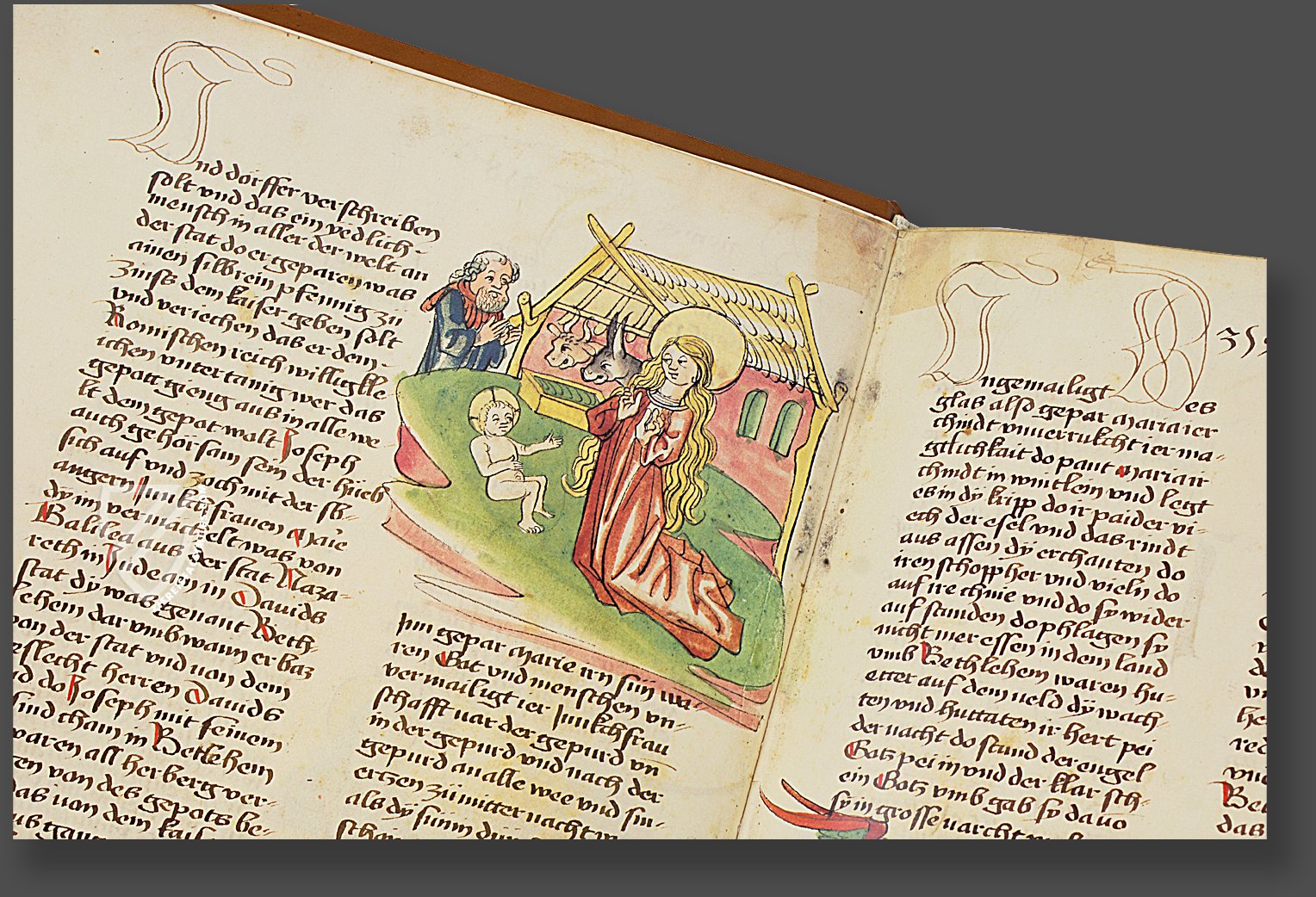
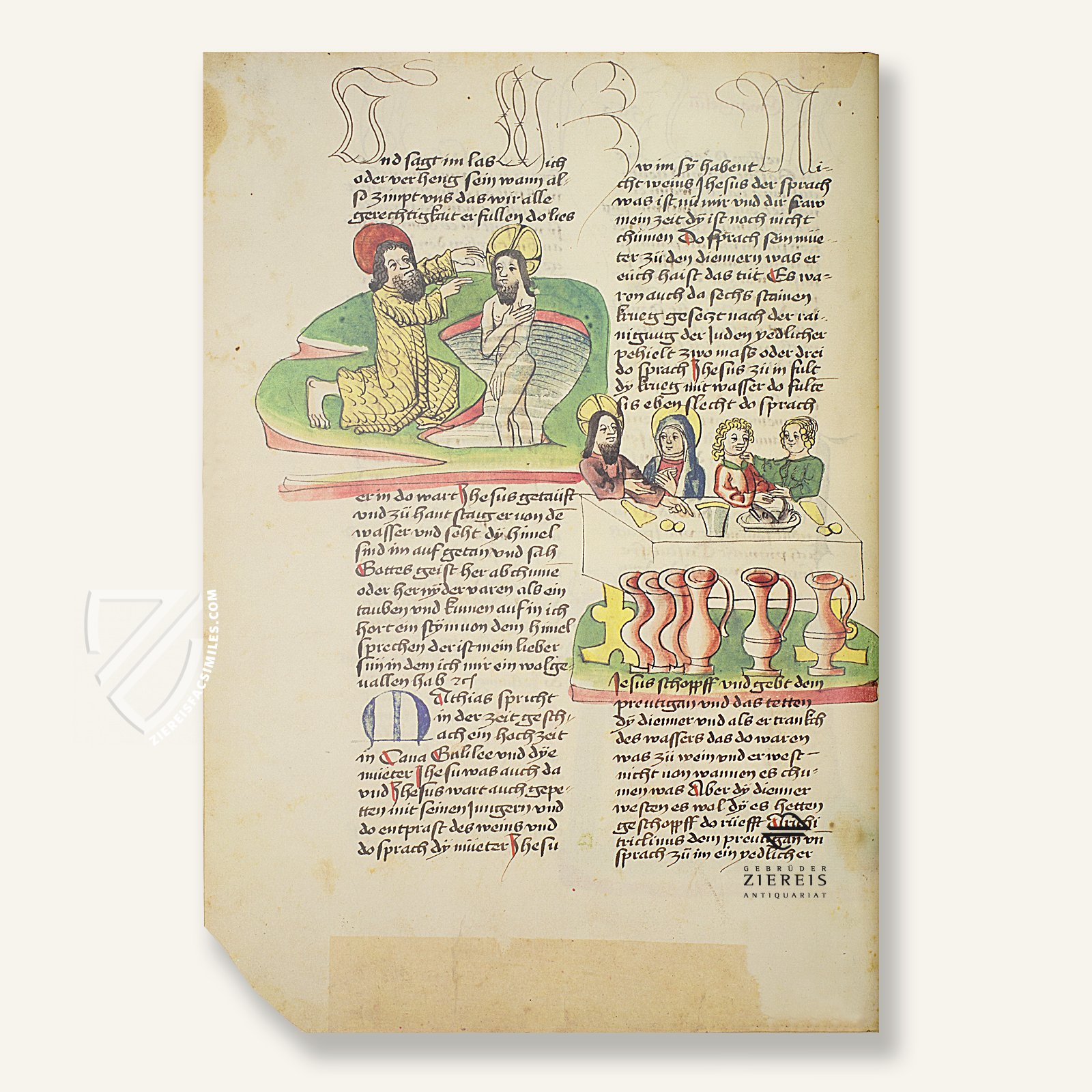
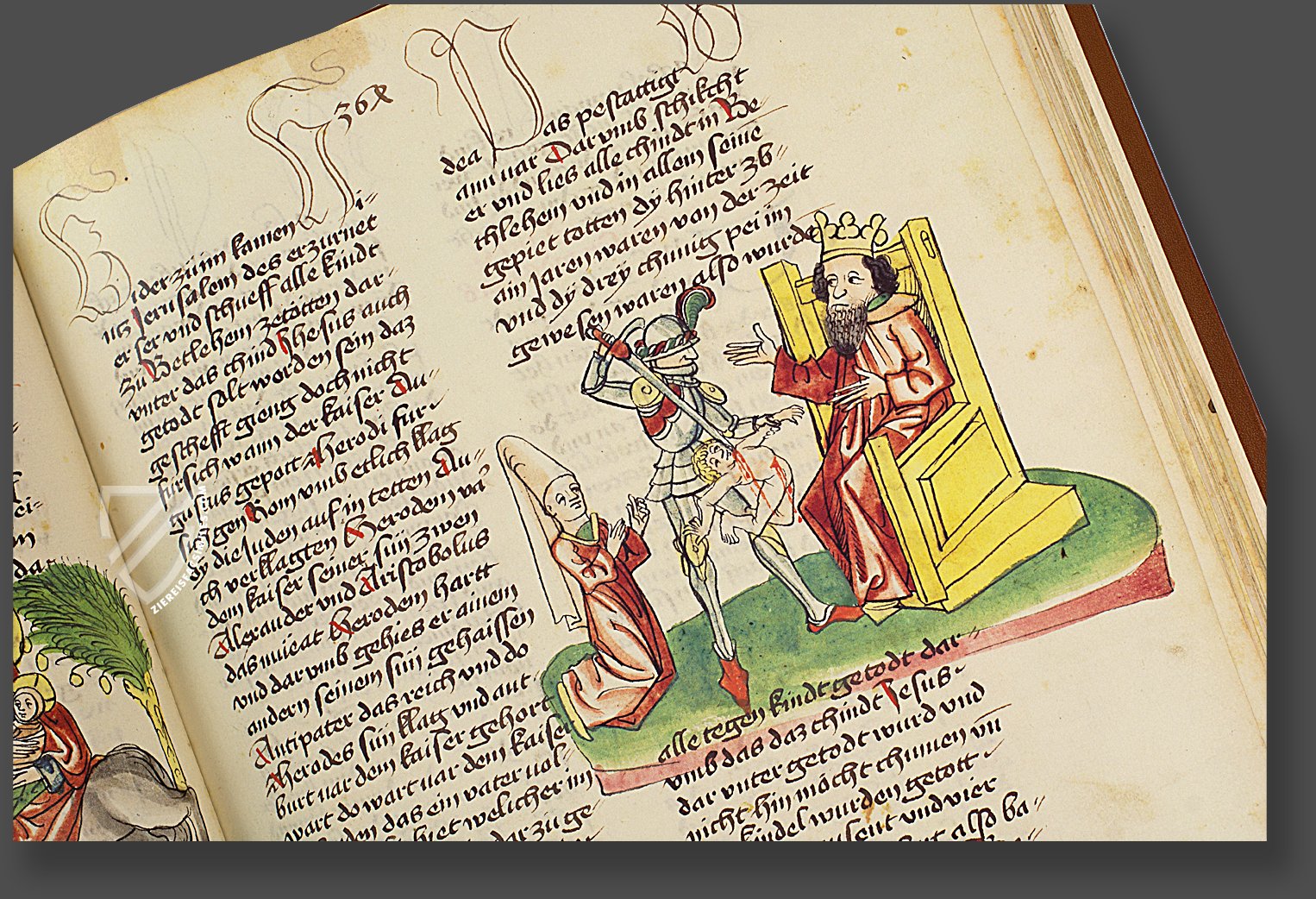
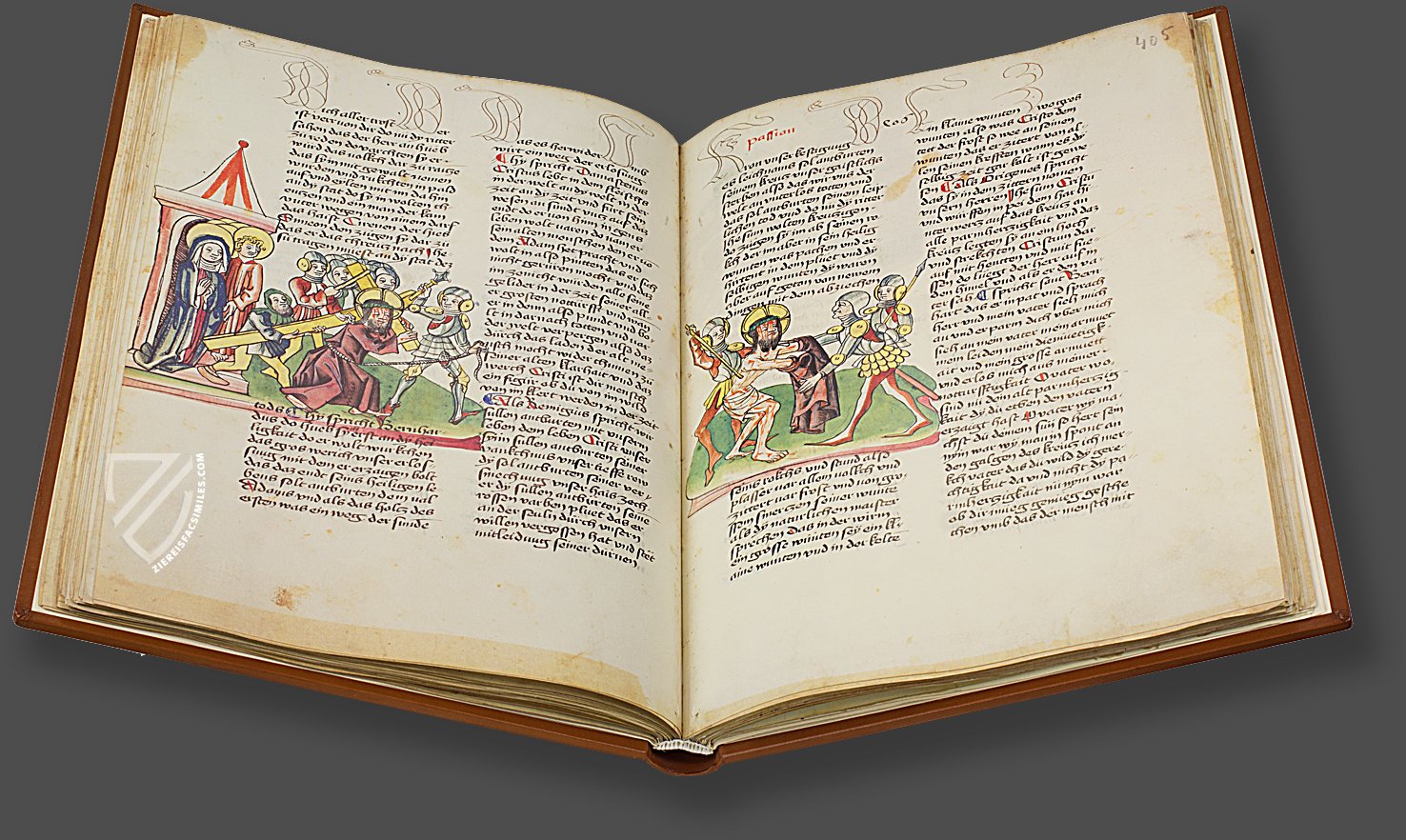
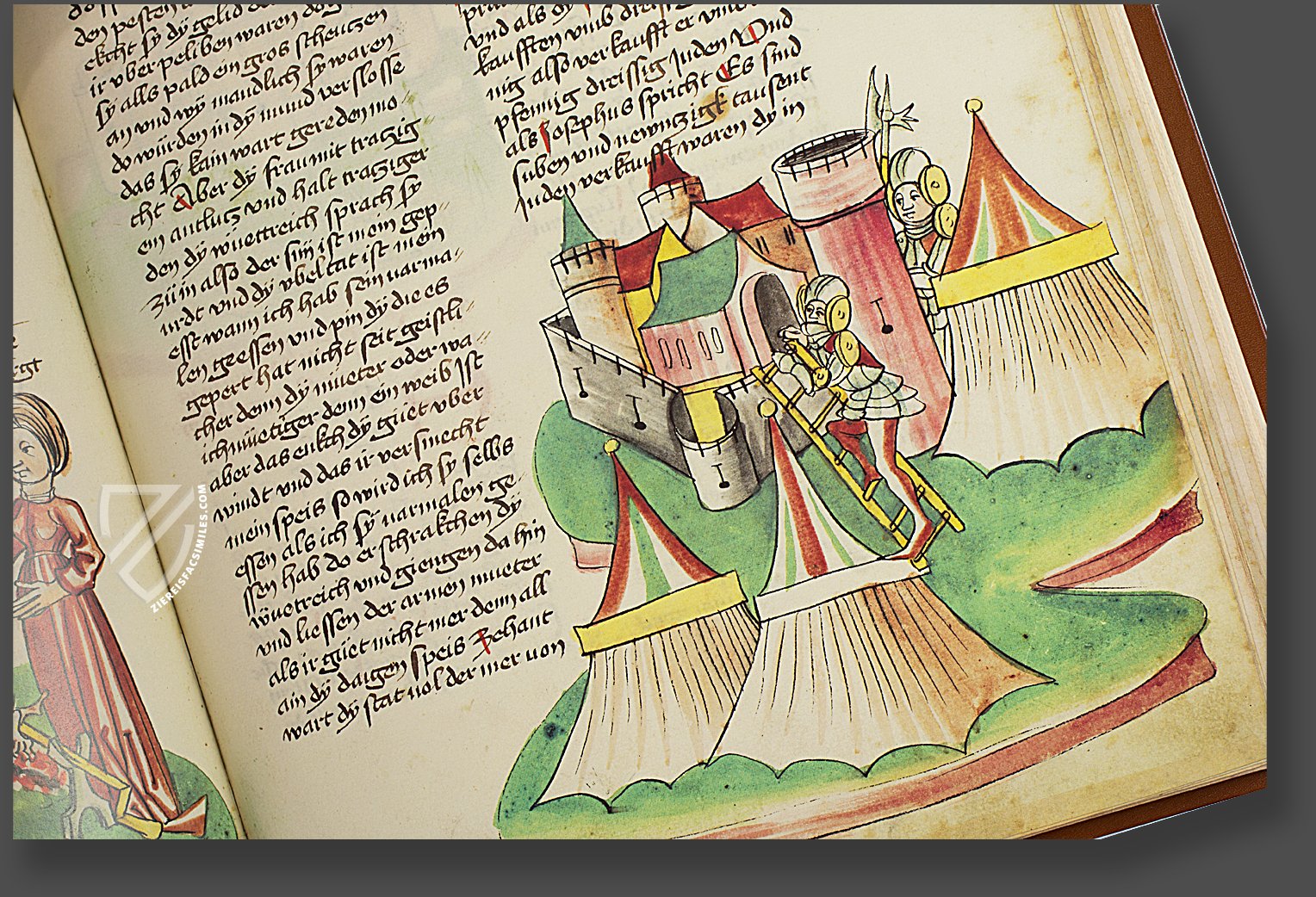
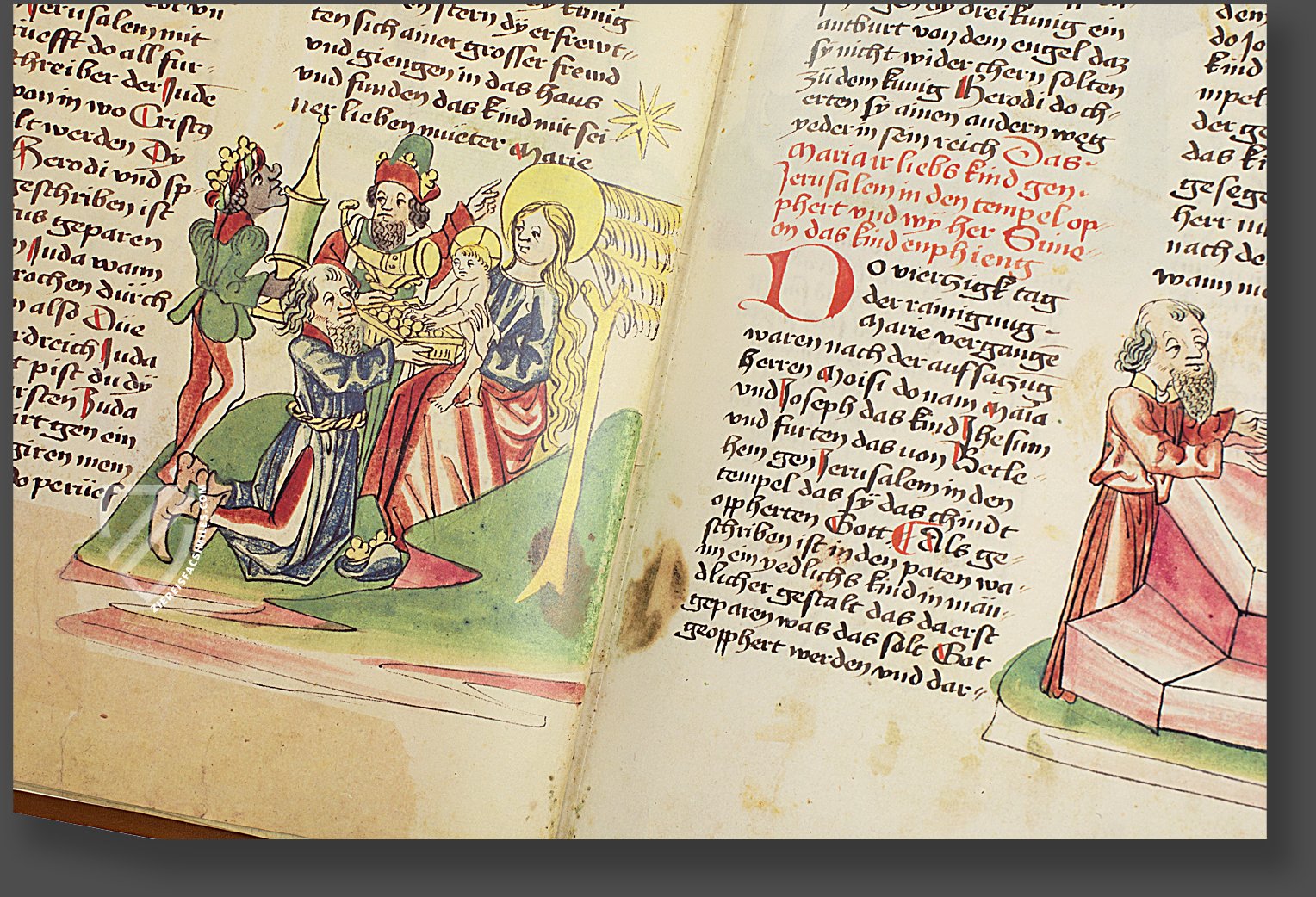
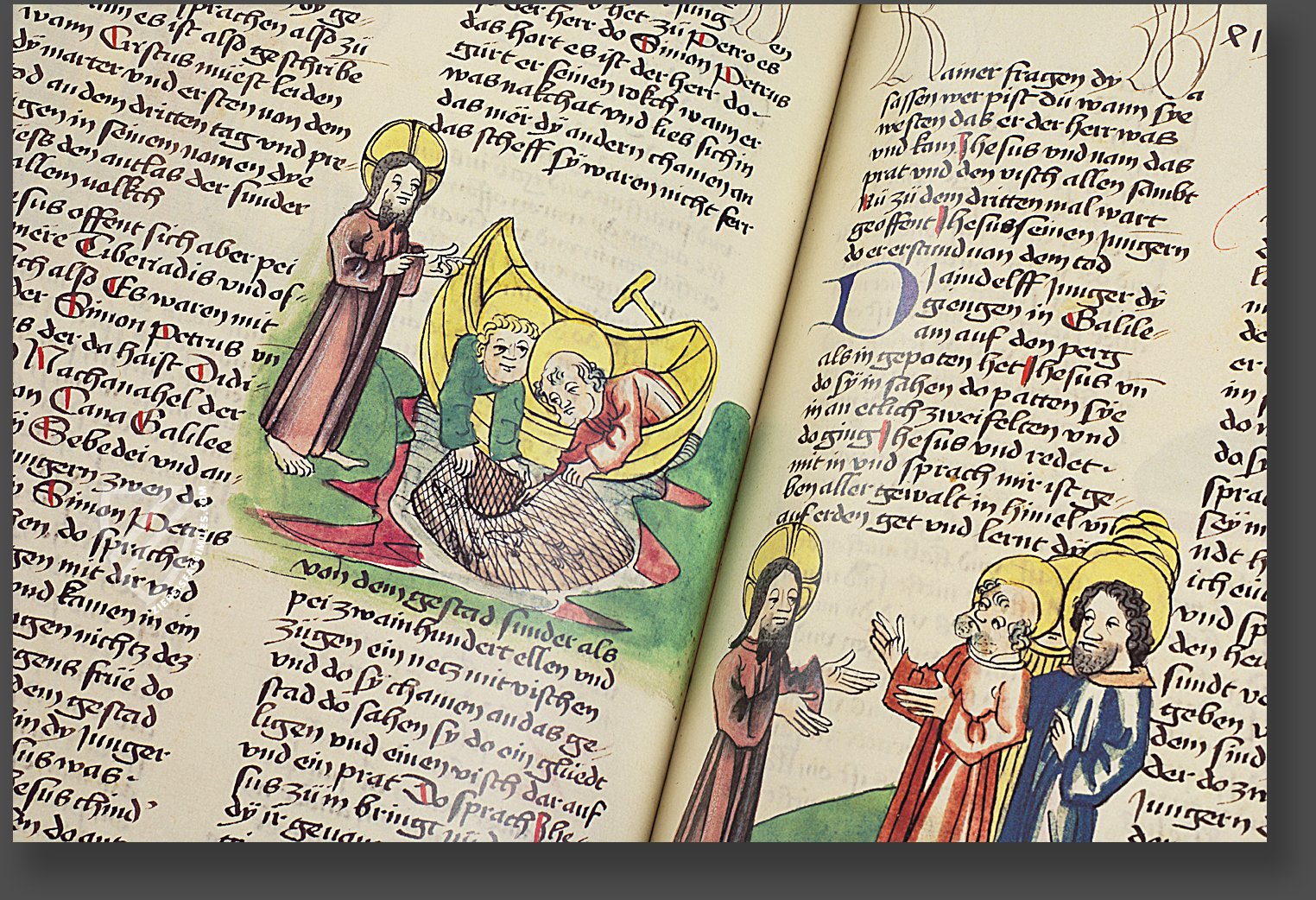
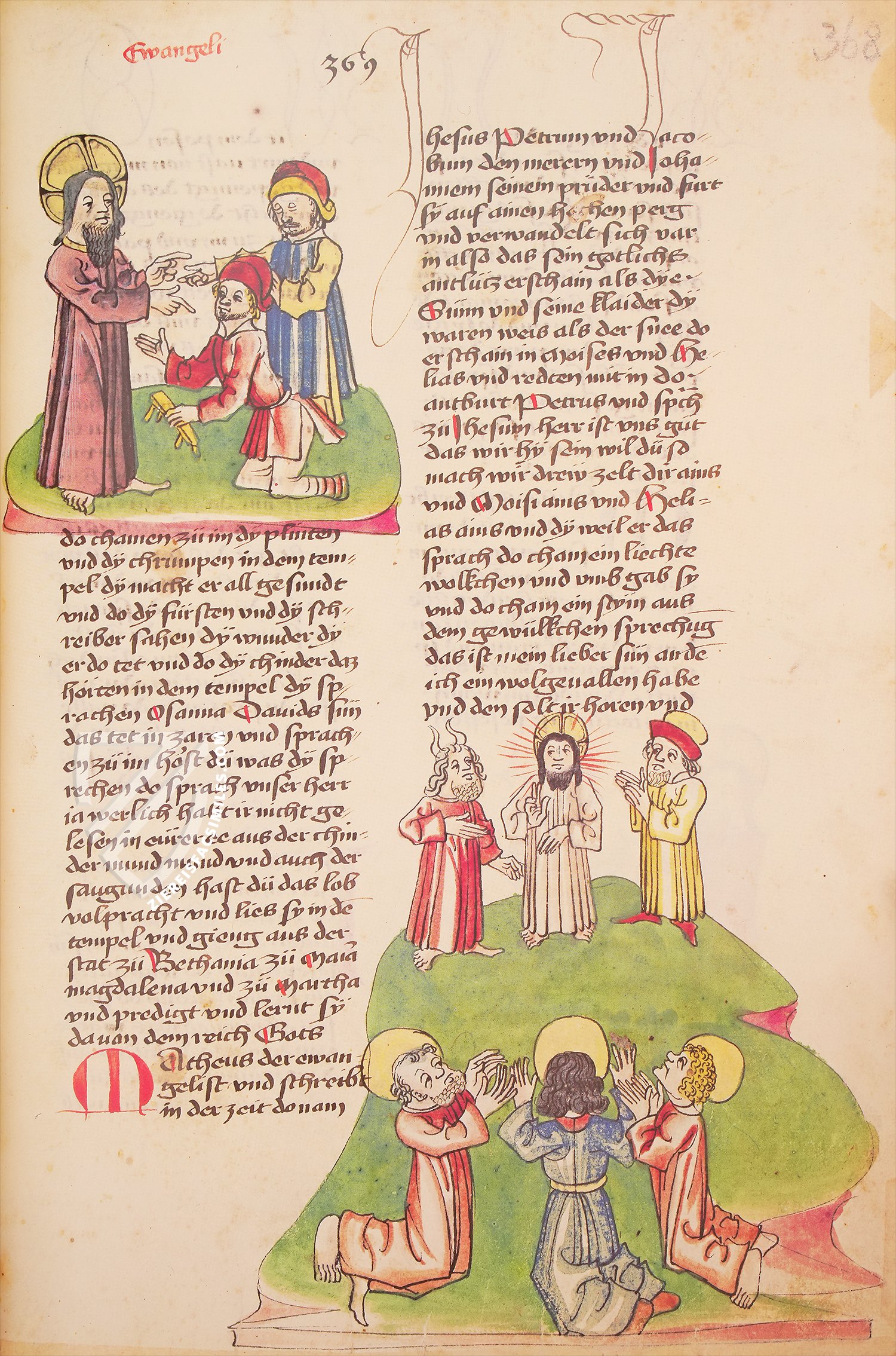
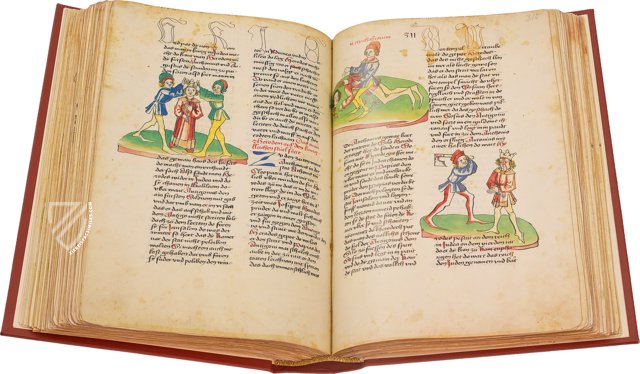
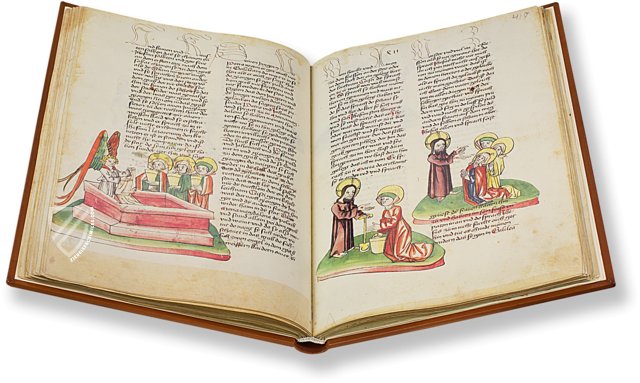
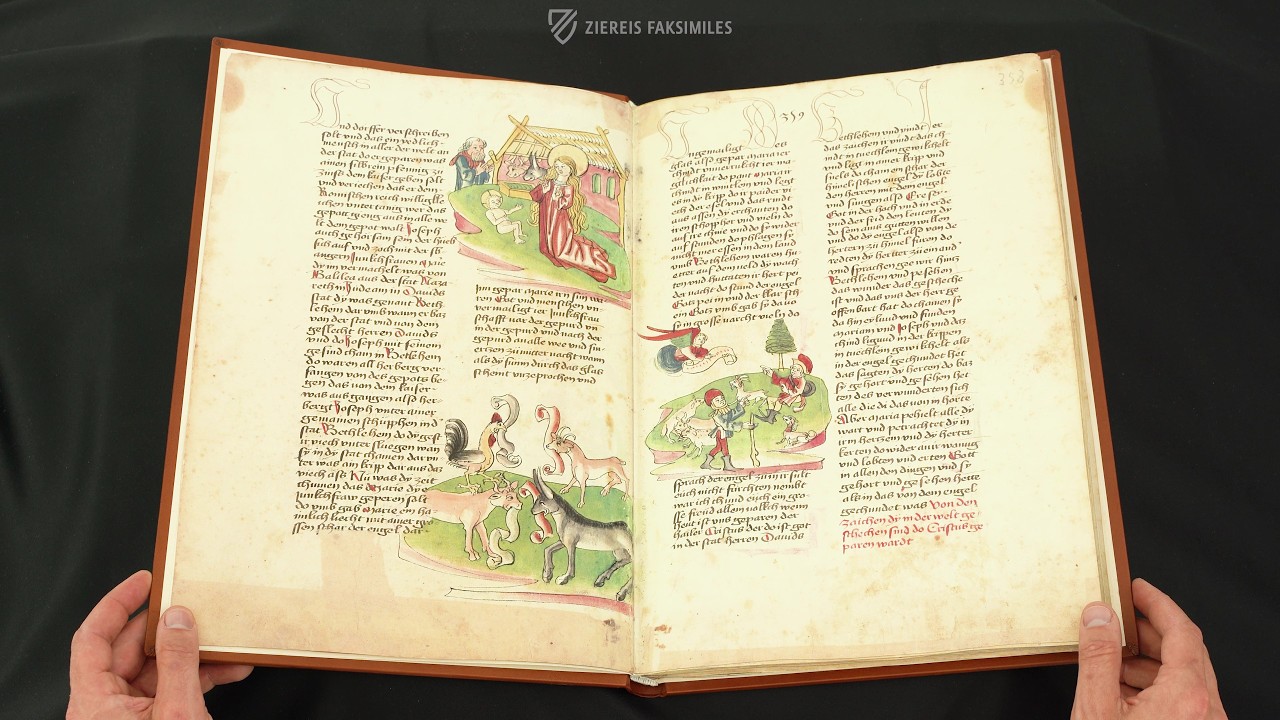
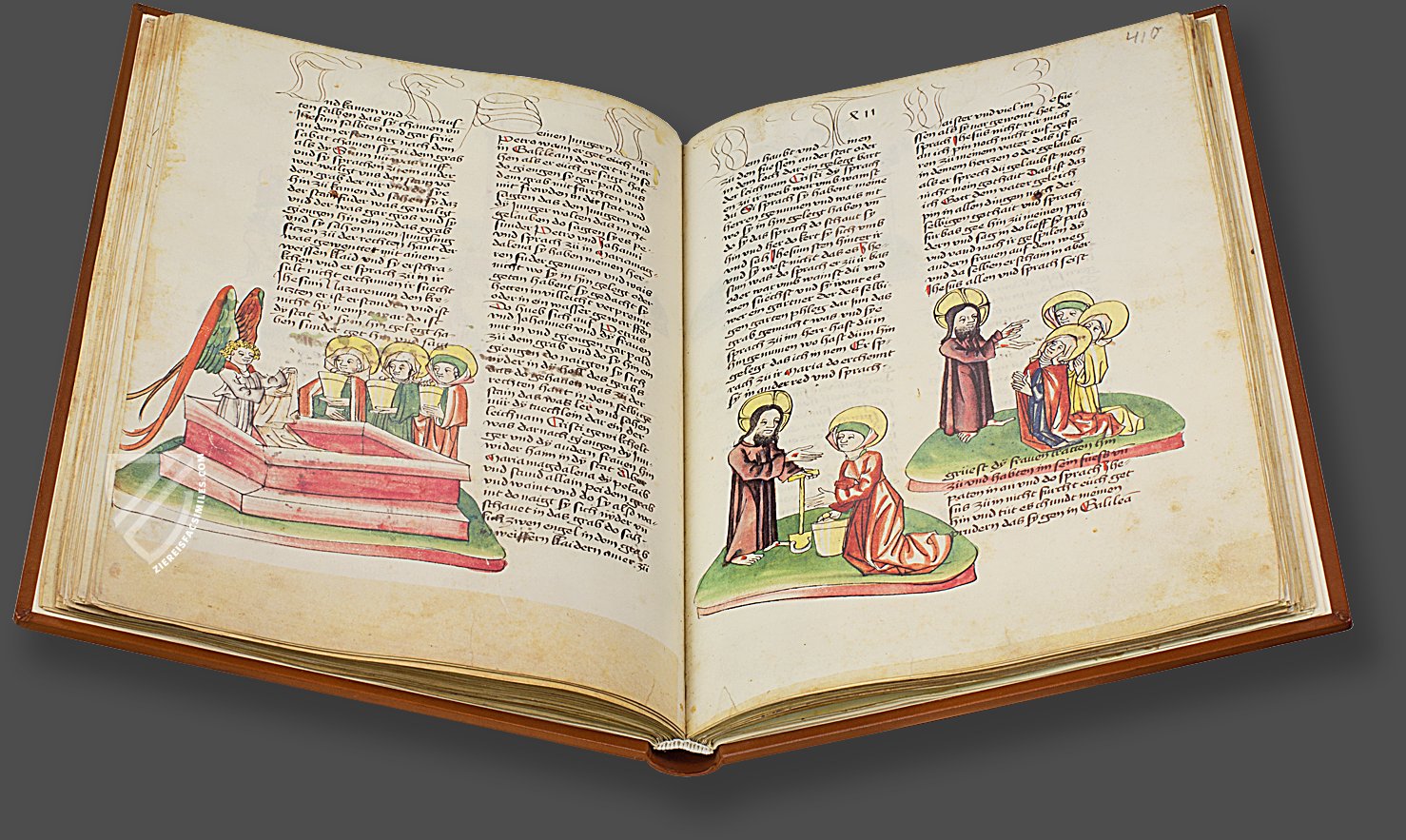
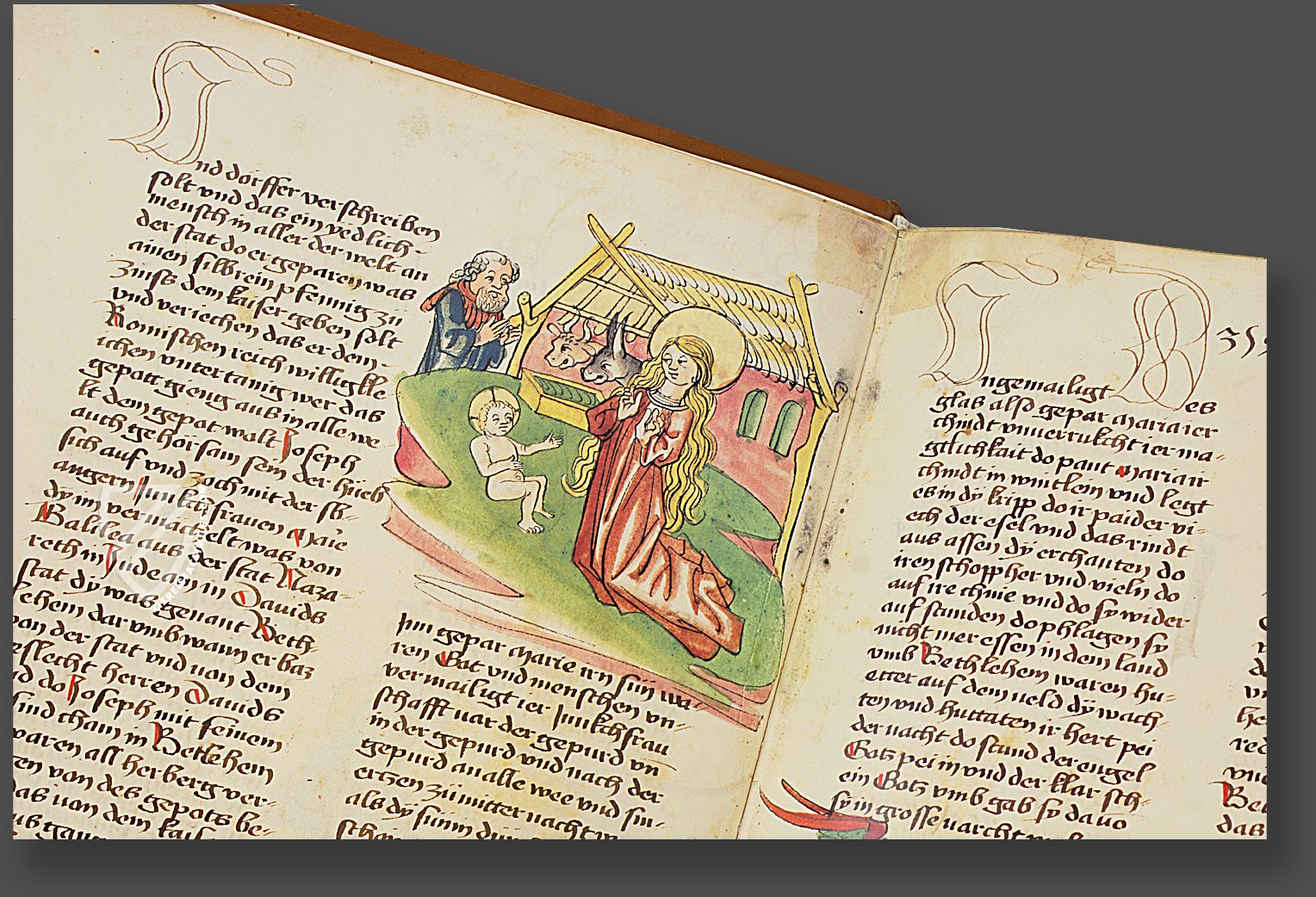
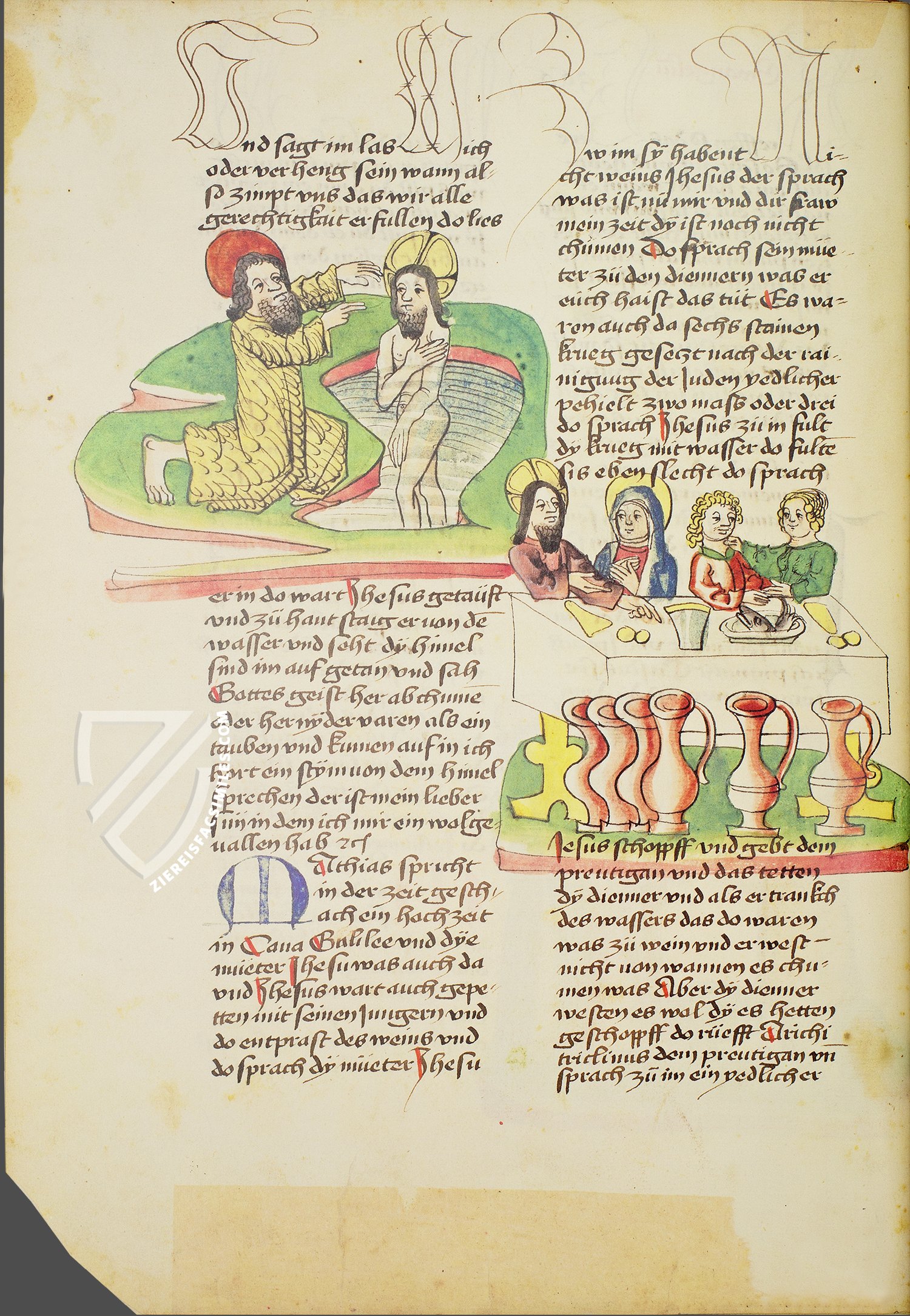
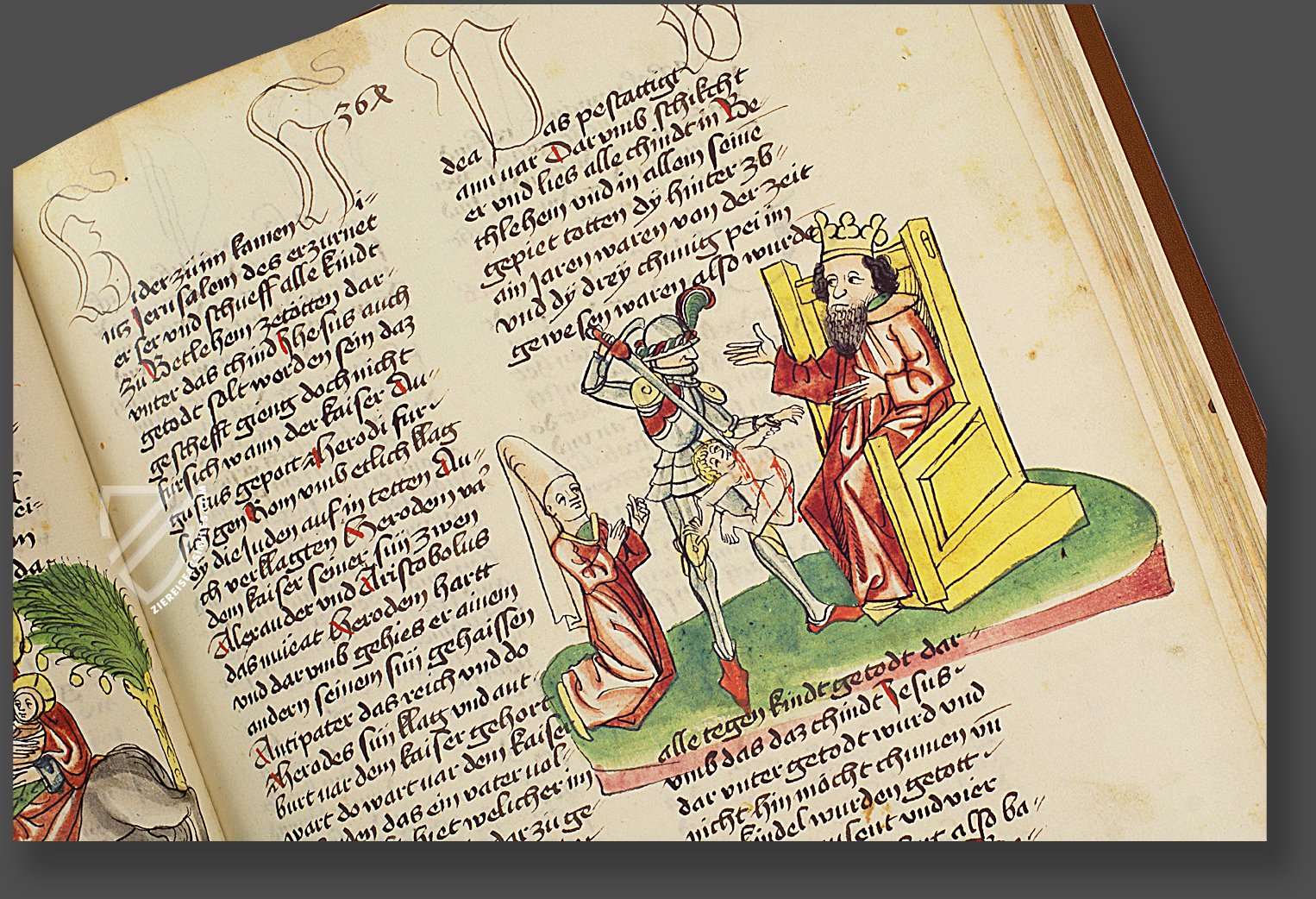
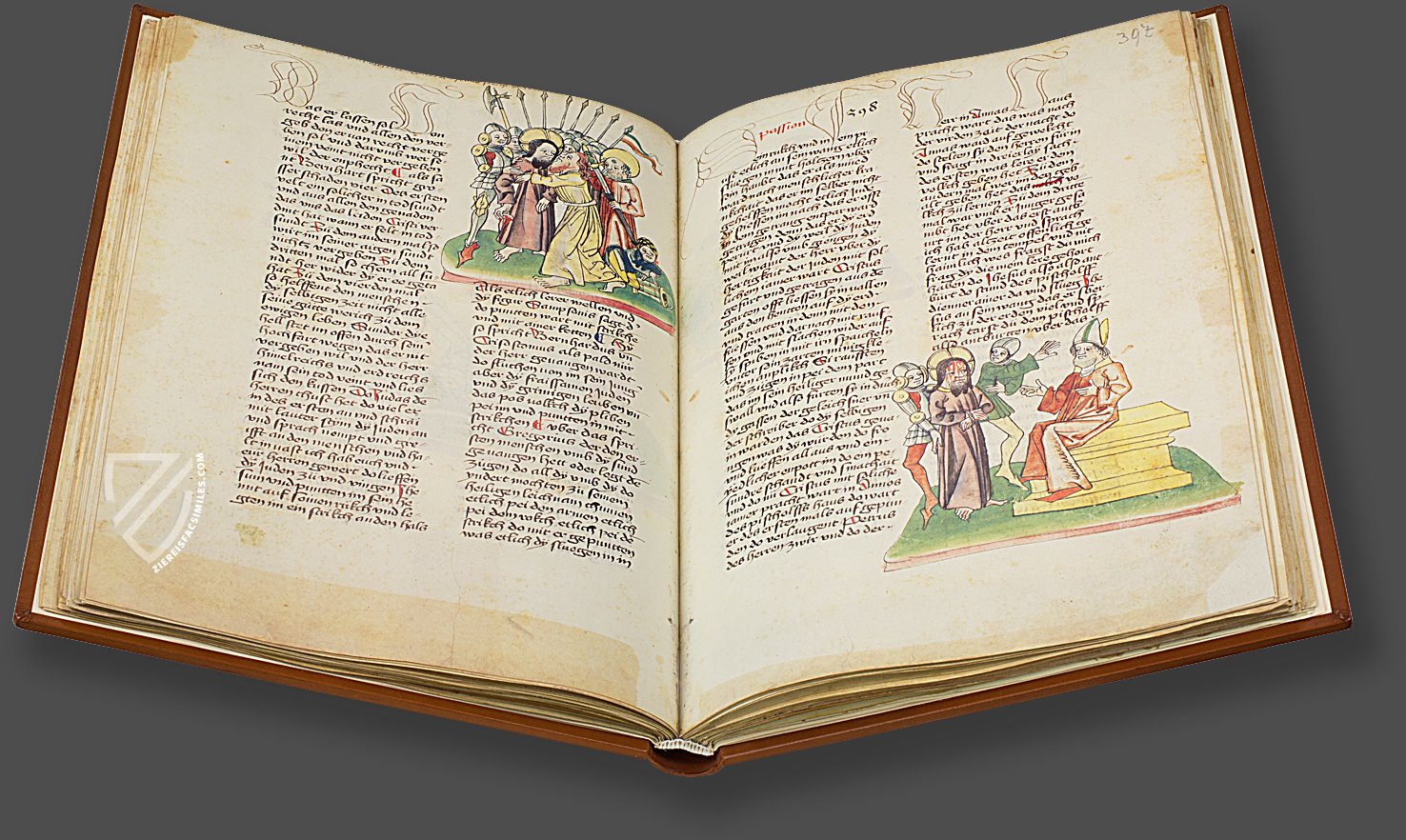
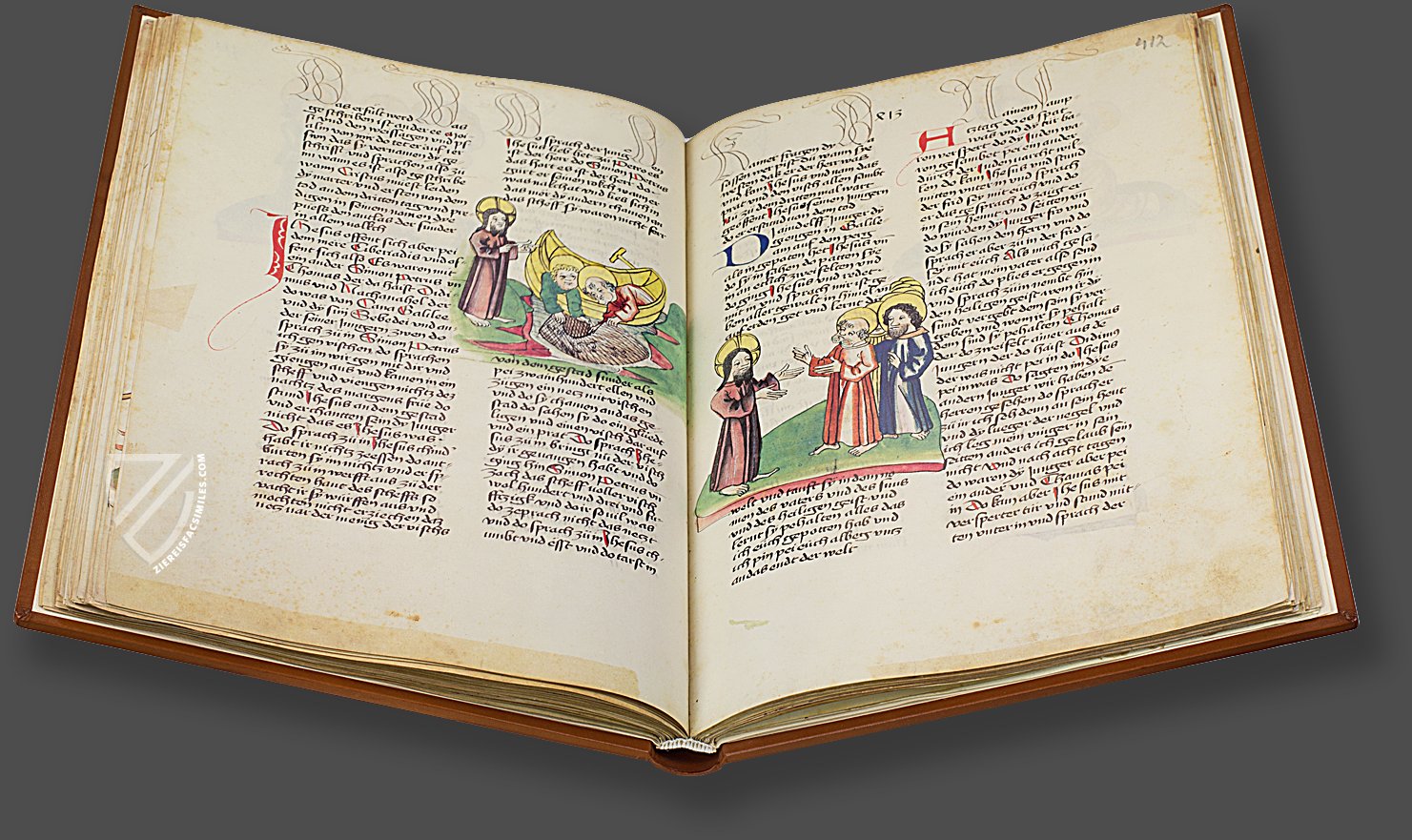
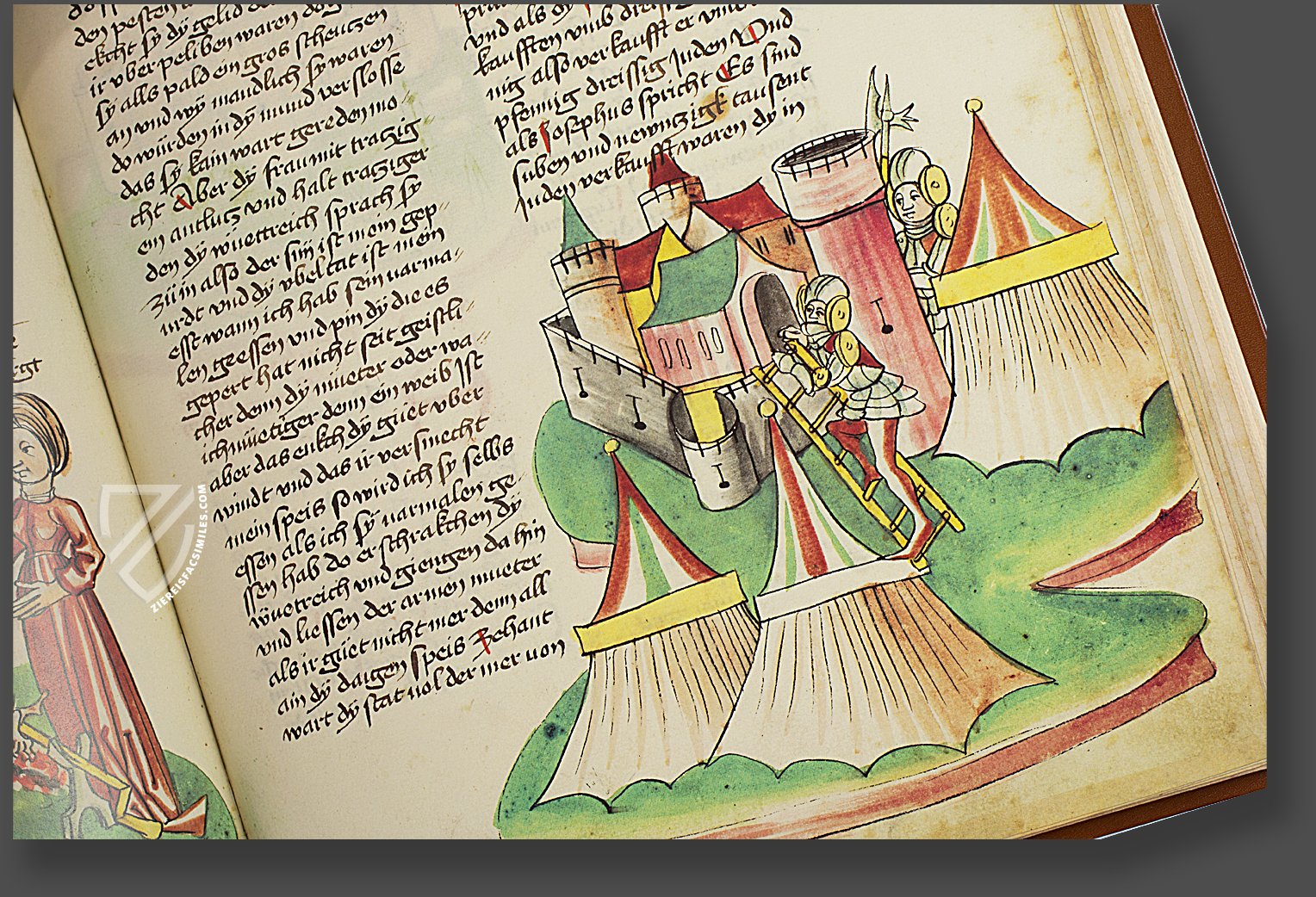
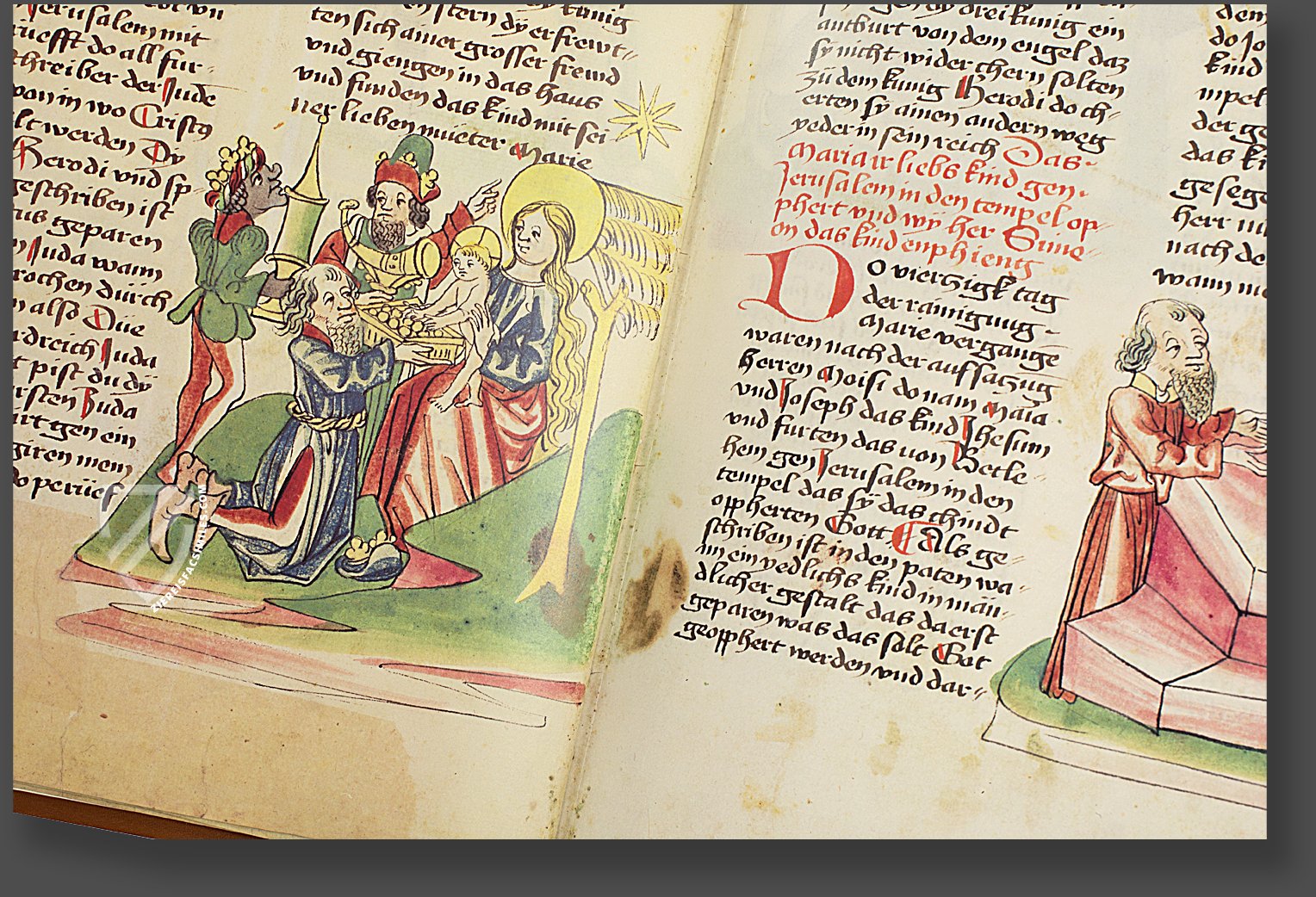
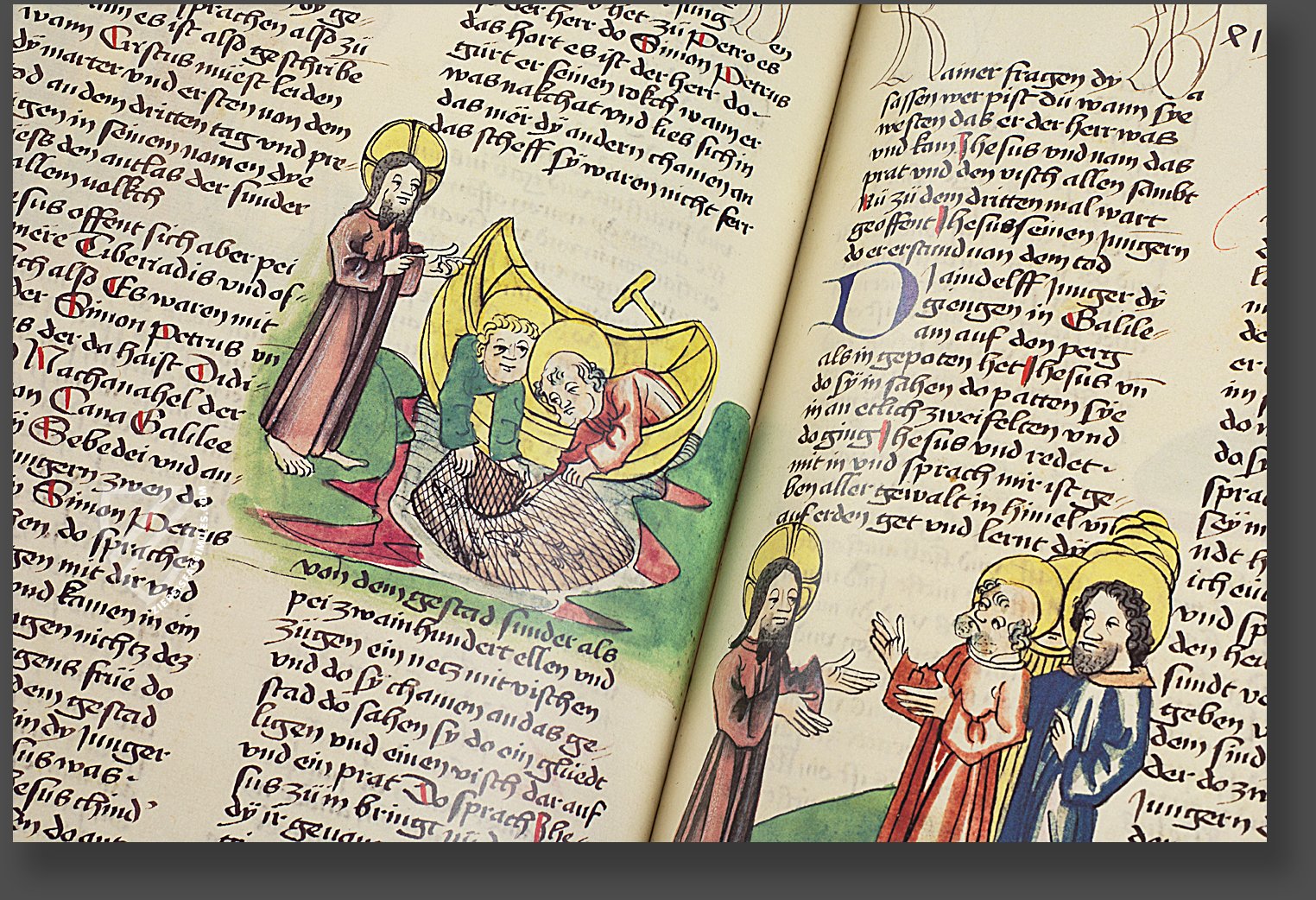
Among the approximately 100 surviving German-language popular Bibles, the Vorau Picture Bible is an undisputed artistic highlight. No fewer than 559 pen-and-ink drawings colored in bright watercolors accompany the text, written in a Bavarian-Austrian dialect, and once again demonstrate the exceptional enjoyment of images in the Late Middle Ages. They were inserted into the text columns by a single hand with great artistic skill, each as close as possible to the relevant passage. Their unmistakable charm comes above all from their extraordinary expressiveness. The figures, captured in moments of inner and outer turmoil, already show the first signs of characterization and individualization – some figures even appear caricatured.
Cultural History and Children's Humor
While the miniatures originally served primarily to interpret and illustrate the texts, they fulfill another function for today's viewer: they document medieval life in a variety of ways. The pen-and-ink drawings also make the Vorau Picture Bible an almost inexhaustible source of information about the costumes and everyday life of its time of creation.
In addition, some preserved and quite detailed instructions for the illuminator provide a good insight into the process of creating a medieval manuscript. It is striking that the instructions were often not followed to the letter and that the illuminator added his or her own ideas to the images.
Last but not least, the Vorau Picture Bible on fol. 190r–203r also becomes a wonderful testimony to the humorous treatment of such a valuable manuscript in its earlier history. Thus, in the 16th century, presumably a child added mustaches to some of the figures.
From the Creation of the World to Charlemagne
Compared to other German-language popular Bibles, the text of the Vorau Picture Bible is quite extensive, especially in terms of its New Testament part. This goes far beyond the biblical stories of the life of Christ and concludes by focusing on the history of the popes and emperors, up to Charlemagne. Overall, the prose text is based on the German translation of Petrus Comestor's Historia Scholastica and Heinrich von München's Weltchronik (World Chronicle). The Old Testament part of the Vorau manuscript was supplemented by the Hiob (Job) of an Austrian Bible translator and the so-called Prophetenauszug (Excerpt from the Prophets). In addition to the Chronicle of Popes and Emperors, the New Testament section is supplemented primarily by texts on the life and Passion of Christ in the form of gospel pericopes and the German translation of Heinrich von St. Gallen's *treatise on the Passion of Christ – a late medieval bestseller of Passion literature. The book closes with the ***Epistel des Rabbi Samuel an Rabbi Isaak*** (Epistle of Rabbi Samuel to Rabbi Isaac) by Irmhart Öser, which provides readers with arguments for the Christian interpretation of Scripture.
Dated to the Day
It is extremely rare that the Vorau Picture Bible can be dated to the day. On fol. 447v there is a respective entry by the scribe: “Also hat ein endt dy wibel dy alt ee vnd ein tail der newen ee vnd ist geendt waren in vigilia omnium sanctorum anno domini M °CCCC °67”. The date of completion was therefore October 31, 1467. The name of the scribe has not been handed down to us. It is most likely that he was a clergyman well versed in religious matters.
How the manuscript found its way to Vorau also remains unclear to this day. Its first mention there dates back to 1733. Since then at the latest, it has been in the possession of the monastery and is one of its greatest treasures.
Codicology
- Alternative Titles
- Vorauer Volksbibel
Vorauer Historienbibel
Vorau Story Bible
Vorau Popular Bible
Vorau Historiated Bible - Type
- Manuscript on paper
- Size / Format
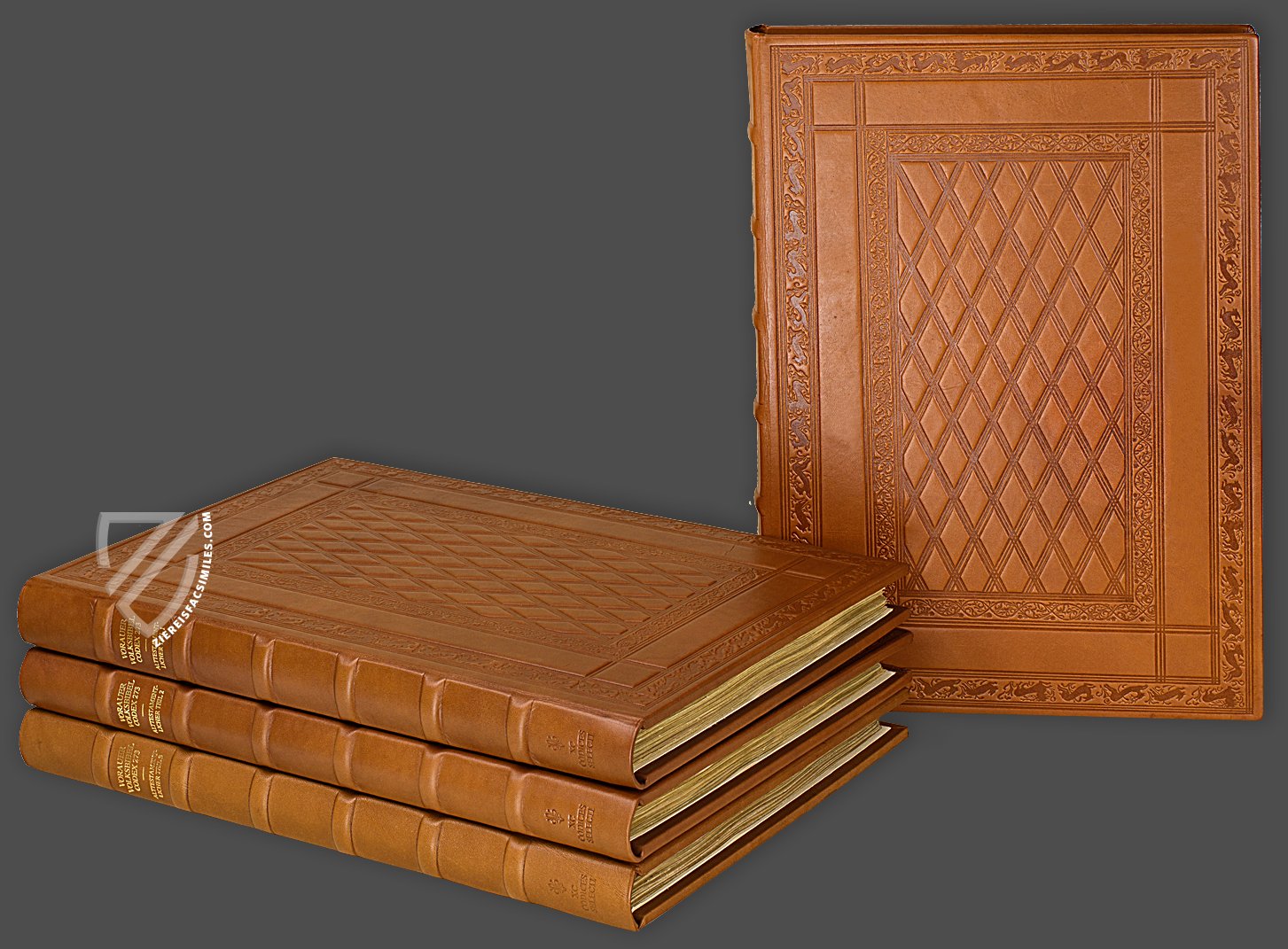
- 916 pages / 40.5 × 28.5 cm
- Origin
- Austria
- Date
- 1467
- Epochs
- Style
- Genre
- Language
- Script
- Littera bastarda
- Illustrations
- 559 colored pen and ink drawings, including 514 miniatures and 45 historiated initials, as well as countless cadels and lombards
- Content
- Popular Bible of the Old and New Testaments, Irmhart Öser's German translation of the “Epistula Samuelis” by Alphonsus Bonihominis
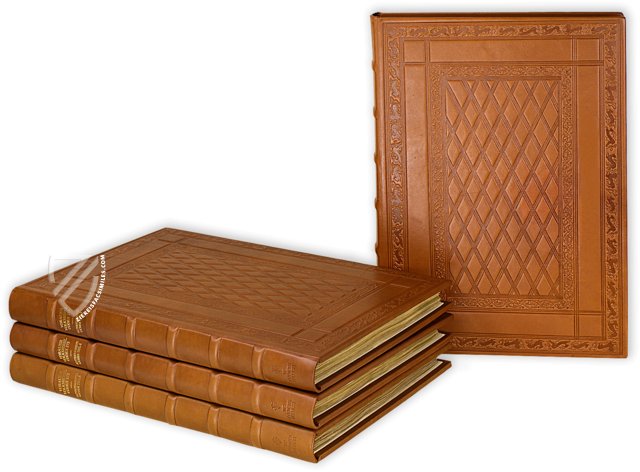
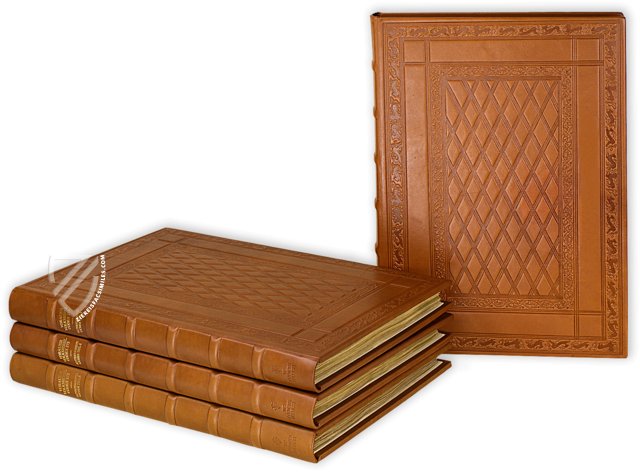
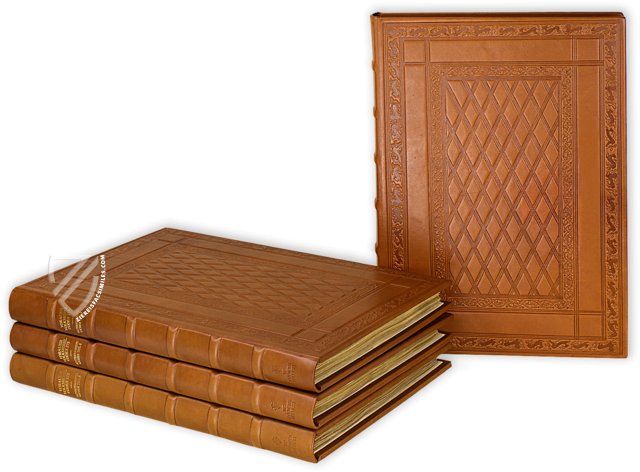
Vorau Picture Bible
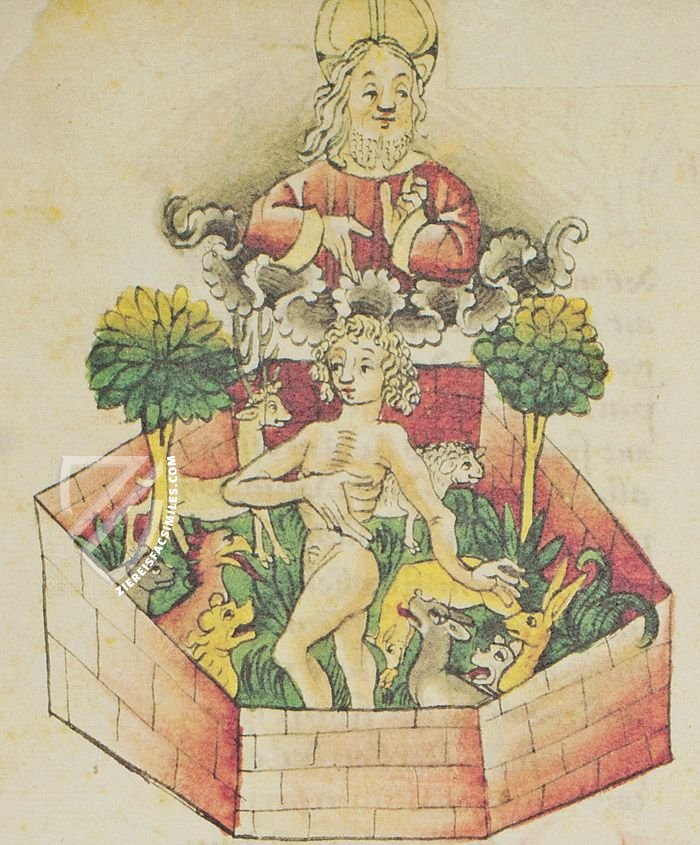
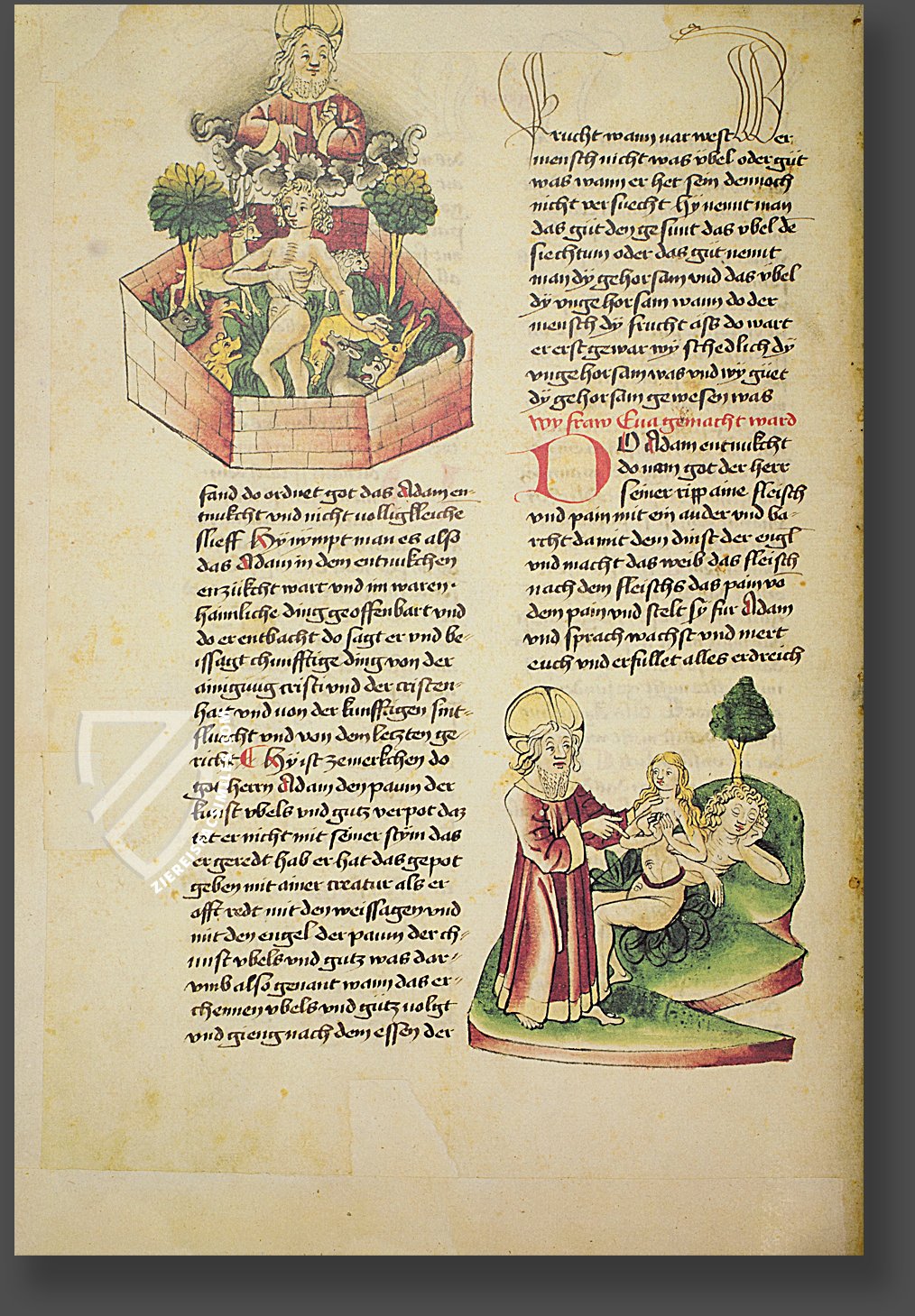
Adam in the Garden of Eden
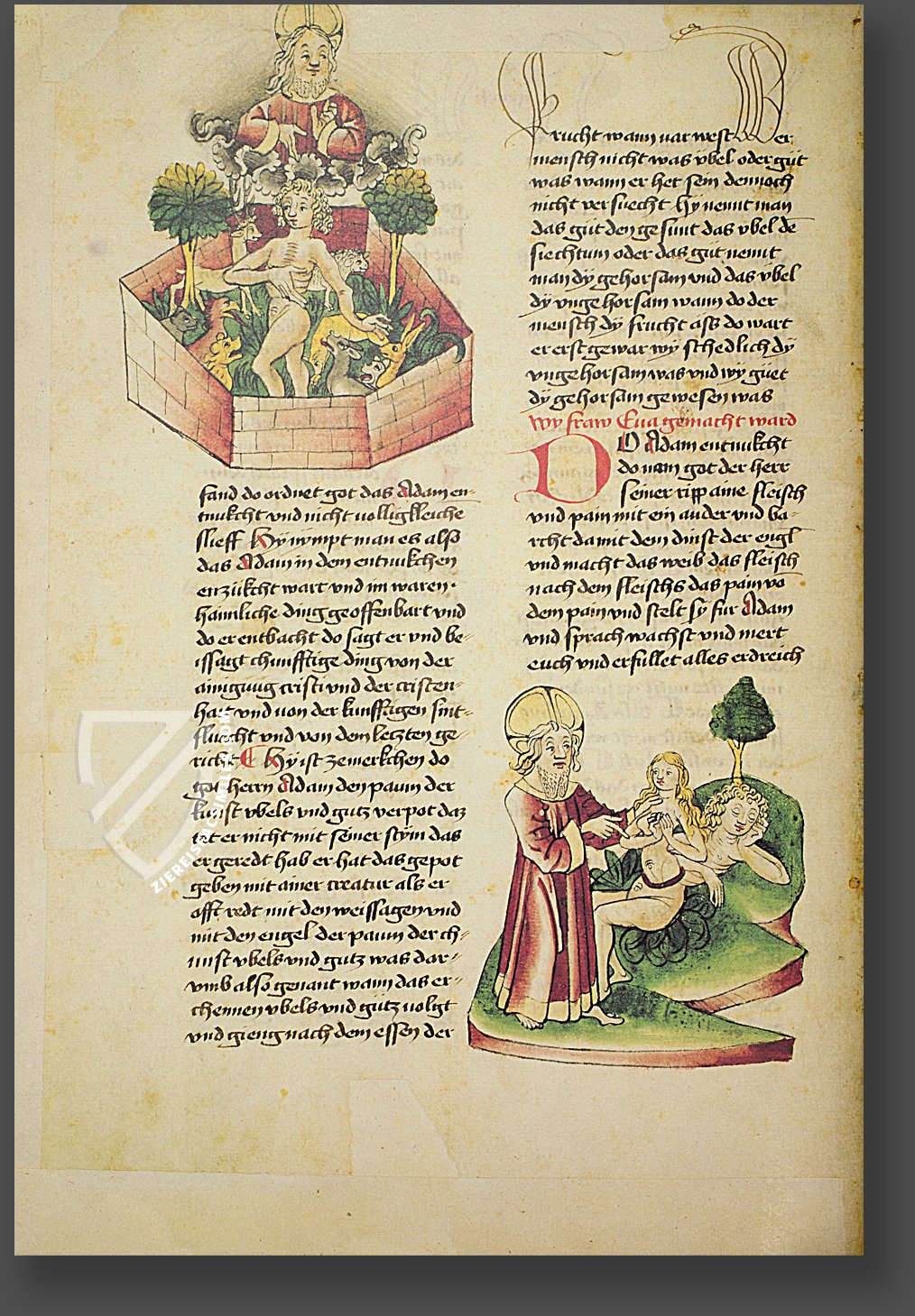
As a joyful God reigns overhead in the clouds, Adam is shown walking through the Garden of Eden in a blissful state of nude ignorance and presumably naming the animals that surround him. This miniature shows the period directly preceding the creation of Eve and depicts Paradise as a walled garden. The enclosed garden or hortus conclusus as a metaphor for paradise goes back to ancient Persia and symbolizes the Immaculate Conception as well as having numerous other allegorical connotations.
Vorau Picture Bible
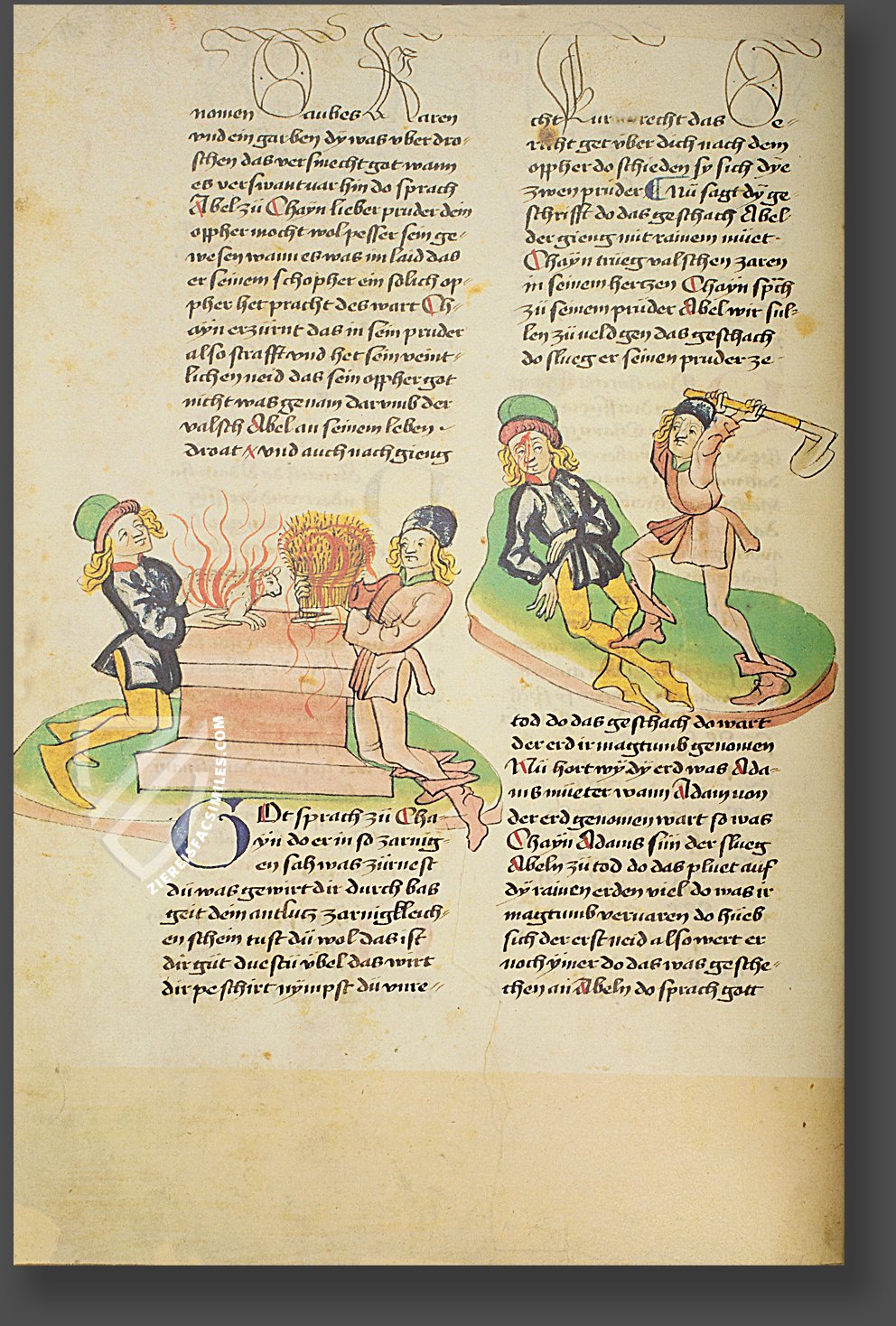
Cain and Abel
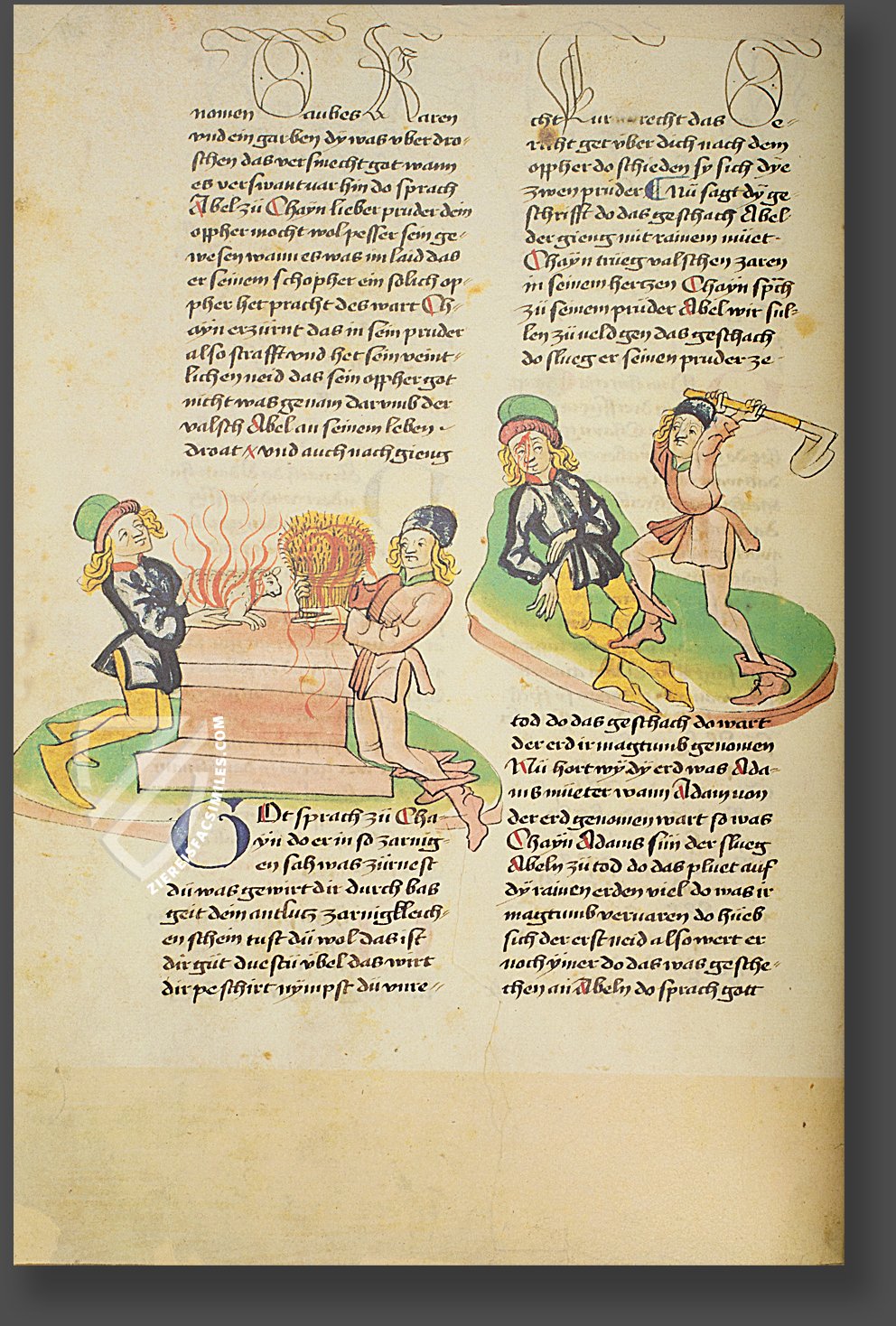
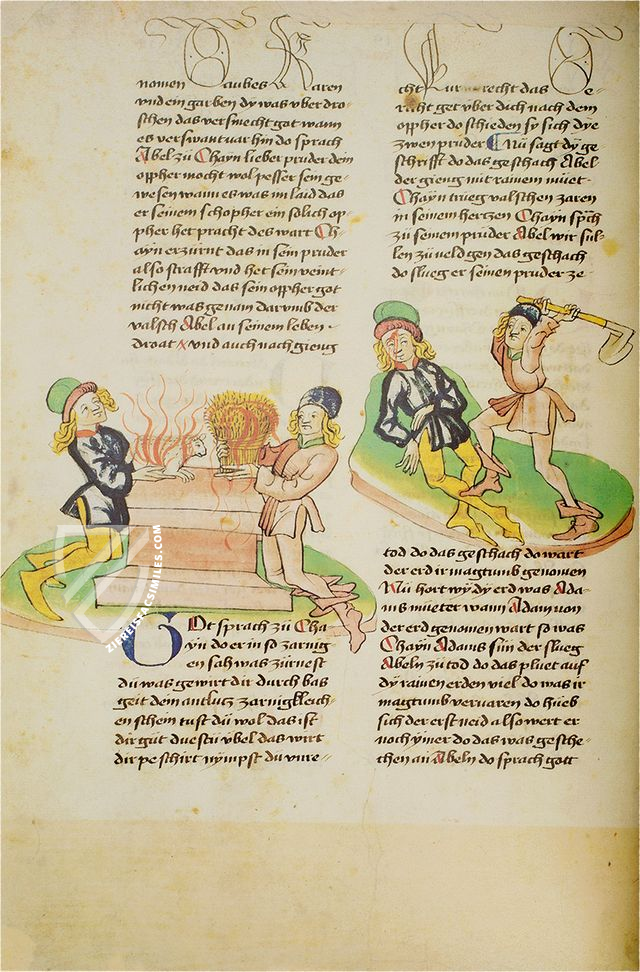
In the Book of Genesis, Cain famously slays his brother Abel after God rejects his offering in favor of his brother’s, and then lies about it, earning him the curse and mark of Cain. Aside from being the first two children of Adam and Eve, the brothers possess tremendous symbolic value, representing everything from the birth of evil to the rise of agriculture.
The miniatures are inserted in line with the two-column German text. On the left, the brothers present their burnt offerings at the altar, Abel the shepherd presents the choicest lamb of his flock while Cain merely offers a bushel of grain. The following scene shows Abel lying on the ground, head already bleeding from a wound, as Cain raises the hoe to strike again.
#1 Die Vorauer Volksbibel (Special Edition in 1 Volume)
Language: German
(3,000€ - 7,000€)
#2 Die Vorauer Volksbibel (Full set of 4 volumes)
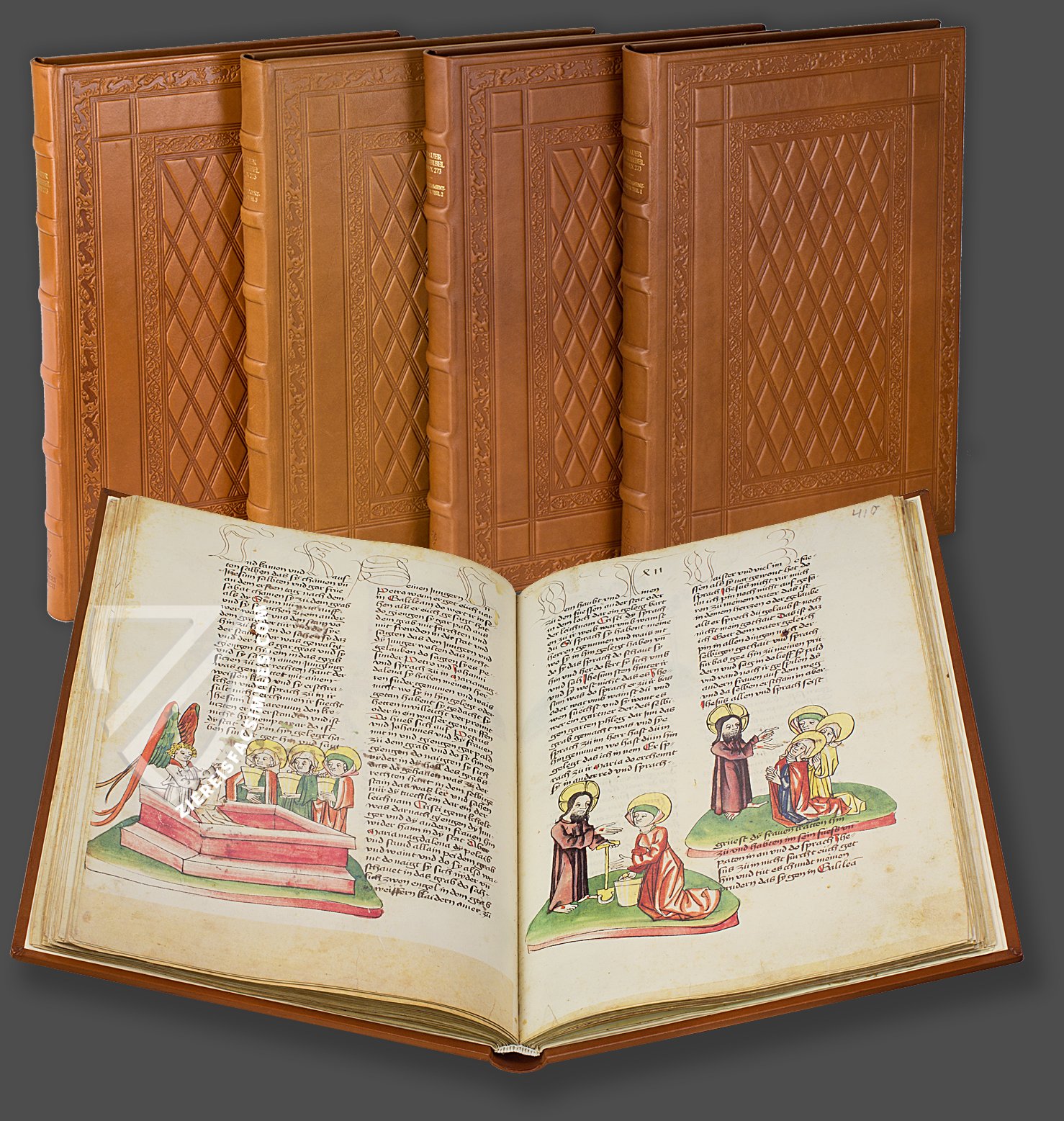
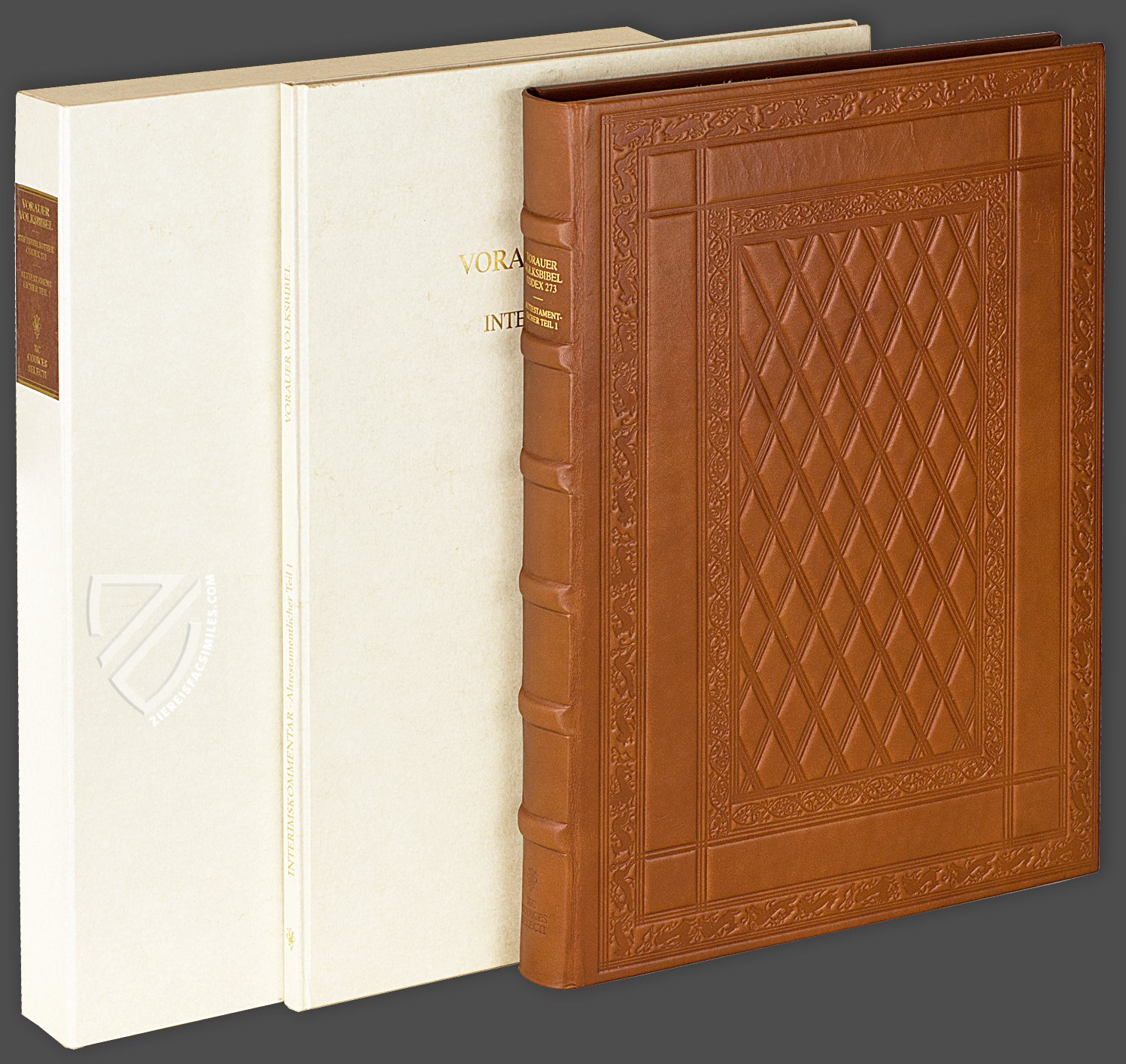
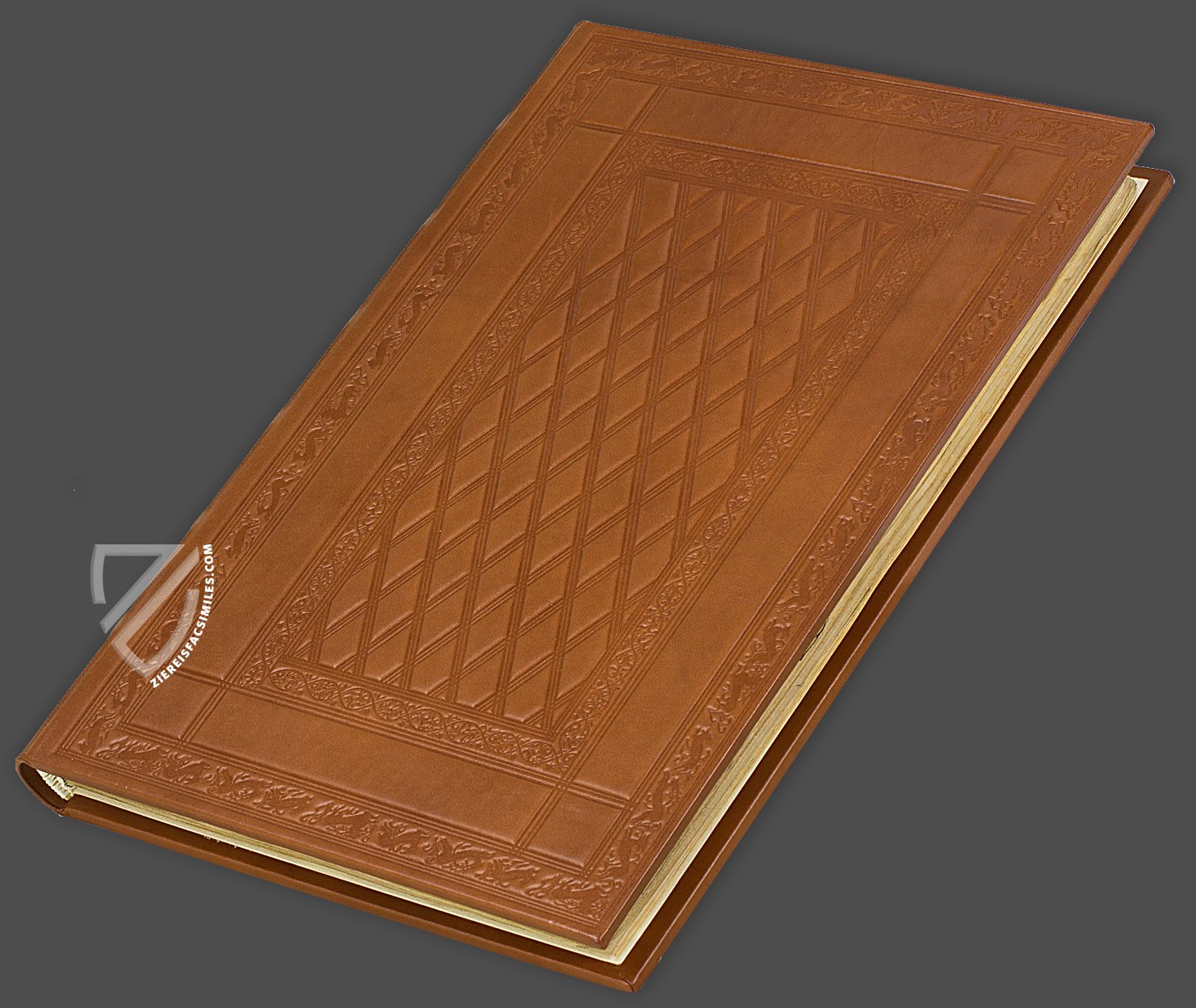
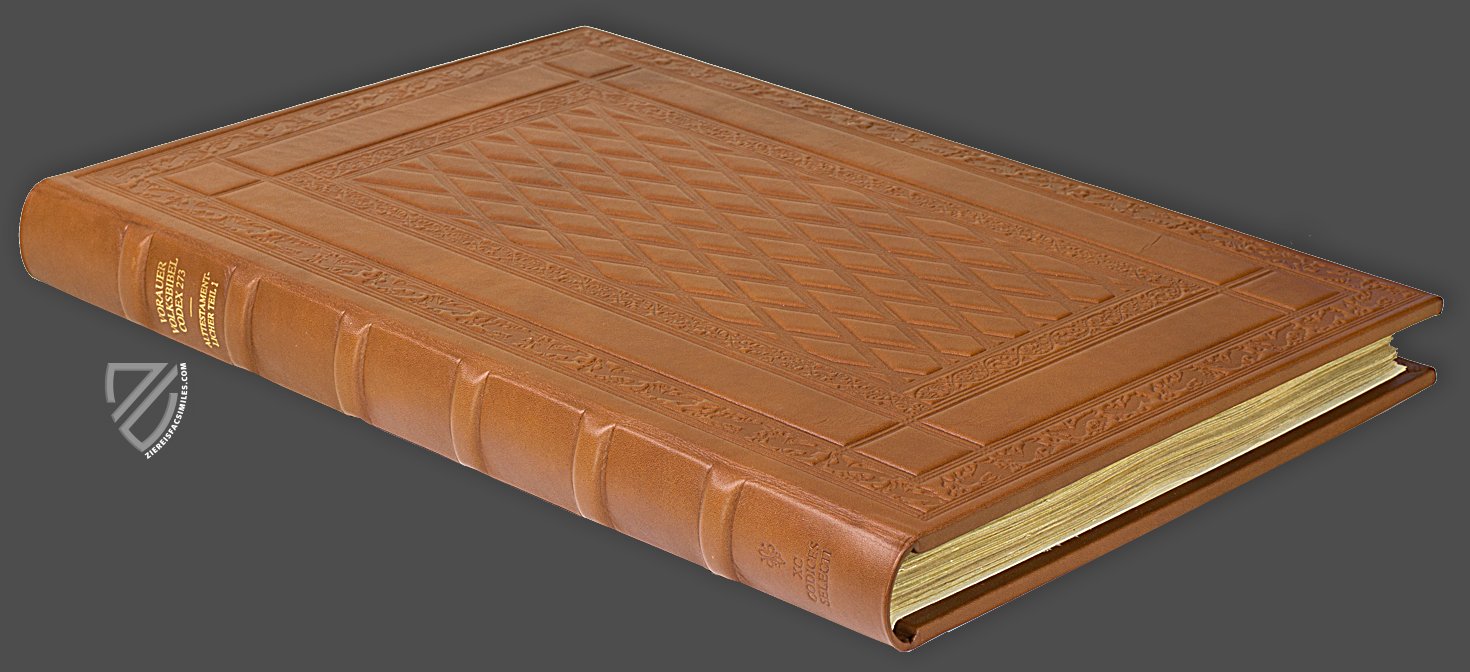
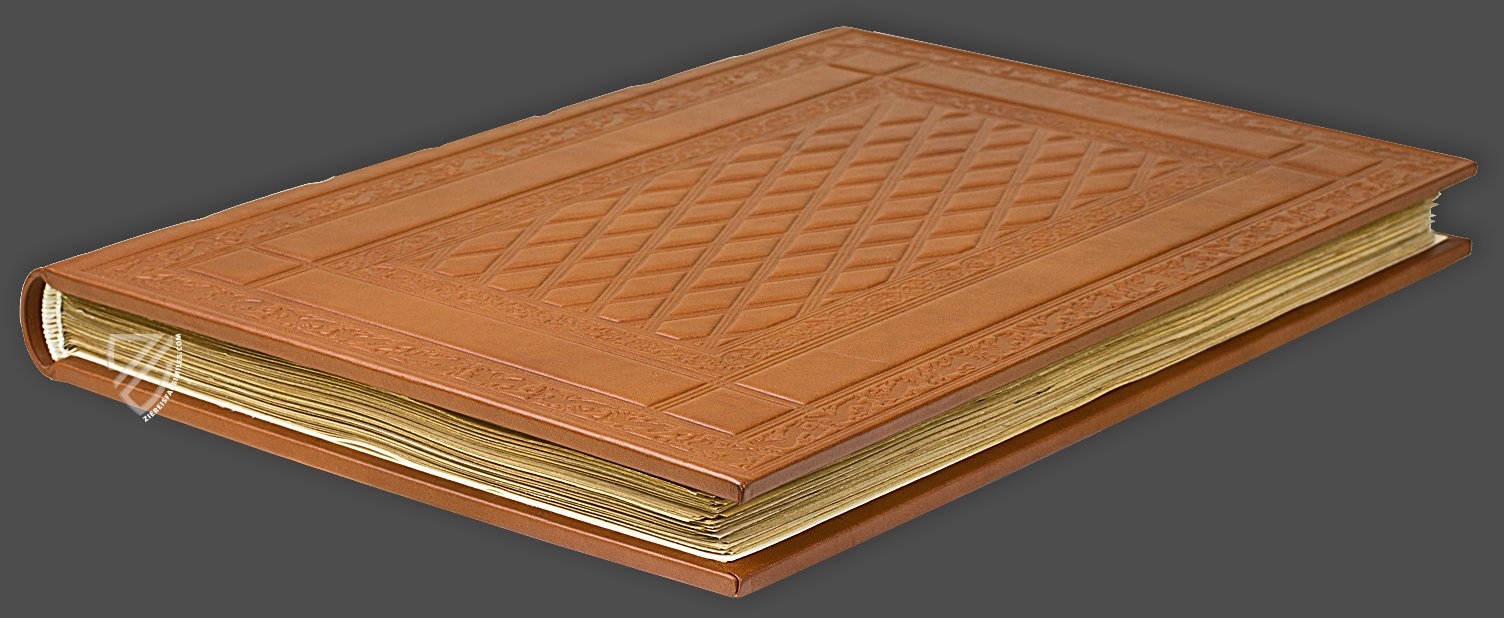
Language: German
(1,000€ - 3,000€)
#3 Die Vorauer Volksbibel (Volume 1)
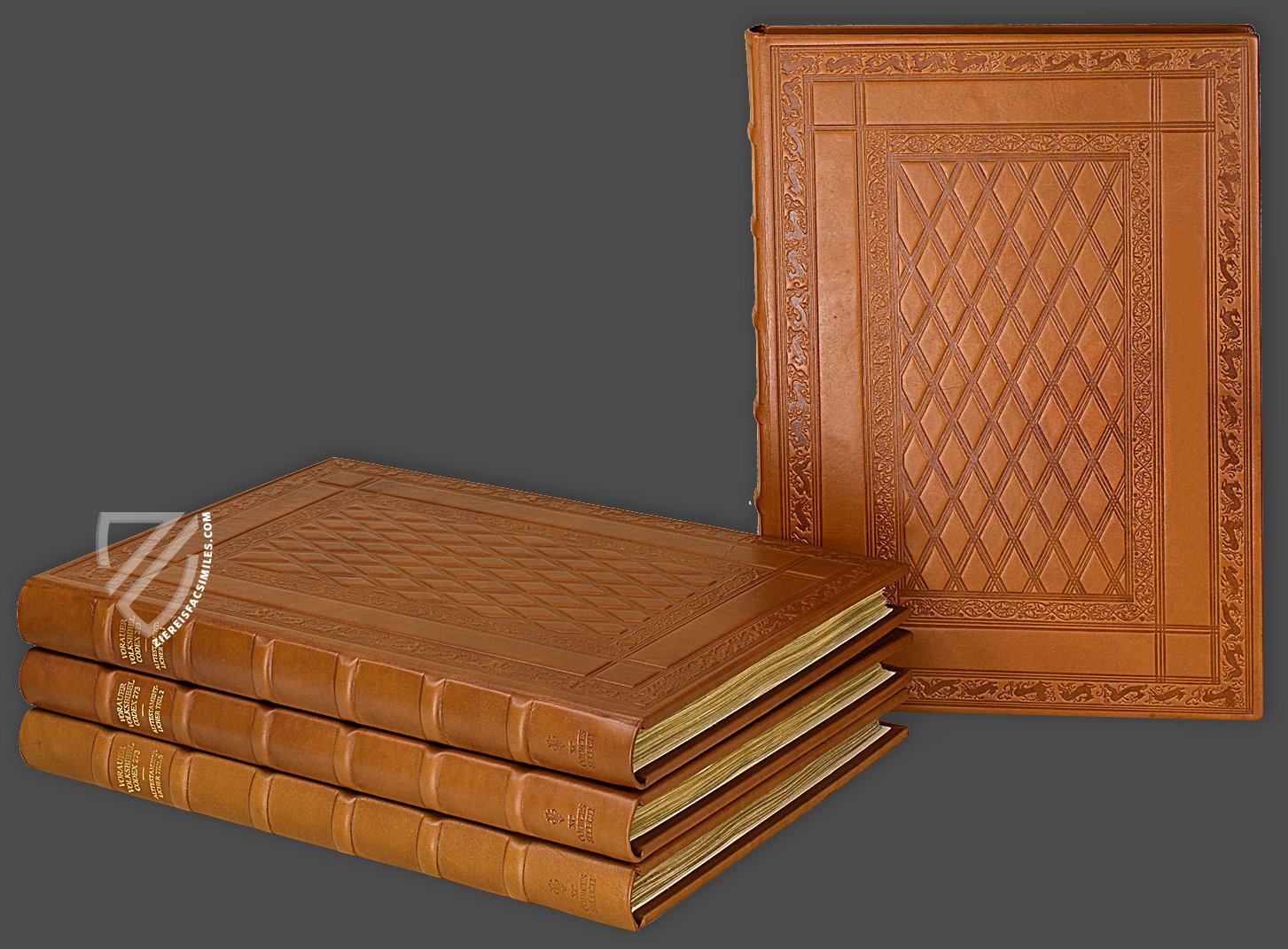
Language: German
(1,000€ - 3,000€)
#4 Die Vorauer Volksbibel (Volume 2)
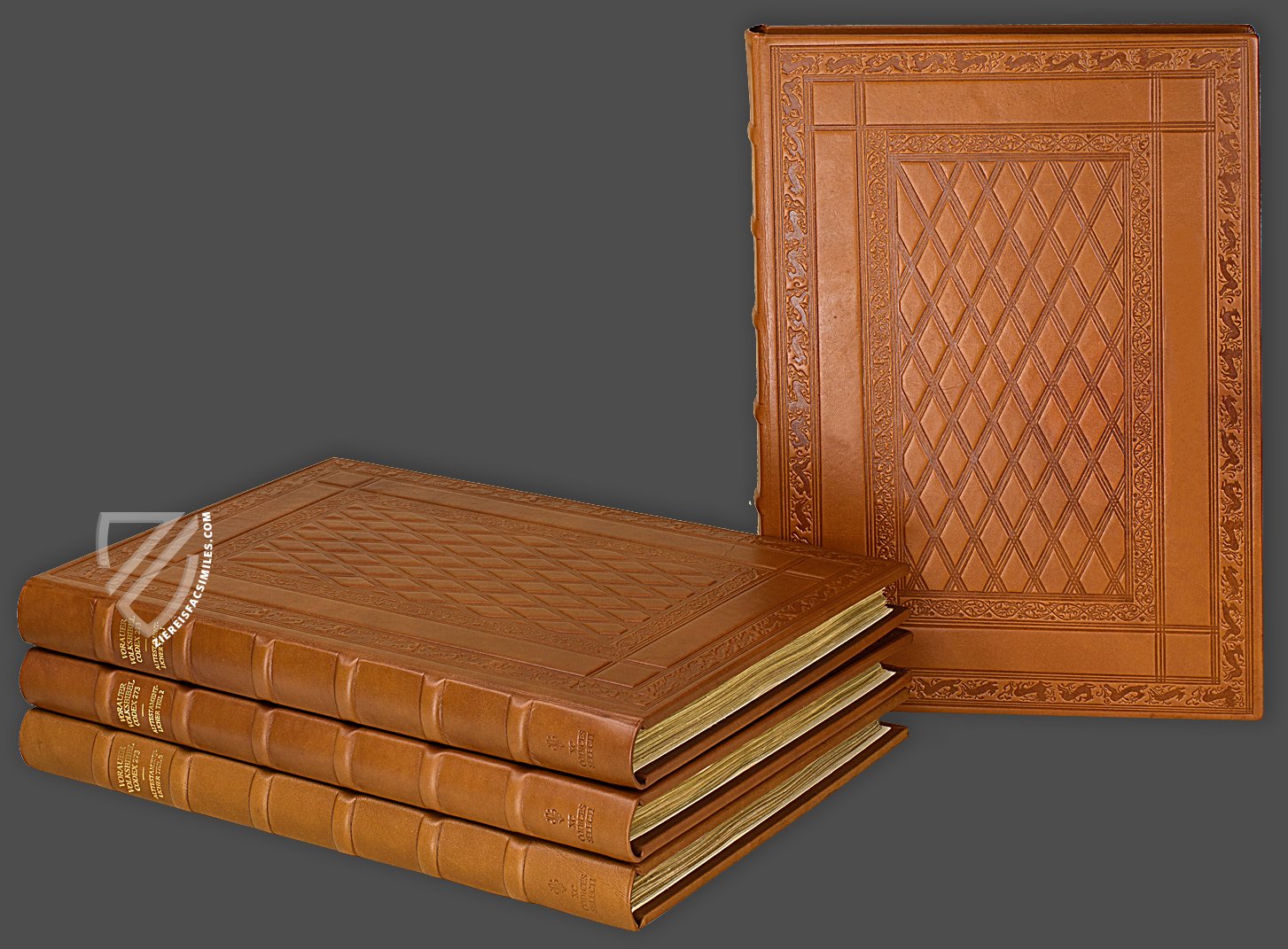
Language: German
(1,000€ - 3,000€)
#5 Die Vorauer Volksbibel (Volume 3)
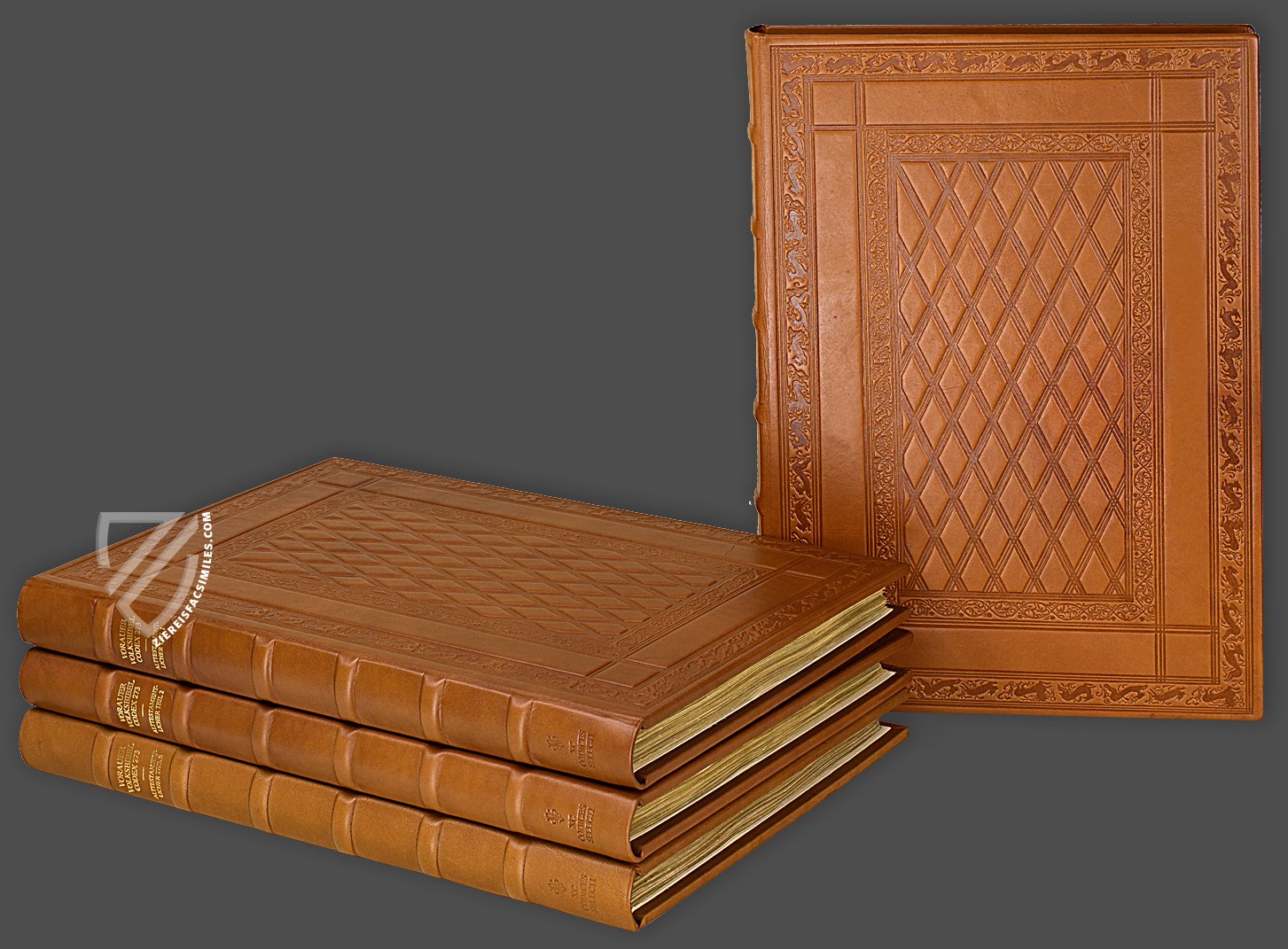
Language: German
(1,000€ - 3,000€)
#6 Die Vorauer Volksbibel (Volume 4)
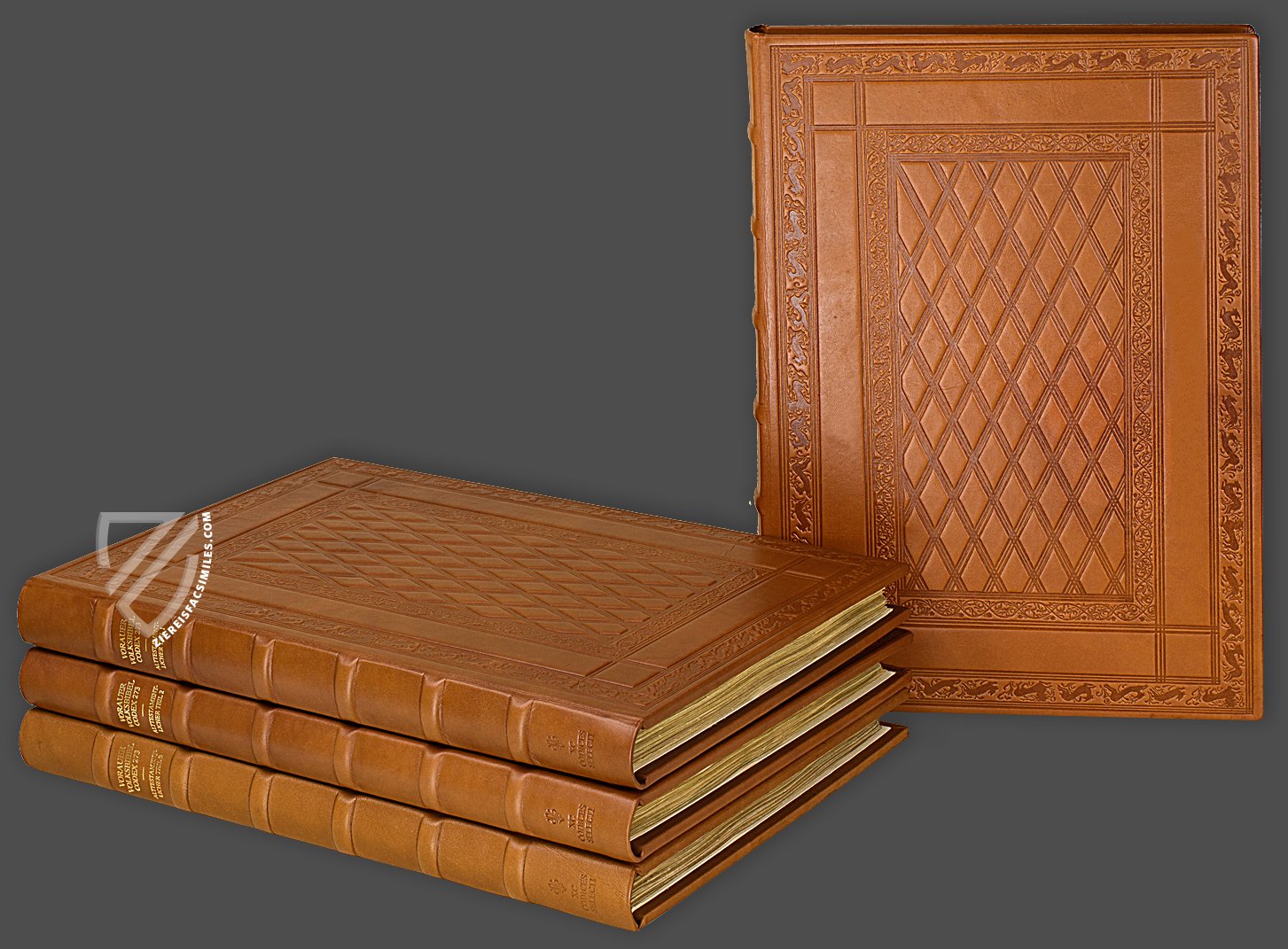
Language: German
(1,000€ - 3,000€)
- Block Books / Incunables / Post-incunables
- Alchemy
- Apocalypses / Beatus Manuscripts
- Astronomy / Astrology
- Bibles / Gospels
- Picture Bibles / Bibles Moralisées / Mirror of Human Salvation
- Botany
- Chronicles / History / Letters
- Cookbook / Recipes
- Diaries / Biographies / Autograph Books
- Encyclopedias
- Fashion / Costume Books
- Games / Game Theory
- Geography / Cartography / Navigation
- Graduals / Antiphonaries / Exultet Roll
- Haggadot
- Hunting Books
- Law / Deeds / Rules
- Leonardo da Vinci
- Literature / Poetry
- Medicine
- Missals / Lectionaries / Sacramentaries
- Model Books / Sketchbooks / Notebooks
- Music
- Mythology
- Natural History / Bestiaries
- Other Liturgical Manuscripts
- Other Religious Works
- Other Secular Works
- Paintings / Graphics
- Primers / Textbooks
- Private Devotion Books
- Prophecies / Divination
- Psalters
- Quran
- Saints' Lives
- Sermons / Homilies
- Single Leaf Collections
- Song Books
- Tanakh
- Tournament Books / Armorials / Genealogy
- Travelogues / Travel Guides
- Treatises
- Afghanistan
- Algeria
- Armenia
- Austria
- Azerbaijan
- Belgium
- Belize
- Bosnia and Herzegovina
- China
- Colombia
- Costa Rica
- Croatia
- Cyprus
- Czech Republic
- Denmark
- Egypt
- El Salvador
- Ethiopia
- France
- Germany
- Greece
- Guatemala
- Honduras
- Hungary
- India
- Iran
- Iraq
- Israel
- Italy
- Japan
- Jordan
- Kazakhstan
- Kyrgyzstan
- Lebanon
- Libya
- Liechtenstein
- Luxembourg
- Mexico
- Morocco
- Netherlands
- Palestine
- Panama
- Peru
- Poland
- Portugal
- Romania
- Russia
- Serbia
- Spain
- Sri Lanka
- Sweden
- Switzerland
- Syria
- Tajikistan
- Tunisia
- Turkey
- Turkmenistan
- Ukraine
- United Kingdom
- United States
- Uzbekistan
- Vatican City
- A. Oosthoek, van Holkema & Warendorf
- Aboca Museum
- Ajuntament de Valencia
- Akademie Verlag
- Akademische Druck- u. Verlagsanstalt (ADEVA)
- Aldo Ausilio Editore - Bottega d’Erasmo
- Alecto Historical Editions
- Alkuin Verlag
- Almqvist & Wiksell
- Amilcare Pizzi
- Andreas & Andreas Verlagsbuchhandlung
- Archa 90
- Archiv Verlag
- Archivi Edizioni
- Arnold Verlag
- ARS
- Ars Magna
- Ars Millenii
- Art Market
- ArtCodex
- AyN Ediciones
- Azimuth Editions
- Badenia Verlag
- Bärenreiter-Verlag
- Belser Verlag
- Belser Verlag / WK Wertkontor
- Benziger Verlag
- Bernardinum Wydawnictwo
- BiblioGemma
- Biblioteca Apostolica Vaticana (Vaticanstadt, Vaticanstadt)
- Bibliotheca Palatina Faksimile Verlag
- Bibliotheca Rara
- Boydell & Brewer
- Bramante Edizioni
- Bredius Genootschap
- Brepols Publishers
- British Library
- Brokarte
- C. Weckesser
- Caixa Catalunya
- Canesi
- CAPSA, Ars Scriptoria
- Caratzas Brothers, Publishers
- Carus Verlag
- Casamassima Libri
- Centrum Cartographie Verlag GmbH
- Chavane Verlag
- Christian Brandstätter Verlag
- Circulo Cientifico
- Club Bibliófilo Versol
- Club du Livre
- Club Internacional del Libro
- CM Editores
- Collegium Graphicum
- Collezione Apocrifa Da Vinci
- Comissão Nacional para as Comemorações dos Descobrimentos Portugueses
- Coron Verlag
- Corvina
- CTHS
- D. S. Brewer
- Damon
- De Agostini/UTET
- De Nederlandsche Boekhandel
- De Schutter
- Deuschle & Stemmle
- Deutscher Verlag für Kunstwissenschaft
- DIAMM
- Dropmore Press
- Droz
- E. Schreiber Graphische Kunstanstalten
- Ediciones Boreal
- Ediciones Grial
- Ediclube
- Edições Inapa
- Edilan
- Editalia
- Edition Deuschle
- Edition Georg Popp
- Edition Leipzig
- Edition Libri Illustri
- Editiones Reales Sitios S. L.
- Éditions de l'Oiseau Lyre
- Editions Medicina Rara
- Editorial Base
- Editorial Casariego
- Editorial Mintzoa
- Editrice Antenore
- Editrice Velar
- Edizioni Edison
- Egeria, S.L.
- Eikon Editores
- Electa
- Emery Walker Limited
- Enciclopèdia Catalana
- Eos-Verlag
- Ephesus Publishing
- Ernst Battenberg
- Eugrammia Press
- Extraordinary Editions
- Fackelverlag
- Facsimila Art & Edition
- Facsimile Editions Ltd.
- Facsimilia Art & Edition Ebert KG
- Faksimile Verlag
- Feuermann Verlag
- Folger Shakespeare Library
- Franco Cosimo Panini Editore
- Friedrich Wittig Verlag
- Fundación Hullera Vasco-Leonesa
- G. Braziller
- Gabriele Mazzotta Editore
- Gebr. Mann Verlag
- Gesellschaft für graphische Industrie
- Getty Research Institute
- Giovanni Domenico de Rossi
- Giunti Editore
- Goldenmark Librarium
- Graffiti
- Grafica European Center of Fine Arts
- Guido Pressler
- Guillermo Blazquez
- Gustav Kiepenheuer
- H. N. Abrams
- Harrassowitz
- Harvard University Press
- Helikon
- Hendrickson Publishers
- Henning Oppermann
- Herder Verlag
- Hes & De Graaf Publishers
- Hoepli
- Holbein-Verlag
- Houghton Library
- Hugo Schmidt Verlag
- Hungarian Academy of Sciences
- Idion Verlag
- Il Bulino, edizioni d'arte
- ILte
- Imago
- In Officina Danesi
- Insel Verlag
- Insel-Verlag Anton Kippenberger
- Instituto de Estudios Altoaragoneses
- Instituto Nacional de Antropología e Historia
- Introligatornia Budnik Jerzy
- Istituto dell'Enciclopedia Italiana - Treccani
- Istituto Ellenico di Studi Bizantini e Postbizantini
- Istituto Geografico De Agostini
- Istituto Poligrafico e Zecca dello Stato
- Italarte Art Establishments
- Jaca Book
- Jan Thorbecke Verlag
- Johnson Reprint Corporation
- Johnson Reprint Corporation
- Jos. Baer
- Josef Stocker
- Josef Stocker-Schmid
- Jugoslavija
- Karl W. Hiersemann
- Kasper Straube
- Kaydeda Ediciones
- Kindler Verlag / Coron Verlag
- Kodansha International Ltd.
- Konrad Kölbl Verlag
- Kurt Wolff Verlag
- La Liberia dello Stato
- La Linea Editrice
- La Meta Editore
- Lambert Schneider
- Landeskreditbank Baden-Württemberg
- Leo S. Olschki
- Les Incunables
- Liber Artis
- Library of Congress
- Libreria Musicale Italiana
- Lichtdruck
- Lito Immagine Editore
- Lumen Artis
- Lund Humphries
- M. Moleiro Editor
- Maison des Sciences de l'homme et de la société de Poitiers
- Manuscriptum
- Martinus Nijhoff
- Maruzen-Yushodo Co. Ltd.
- MASA
- Massada Publishers
- McGraw-Hill
- Metropolitan Museum of Art
- Militos
- Millennium Liber
- Müller & Schindler
- Nahar - Stavit
- Nahar and Steimatzky
- National Library of Wales
- Neri Pozza
- Nova Charta
- Oceanum Verlag
- Odeon
- Omnia Arte
- Orbis Mediaevalis
- Orbis Pictus
- Österreichische Staatsdruckerei
- Oxford University Press
- Pageant Books
- Parzellers Buchverlag
- Patrimonio Ediciones
- Pattloch Verlag
- PIAF
- Plon-Nourrit et cie
- Poligrafiche Bolis
- Presses Universitaires de Strasbourg
- Prestel Verlag
- Princeton University Press
- Prisma Verlag
- Priuli & Verlucca, editori
- Pro Sport Verlag
- Propyläen Verlag
- Pytheas Books
- Quaternio Verlag Luzern
- Reales Sitios
- Recht-Verlag
- Reichert Verlag
- Reichsdruckerei
- Reprint Verlag
- Riehn & Reusch
- Rizzoli
- Roberto Vattori Editore
- Rosenkilde and Bagger
- Roto-Sadag
- Roxburghe Club
- Salerno Editrice
- Saltellus Press
- Sandoz
- Sarajevo Svjetlost
- Schöck ArtPrint Kft.
- Schulsinger Brothers
- Scolar Press
- Scrinium
- Scripta Maneant
- Scriptorium
- Shazar
- Siloé, arte y bibliofilia
- SISMEL - Edizioni del Galluzzo
- Sociedad Mexicana de Antropología
- Société des Bibliophiles & Iconophiles de Belgique
- Soncin Publishing
- Sorli Ediciones
- Stainer and Bell
- Studer
- Styria Verlag
- Sumptibus Pragopress
- Szegedi Tudomànyegyetem
- Taberna Libraria
- Tarshish Books
- Taschen
- Tempus Libri
- Testimonio Compañía Editorial
- TGB Limited Editions
- Thames and Hudson
- The Clear Vue Publishing Partnership Limited
- The Facsimile Codex
- The Folio Society
- The Marquess of Normanby
- The Orphan Hospital Ward of Israel
- The Richard III and Yorkist History Trust
- The Warburg Institute
- Tip.Le.Co
- TouchArt
- TREC Publishing House
- TRI Publishing Co.
- Trident Editore
- Tuliba Collection
- Typis Regiae Officinae Polygraphicae
- Union Verlag Berlin
- Universidad de Granada
- Universitaire Bibliotheken Leiden
- University of California Press
- University of Chicago Press
- Urs Graf
- Vallecchi
- Van Wijnen
- VCH, Acta Humaniora
- VDI Verlag
- VEB Deutscher Verlag für Musik
- Verein Schweizerischer Lithographie-Besitzer
- Verlag Anton Pustet / Andreas Verlag
- Verlag Bibliophile Drucke Josef Stocker
- Verlag der Münchner Drucke
- Verlag für Regionalgeschichte
- Verlag Styria
- Vicent Garcia Editores
- W. Turnowsky
- Waanders Printers
- Wiener Mechitharisten-Congregation (Wien, Österreich)
- Wissenschaftliche Buchgesellschaft
- Wissenschaftliche Verlagsgesellschaft
- Wydawnictwo Dolnoslaskie
- Xuntanza Editorial
- Zakład Narodowy
- Zollikofer AG