
Vaticinia Pontificum

Basel (Switzerland) — first half of the 15th century
Prophetic divinations concerning the popes of two centuries: Divinations once attributed to Joachim of Fiore on the life and work of various church leaders in 46 portraits as beautiful as they are fantastical
This is a text that contains prophecies concerning the lives and works of medieval popes
The Calabrian order founder Joachim of Fiore (d. 1202) was considered to be the author of these prophecies for a long time
46 unbelievably fanciful, colorful portraits depict the popes from Nicolaus III (ca. 1225–1280) to Eugene IV (1383–1447)
Vaticinia Pontificum


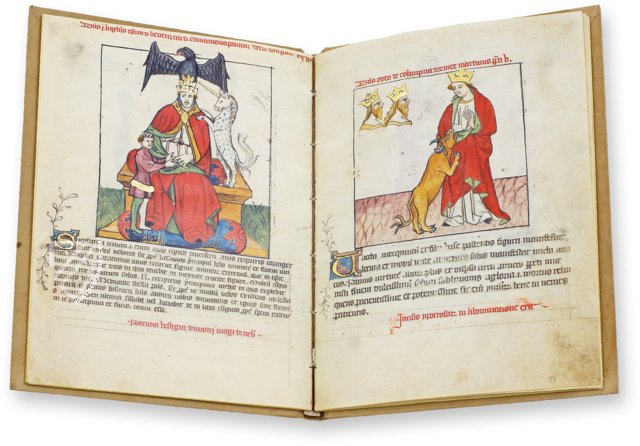
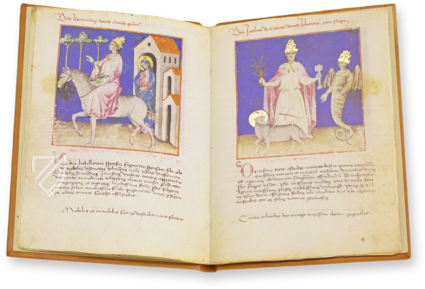
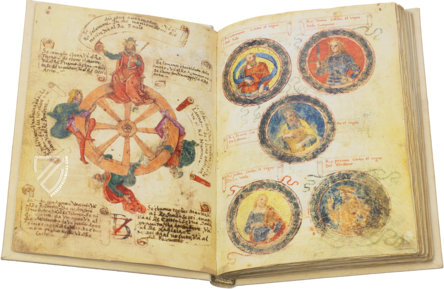
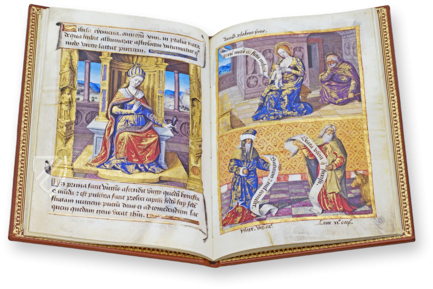
In the Middle Ages, everyday life was shaped by superstition and mystical prophecy. Secular affairs lay largely in the hands of the nobility and the clergy, while the political and religious head of a large part of the Christian world was the reigning pope. The so-called Vaticinia Pontificum contain prophetic predictions concerning the popes who held the highest office of the medieval Church in the Latin West during the 13th and 15th centuries—from Nicholas III (c. 1225–1280) to Eugene IV (1383–1447). In this late Gothic manuscript from the Biblioteca dell'Archiginnasio, these popes are depicted in 46 large and, above all, highly imaginative miniatures, which often also incorporate allegorical representations of animals and mythical creatures. The corresponding prophecies are written beneath these images. They derive from earlier sources and were once attributed to the high medieval scholar and monk Joachim of Fiore (c. 1135–1202), although this attribution has since been disproved by modern scholarship.
Vaticinia Pontificum
The word Vaticinia is the Latin term for prophecies or predictions. The collection of documents with the title Vaticinia Pontificum is a unique manuscript that presents prophecies concerning the lives and works of the popes during the Middle Ages. The edition of the Vaticinia Pontificum presented before us is furnished with incomparably-beautiful illustrations. 46 unbelievably fanciful, colorful miniatures depict the popes from Nicolaus III to Eugene IV in portrait, along with allegorical animals and mythical creatures. Although the masterly work was ascribed to the Italian monk Joachim of Fiore for a long time, this assumption has admittedly been refuted by recent research.
A Mysterious Author
Joachim of Fiore – Gioacchino da Fiore in Italian – was an abbot and founder of an order in Calabria and a theological historian in the 12th century. The gifted scholar achieved fame above all because of his specific view of history and his salvation-historical worldview. His teachings were amalgamated under the name of the “Theory of the Three Ages”. He subdivided the history of the world and humanity in three historical eras, which he connected with the Holy Trinity. It was believed for a long time, because of his influential teachings from the 12th century, that the Vaticinia Pontificum with its salvation-historical worldview, was created by Joachim of Fiore. Since this assumption has been proven false by the most recent research, the actual author of the work cannot be determined, and so one now refers to the author of the Vaticiniaperforce as the Pseudo-Joachim. The dreamlike pictures were designed by the most gifted Italian court painters of the Middle Ages. Among them were the famous Master of the Vitae Imperatorum, who was employed at the court of Filippo Maria Visconti.
The Destiny of the Catholic Church
The Vaticinia are a series of prophecies about the popes who were invested into the highest office of the Catholic Church in the course of the 13th and 15th centuries. The allegorical, mythical text interpreted the influence of the popes at that time on the destiny of the Catholic community worldwide with the help of its metaphorically-charged illustrations. Pope Urban VI is described here as a devilish monster of the apocalypse. He was a pope during the time period that immediately followed the Avignon Papacy and resided in Rome, as his predecessor Gregory XI had already done. The dispute following his election unleashed a chain of adverse events that ultimately lead to the Great Western Schism. This was the greatest fault line to occur within the Catholic Church and went on for nearly 40 years. In the Vaticinia, Urban’s influence on this significant religious conflict is more closely discussed in mysterious visual language.
Significant Former Owners
In the course of history, the universally-coveted masterpiece found itself in the possession of numerous famous personalities. It belonged to the art collector Francesco Antonio Bonali for a long time, though the most famous owner of the precious text was indeed the Italian artist Pelagio Palagi. The painter, sculptor, and furniture designer from Turin was interested in Egyptian, Greek, Etruscan, and Roman sculptures and was known worldwide as a book collector. The precious Vaticinia remained in his private library until the artist’s death. In his will, the book was left to the Biblioteca dell'Archiginnasio in the Italian art metropolis of Bologna, where it is housed today.
Codicology
- Alternative Titles
- Vaticinia Pontificum de Gioacchino da Fiore
Bologna Vaticinia Pontificum
Papalista
Vaticinia de Pontificibus
Vaticinia Pontificum, sive Prophetiae Abbatis Joachini - Size / Format
- 46 pages / 25.7 × 18.6 cm
- Origin
- Switzerland
- Date
- first half of the 15th century
- Epochs
- Style
- Genre
- Language
- Script
- Gothic textura
- Illustrations
- 46 gold-decorated, large miniatures and 46 gold champie initials
- Content
- Prophecies concerning the Papacy
- Artist / School
- Author: anonymous (formerly attributed to Joachim of Fiore)
Illuminators: Master of Vitae Imperatorum and one other anonymous master - Previous Owners
- Francesco Antonio Bonali
Ognibene Montanari
Pelagius Palagi (1775–1860)
Vaticinia Pontificum
Pope Urban VI
Born Bartolomeo Prignano, Urban VI was native to a place called Inferno near Naples, a region of Italy famous for its natural hot springs that bubble up from deep in the earth. He sat on the throne of Saint Peter from 1378 to 1389 in the aftermath of the Avignon Papacy and at the dawn of the Western Schism, a low point in church history. He had a reputation for harshness in trying to reform the church, which earned him few friends and embroiled him in a war with the Antipope Clement VII.

Vaticinia Pontificum
Pope Urban V
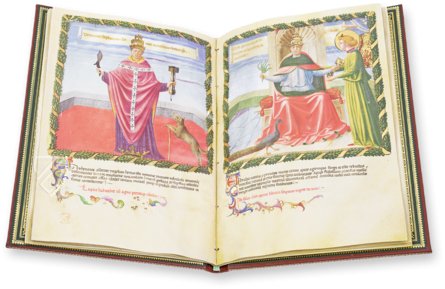
Reigning from 1362 to 1370, Urban V was the only Avignon pope to be beatified and a strict adherent of the modest Benedictine Rule. His efforts as a reformer gained him a great deal of opposition among the privileged princes of the church who were used to opulent lifestyles, but was also celebrated for leading military campaigns in an attempt to return the papacy to Rome.
Resting on blue cushions, Urban V is draped in a red cloak lined with green and wears a golden papal tiara. His legitimacy and divine favor are symbolized by the golden key of St. Peter being handed to him by an angel, who also has a golden halo. Threatening the peacock, symbol of pride, with the red scourge in his right hand symbolizes his attempts to reform the church.

#1 Vaticinia Pontificum De Gioachino Da Fiore
Language: Spanish

- Block Books / Incunables / Post-incunables
- Alchemy
- Apocalypses / Beatus Manuscripts
- Astronomy / Astrology
- Bibles / Gospels
- Picture Bibles / Bibles Moralisées / Mirror of Human Salvation
- Botany
- Chronicles / History / Letters
- Cookbook / Recipes
- Diaries / Biographies / Autograph Books
- Encyclopedias
- Fashion / Costume Books
- Games / Game Theory
- Geography / Cartography / Navigation
- Graduals / Antiphonaries / Exultet Roll
- Haggadot
- Hunting Books
- Law / Deeds / Rules
- Leonardo da Vinci
- Literature / Poetry
- Medicine
- Missals / Lectionaries / Sacramentaries
- Model Books / Sketchbooks / Notebooks
- Music
- Mythology
- Natural History / Bestiaries
- Other Liturgical Manuscripts
- Other Religious Works
- Other Secular Works
- Paintings / Graphics
- Primers / Textbooks
- Private Devotion Books
- Prophecies / Divination
- Psalters
- Quran
- Saints' Lives
- Sermons / Homilies
- Single Leaf Collections
- Song Books
- Tanakh
- Tournament Books / Armorials / Genealogy
- Travelogues / Travel Guides
- Treatises
- Afghanistan
- Algeria
- Armenia
- Austria
- Azerbaijan
- Belarus
- Belgium
- Belize
- Bosnia and Herzegovina
- China
- Colombia
- Costa Rica
- Croatia
- Cyprus
- Czech Republic
- Denmark
- Egypt
- El Salvador
- Ethiopia
- France
- Germany
- Greece
- Guatemala
- Honduras
- Hungary
- India
- Iran
- Iraq
- Israel
- Italy
- Japan
- Jordan
- Kazakhstan
- Kyrgyzstan
- Lebanon
- Libya
- Liechtenstein
- Luxembourg
- Mexico
- Morocco
- Netherlands
- Palestine
- Panama
- Peru
- Poland
- Portugal
- Romania
- Russia
- Serbia
- Slovakia
- Spain
- Sri Lanka
- Sweden
- Switzerland
- Syria
- Tajikistan
- Tunisia
- Turkey
- Turkmenistan
- Ukraine
- United Kingdom
- United States
- Uzbekistan
- Vatican City
- A. Oosthoek, van Holkema & Warendorf
- Aboca Museum
- Ajuntament de Valencia
- Akademie Verlag
- Akademische Druck- u. Verlagsanstalt (ADEVA)
- Aldo Ausilio Editore - Bottega d’Erasmo
- Alecto Historical Editions
- Alkuin Verlag
- Almqvist & Wiksell
- Amilcare Pizzi
- Andreas & Andreas Verlagsbuchhandlung
- Archa 90
- Archiv Verlag
- Archivi Edizioni
- Arnold Verlag
- ARS
- Ars Magna
- Ars Millenii
- Art Market
- ArtCodex
- AyN Ediciones
- Azimuth Editions
- Badenia Verlag
- Bärenreiter-Verlag
- Belser Verlag
- Belser Verlag / WK Wertkontor
- Benziger Verlag
- Bernardinum Wydawnictwo
- BiblioGemma
- Biblioteca Apostolica Vaticana (Vaticanstadt, Vaticanstadt)
- Bibliotheca Palatina Faksimile Verlag
- Bibliotheca Rara
- Boydell & Brewer
- Bramante Edizioni
- Bredius Genootschap
- Brepols Publishers
- British Library
- Brokarte
- C. Weckesser
- Caixa Catalunya
- Canesi
- CAPSA, Ars Scriptoria
- Caratzas Brothers, Publishers
- Carus Verlag
- Casamassima Libri
- Centrum Cartographie Verlag GmbH
- Chavane Verlag
- Christian Brandstätter Verlag
- Circulo Cientifico
- Club Bibliófilo Versol
- Club du Livre
- Club Internacional del Libro
- CM Editores
- Collegium Graphicum
- Collezione Apocrifa Da Vinci
- Comissão Nacional para as Comemorações dos Descobrimentos Portugueses
- Coron Verlag
- Corvina
- CTHS
- D. S. Brewer
- Damon
- De Agostini/UTET
- De Nederlandsche Boekhandel
- De Schutter
- Deuschle & Stemmle
- Deutscher Verlag für Kunstwissenschaft
- DIAMM
- Dropmore Press
- Droz
- E. Schreiber Graphische Kunstanstalten
- Ediciones Boreal
- Ediciones Grial
- Ediclube
- Edições Inapa
- Edilan
- Editalia
- Edition Deuschle
- Edition Georg Popp
- Edition Leipzig
- Edition Libri Illustri
- Editiones Reales Sitios S. L.
- Éditions de l'Oiseau Lyre
- Editions Medicina Rara
- Editorial Base
- Editorial Casariego
- Editorial Mintzoa
- Editrice Antenore
- Editrice Velar
- Edizioni Edison
- Egeria, S.L.
- Eikon Editores
- Electa
- Emery Walker Limited
- Enciclopèdia Catalana
- Eos-Verlag
- Ephesus Publishing
- Ernst Battenberg
- Eugrammia Press
- Extraordinary Editions
- Fackelverlag
- Facsimila Art & Edition
- Facsimile Editions Ltd.
- Facsimilia Art & Edition Ebert KG
- Faksimile Verlag
- Feuermann Verlag
- Folger Shakespeare Library
- Franco Cosimo Panini Editore
- Friedrich Wittig Verlag
- Fundación Hullera Vasco-Leonesa
- G. Braziller
- Gabriele Mazzotta Editore
- Gebr. Mann Verlag
- Gesellschaft für graphische Industrie
- Getty Research Institute
- Giovanni Domenico de Rossi
- Giunti Editore
- Goldenmark Librarium
- Graffiti
- Grafica European Center of Fine Arts
- Guido Pressler
- Guillermo Blazquez
- Gustav Kiepenheuer
- H. N. Abrams
- Harrassowitz
- Harvard University Press
- Helikon
- Hendrickson Publishers
- Henning Oppermann
- Herder Verlag
- Hes & De Graaf Publishers
- Hoepli
- Holbein-Verlag
- Houghton Library
- Hugo Schmidt Verlag
- Hungarian Academy of Sciences
- Idion Verlag
- Il Bulino, edizioni d'arte
- ILte
- Imago
- In Officina Danesi
- Insel Verlag
- Instituto de Estudios Altoaragoneses
- Instituto Nacional de Antropología e Historia
- Introligatornia Budnik Jerzy
- Istituto dell'Enciclopedia Italiana - Treccani
- Istituto Ellenico di Studi Bizantini e Postbizantini
- Istituto Geografico De Agostini
- Istituto Poligrafico e Zecca dello Stato
- Italarte Art Establishments
- Jaca Book
- Jan Thorbecke Verlag
- Johnson Reprint Corporation
- Johnson Reprint Corporation
- Jos. Baer
- Josef Stocker
- Josef Stocker-Schmid
- Jugoslavija
- Karl W. Hiersemann
- Kasper Straube
- Kaydeda Ediciones
- Kindler Verlag / Coron Verlag
- Kodansha International Ltd.
- Konrad Kölbl Verlag
- Kurt Wolff Verlag
- La Linea Editrice
- La Meta Editore
- Lambert Schneider
- Landeskreditbank Baden-Württemberg
- Leo S. Olschki
- Les Incunables
- Liber Artis
- Library of Congress
- Libreria Musicale Italiana
- Lichtdruck
- Lito Immagine Editore
- Lumen Artis
- Lund Humphries
- M. Moleiro Editor
- Maison des Sciences de l'homme et de la société de Poitiers
- Manuscriptum
- Martinus Nijhoff
- Maruzen-Yushodo Co. Ltd.
- MASA
- Massada Publishers
- McGraw-Hill
- Metropolitan Museum of Art
- Militos
- Millennium Liber
- Müller & Schindler
- Nahar - Stavit
- Nahar and Steimatzky
- National Library of Wales
- Neri Pozza
- Nova Charta
- Oceanum Verlag
- Odeon
- Omnia Arte
- Orbis Mediaevalis
- Orbis Pictus
- Österreichische Staatsdruckerei
- Oxford University Press
- Pageant Books
- Parzellers Buchverlag
- Patrimonio Ediciones
- Pattloch Verlag
- PIAF
- Plon-Nourrit et cie
- Poligrafiche Bolis
- Presses Universitaires de Strasbourg
- Prestel Verlag
- Princeton University Press
- Prisma Verlag
- Priuli & Verlucca, editori
- Pro Sport Verlag
- Propyläen Verlag
- Pytheas Books
- Quaternio Verlag Luzern
- Reales Sitios
- Recht-Verlag
- Reichert Verlag
- Reichsdruckerei
- Reprint Verlag
- Riehn & Reusch
- Rizzoli
- Roberto Vattori Editore
- Rosenkilde and Bagger
- Roto-Sadag
- Roxburghe Club
- Salerno Editrice
- Saltellus Press
- Sandoz
- Sarajevo Svjetlost
- Schöck ArtPrint Kft.
- Schulsinger Brothers
- Scolar Press
- Scrinium
- Scripta Maneant
- Scriptorium
- Shazar
- Siloé, arte y bibliofilia
- SISMEL - Edizioni del Galluzzo
- Sociedad Mexicana de Antropología
- Société des Bibliophiles & Iconophiles de Belgique
- Soncin Publishing
- Sorli Ediciones
- Stainer and Bell
- Studer
- Styria Verlag
- Sumptibus Pragopress
- Szegedi Tudomànyegyetem
- Taberna Libraria
- Tarshish Books
- Taschen
- Tempus Libri
- Testimonio Compañía Editorial
- TGB Limited Editions
- Thames and Hudson
- The Clear Vue Publishing Partnership Limited
- The Facsimile Codex
- The Folio Society
- The Marquess of Normanby
- The Orphan Hospital Ward of Israel
- The Richard III and Yorkist History Trust
- The Warburg Institute
- Tip.Le.Co
- TouchArt
- TREC Publishing House
- TRI Publishing Co.
- Trident Editore
- Tuliba Collection
- Typis Regiae Officinae Polygraphicae
- Union Verlag Berlin
- Universidad de Granada
- Universitaire Bibliotheken Leiden
- University of California Press
- University of Chicago Press
- Urs Graf
- Vallecchi
- Van Wijnen
- VCH, Acta Humaniora
- VDI Verlag
- VEB Deutscher Verlag für Musik
- Verein Schweizerischer Lithographie-Besitzer
- Verlag Anton Pustet / Andreas Verlag
- Verlag Bibliophile Drucke Josef Stocker
- Verlag der Münchner Drucke
- Verlag für Regionalgeschichte
- Verlag Styria
- Vicent Garcia Editores
- W. Turnowsky
- Waanders Printers
- Wiener Mechitharisten-Congregation (Wien, Österreich)
- Wissenschaftliche Buchgesellschaft
- Wissenschaftliche Verlagsgesellschaft
- Wydawnictwo Dolnoslaskie
- Xuntanza Editorial
- Zakład Narodowy
- Zollikofer AG